Scaling Your MVP: Growth Hacking for U.S. Startups in 2026

Scaling Your MVP: Essential Growth Hacking Tactics for U.S. Startups in the Current Market (2026)
In the fiercely competitive landscape of the U.S. startup ecosystem in 2026, merely launching a Minimum Viable Product (MVP) is no longer sufficient for success. The true challenge and the ultimate differentiator lie in how effectively a startup can scale its MVP, transforming initial traction into sustained growth and market dominance. This is where MVP growth hacking becomes not just a strategy, but a necessity. Growth hacking, at its core, is about employing creative, low-cost strategies to help companies acquire and retain customers. For an MVP, this means an intense focus on rapid experimentation, data-driven decision-making, and leveraging unconventional methods to achieve exponential user growth and product-market fit.
The current market, characterized by rapid technological advancements, evolving consumer behaviors, and increasing investor scrutiny, demands a sophisticated approach to scaling. U.S. startups must navigate a complex environment where traditional marketing often falls short. This article delves into essential MVP growth hacking tactics specifically tailored for the U.S. market in 2026, providing a roadmap for startups aiming to not just survive, but thrive and lead.
Understanding the 2026 U.S. Startup Landscape and the Need for MVP Growth Hacking
The U.S. startup scene in 2026 is a paradox of opportunity and challenge. On one hand, venture capital remains robust for promising innovations, and digital infrastructure is more advanced than ever. On the other hand, market saturation in many sectors means that capturing user attention and loyalty is harder than before. Consumers are savvier, less tolerant of subpar experiences, and more discerning about where they invest their time and money. This environment makes traditional, slow-burn marketing strategies obsolete for an MVP that needs to demonstrate rapid value and potential.
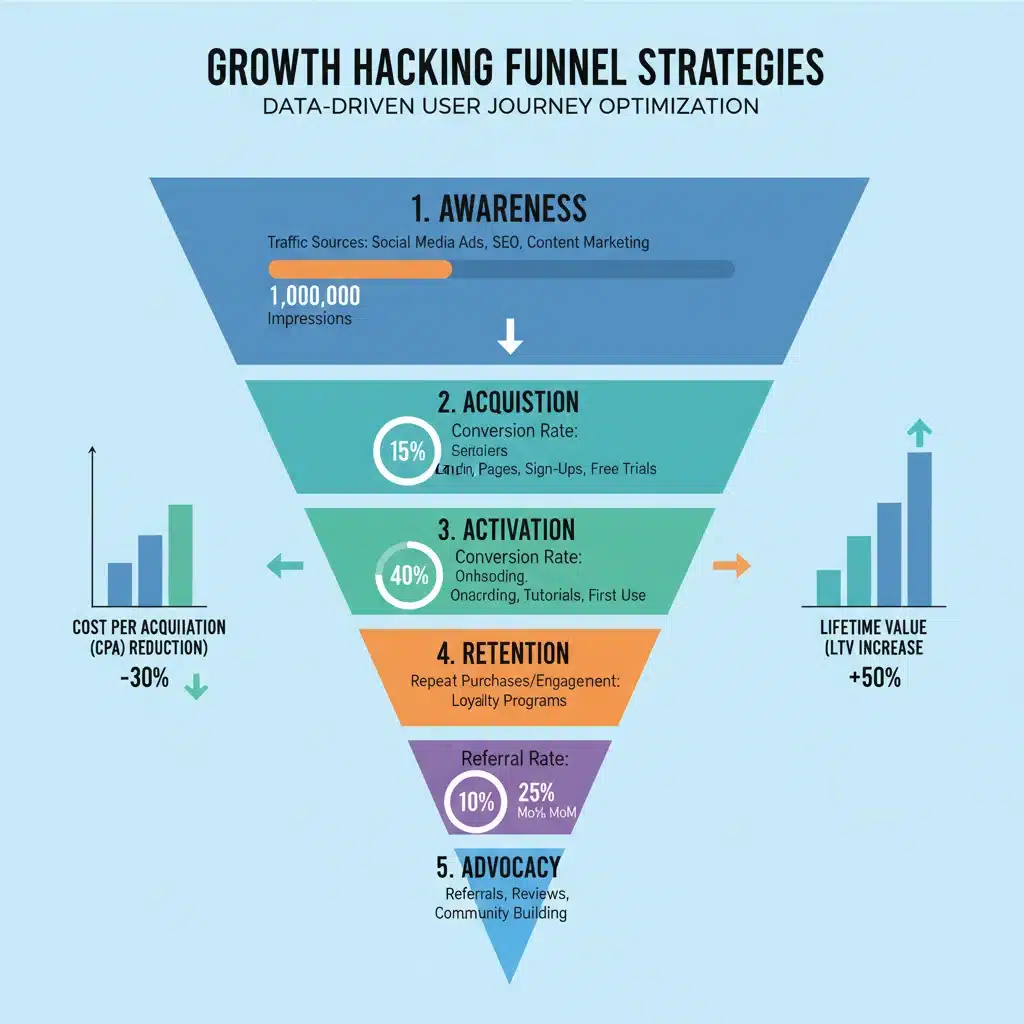
MVP growth hacking emphasizes speed, iteration, and measurable results. It’s about finding shortcuts to growth, not by cutting corners on quality, but by identifying the most efficient pathways to user acquisition, activation, retention, referral, and revenue (AARRR funnel). For U.S. startups, this means understanding the nuances of local markets, leveraging cutting-edge technologies like AI and machine learning for personalization, and building communities around their products.
The goal of an MVP is to test core hypotheses with minimal resources. Once validated, the focus shifts to scaling. Without effective growth hacking, even the most innovative MVP can languish, unable to break through the noise. Therefore, integrating growth hacking principles from day one, even during the MVP development phase, is crucial. It ensures that the product is built with virality and user engagement in mind, rather than as an afterthought.
Product-Led Growth: The Foundation of Modern MVP Growth Hacking
In 2026, product-led growth (PLG) has solidified its position as a cornerstone of successful MVP growth hacking. PLG is a business methodology where user acquisition, expansion, conversion, and retention are all driven primarily by the product itself. Instead of relying heavily on sales or marketing teams to sell the product, the product is designed to be self-serve, intuitive, and inherently valuable, allowing users to experience its core benefits quickly and seamlessly.
Key Principles of Product-Led Growth for MVPs:
- Value First: The MVP must deliver immediate, undeniable value to the user. This means focusing on a single, compelling use case that solves a specific problem effectively.
- Self-Service Onboarding: Users should be able to sign up, understand, and start using the MVP without extensive human intervention. Intuitive design and clear in-app guidance are paramount.
- Freemium or Free Trial Models: Offering a free tier or a generous free trial is a classic PLG tactic that allows users to experience the product’s value firsthand, reducing friction to adoption. This is a powerful form of MVP growth hacking as it allows for broad reach.
- In-Product Virality: Design features that encourage users to invite others or share their experiences within the product. This could be collaborative features, referral programs, or social sharing functionalities.
- Data-Driven Iteration: Continuously collect and analyze user behavior data within the product to identify areas for improvement, optimize user flows, and enhance the overall experience. This feedback loop is vital for refining the MVP and ensuring product-market fit.
For U.S. startups, embracing PLG means investing in excellent user experience (UX) and user interface (UI) design, robust analytics infrastructure, and a culture of continuous improvement. The product itself becomes the primary growth engine, making every feature and every interaction a potential growth lever.
Strategic User Acquisition: Beyond Traditional Marketing
While traditional marketing has its place, MVP growth hacking demands more creative and often more targeted acquisition strategies. The goal is to acquire the right users – those who will not only use the product but also become advocates and provide valuable feedback.
Leveraging Niche Communities and Influencers:
Instead of broad advertising, U.S. startups should identify niche online communities, forums, and social groups where their target audience congregates. Engaging authentically in these spaces, offering value, and subtly introducing the MVP can lead to highly qualified leads. Micro-influencers and nano-influencers, who have smaller but highly engaged audiences, can also be incredibly effective for an MVP. Their recommendations often carry more weight than those from large celebrities, making this a cost-effective MVP growth hacking tactic.
Content Marketing for Problem/Solution Fit:
Create high-quality content (blog posts, videos, podcasts, case studies) that addresses the pain points your MVP solves. This positions your startup as a thought leader and attracts users who are actively searching for solutions. Optimize this content for search engines (SEO) to ensure discoverability. For an MVP, this content should be highly focused on the specific problem your product addresses, clearly demonstrating how your solution is superior.
Partnerships and Integrations:
Collaborate with complementary businesses or platforms. If your MVP integrates seamlessly with another popular tool, it can expose your product to a ready-made user base. These strategic partnerships can be a rapid way to gain traction, especially in the B2B SaaS space within the U.S. market.
Referral Programs with a Twist:
Standard referral programs are good, but for an MVP, consider making them exceptionally compelling or gamified. Offer unique rewards, early access to new features, or status within a community for successful referrals. The key is to make the act of referring as rewarding for the referrer as it is beneficial for the startup.
Activation and Retention: The Heart of Sustainable MVP Growth
Acquiring users is only half the battle. True MVP growth hacking focuses heavily on activating users (getting them to experience the core value of the product) and retaining them over time. Without strong activation and retention, user acquisition efforts become a leaky bucket.
Optimizing the “Aha! Moment”:
Every MVP has an “Aha! Moment” – the point where a user truly understands and experiences the product’s value. Identify this moment and design the onboarding flow to get users there as quickly and efficiently as possible. A/B test different onboarding sequences, tutorials, and in-app messages to optimize this critical stage. Personalized onboarding, leveraging user data, can significantly improve activation rates.
Personalization and Behavioral Triggers:
In 2026, generic experiences are a turn-off. Utilize data to personalize the user experience, from customized dashboards to tailored content recommendations. Implement behavioral triggers – automated messages or actions based on user behavior – to guide users, re-engage inactive ones, and celebrate milestones. For instance, an email reminding a user about a feature they haven’t explored after a few days of inactivity can be highly effective.
Community Building and Feedback Loops:
Foster a sense of community around your MVP. This could be through dedicated forums, social media groups, or even in-person meetups (where applicable). Actively solicit and act on user feedback. Users who feel heard and see their suggestions implemented are far more likely to remain loyal. This also provides invaluable insights for product development, ensuring the MVP evolves in line with user needs. This continuous feedback loop is a cornerstone of effective MVP growth hacking.
Gamification to Drive Engagement:
Integrate game-like elements into your MVP to increase engagement and retention. This could include points, badges, leaderboards, or challenges. Gamification taps into users’ intrinsic motivations and can make repetitive tasks more enjoyable, leading to higher product usage.
Monetization and Referral: Completing the Growth Loop
The final stages of the AARRR funnel – Revenue and Referral – are crucial for the long-term viability of any MVP. Effective MVP growth hacking ensures these are not afterthoughts but integrated into the product’s design and strategy.
Experimenting with Monetization Models:
An MVP is an ideal environment for testing different pricing strategies and monetization models. Don’t be afraid to experiment with freemium, subscription, pay-per-use, or even hybrid models. Analyze which models resonate best with your target audience and provide the most sustainable revenue stream. The U.S. market is diverse, and what works for one demographic might not work for another. Continuous A/B testing of pricing pages and offers is essential.
Building Virality into the Product:
True viral growth comes from the product itself, not just external marketing. Design features that inherently encourage users to invite others or share their progress. Examples include collaborative features, shareable content, or network effects where the product becomes more valuable as more people use it. Think about how the product can become a conversation starter or a status symbol. This is the ultimate form of MVP growth hacking.
Advocacy Programs:
Beyond simple referrals, cultivate a program for product advocates. These are your most enthusiastic users who are willing to champion your MVP. Provide them with exclusive access, early betas, or special recognition. Their authentic endorsements are incredibly powerful for attracting new users and building trust.
Data-Driven Decision Making: The Engine of MVP Growth Hacking
At the core of all successful MVP growth hacking lies a relentless commitment to data. Every tactic, every experiment, and every iteration must be informed by data. In 2026, advanced analytics tools, AI-powered insights, and predictive modeling are more accessible than ever, providing startups with unprecedented capabilities.
Key Data Metrics to Track:
- User Acquisition Cost (CAC): How much does it cost to acquire a new user?
- Lifetime Value (LTV): How much revenue can you expect from a user over their entire relationship with your product?
- Conversion Rates: From visitor to sign-up, sign-up to active user, active user to paying customer.
- Retention Rates: How many users return to your product over time?
- Churn Rate: How many users stop using your product?
- Engagement Metrics: Time spent in-app, features used, frequency of use.
- Net Promoter Score (NPS): A measure of customer loyalty and willingness to recommend.
By constantly monitoring these metrics, U.S. startups can quickly identify what’s working, what’s not, and where to allocate resources for maximum impact. A/B testing is paramount for validating hypotheses and ensuring that changes lead to positive outcomes. The ability to rapidly iterate based on data is a significant competitive advantage in the fast-paced U.S. market.

Emerging Trends and Technologies for MVP Growth Hacking in 2026
The U.S. market in 2026 is influenced by several technological and societal trends that savvy startups can leverage for their MVP growth hacking efforts.
AI and Machine Learning for Hyper-Personalization:
AI is no longer a futuristic concept; it’s a practical tool for growth. AI-powered analytics can identify patterns in user behavior that humans might miss, enabling hyper-personalized experiences, predictive churn prevention, and highly targeted marketing campaigns. ML algorithms can optimize onboarding flows in real-time based on individual user profiles, accelerating the “Aha! moment.”
Web3 and Decentralized Growth:
While still nascent, Web3 technologies, including blockchain and decentralized autonomous organizations (DAOs), offer new avenues for community-led growth and user ownership. For certain MVPs, integrating Web3 elements can foster extreme loyalty and create novel incentive structures for users to contribute to and evangelize the product. This could involve tokenized rewards for referrals or contributions, creating a truly community-driven MVP growth hacking model.
Privacy-First Growth Strategies:
With increasing emphasis on data privacy (e.g., CCPA and evolving federal regulations in the U.S.), startups must adopt privacy-first growth strategies. This means building trust through transparent data practices, offering users control over their data, and focusing on first-party data collection and consent-based marketing. Growth hacking in 2026 is about being clever within ethical and legal boundaries.
Interactive and Experiential Marketing:
Beyond traditional ads, interactive content (quizzes, configurators, AR/VR experiences) and experiential marketing (pop-ups, virtual events) can create memorable brand interactions and drive higher engagement for an MVP. These methods are particularly effective in capturing attention in a crowded digital space.
Building a Growth-Oriented Culture within Your Startup
Ultimately, successful MVP growth hacking isn’t just about implementing a few tactics; it’s about embedding a growth mindset throughout the entire startup. This means:
- Cross-Functional Collaboration: Growth is everyone’s responsibility. Marketing, product, engineering, and sales teams must work together, sharing data and insights.
- Experimentation Mindset: Encourage a culture where experimentation is celebrated, and failures are viewed as learning opportunities. Rapid hypothesis testing is key.
- Customer Obsession: Keep the user at the center of every decision. Understand their needs, pain points, and aspirations.
- Agility and Adaptability: The U.S. market is constantly changing. Startups must be agile enough to pivot strategies quickly based on new data and emerging trends.
For U.S. startups in 2026, the journey from MVP to market leader is fraught with challenges, but also rich with opportunities. By strategically applying MVP growth hacking principles, focusing on product-led growth, employing creative user acquisition and retention tactics, and making data the cornerstone of every decision, startups can significantly increase their chances of not just scaling, but truly dominating their respective niches. The future belongs to those who can grow fast, smart, and sustainably.