Achieving Product-Market Fit in 2026: A 6-Step Framework for U.S. Startups to Validate Demand

In the dynamic and hyper-competitive landscape of 2026, the quest for product-market fit remains the paramount challenge for U.S. startups. It’s the elusive sweet spot where your product perfectly satisfies a strong market demand, leading to sustainable growth, reduced churn, and a clear path to scalability. Without achieving product-market fit, even the most innovative ideas can falter, burning through capital and morale. This isn’t just about having a great product; it’s about having the right product for the right people at the right time. For U.S. startups navigating an increasingly complex technological and economic environment, understanding and systematically pursuing product-market fit is not merely an advantage – it’s a necessity for survival.
The year 2026 brings with it new market dynamics, consumer behaviors, and technological advancements that demand a refined approach to product validation. Traditional methods, while still foundational, must be augmented with agile strategies that account for rapid change and data-driven insights. This comprehensive guide outlines a 6-step framework specifically tailored for U.S. startups aiming to not just find, but truly nail product-market fit. We’ll delve into actionable strategies, real-world considerations, and the mindset required to transform a promising concept into a market-leading solution. Prepare to embark on a structured journey that will empower your startup to validate demand, iterate effectively, and ultimately, thrive.
Understanding Product-Market Fit in the 2026 Landscape
Before we dive into the ‘how,’ it’s crucial to solidify our understanding of what product-market fit truly means in 2026. Coined by Marc Andreessen, product-market fit (PMF) is often described as ‘being in a good market with a product that can satisfy that market.’ It’s the moment when you know you’ve created something that people genuinely want and are willing to pay for, and that your business model can effectively deliver it to them. In 2026, this definition is amplified by several factors:
- Accelerated Digital Transformation: The pandemic-driven acceleration of digital adoption has created both immense opportunities and heightened expectations. Users are savvier, more demanding, and less tolerant of subpar experiences. Your product must not only solve a problem but do so elegantly and intuitively.
- Hyper-Personalization and Niche Markets: Generic solutions are increasingly overlooked. The market demands hyper-personalized experiences and solutions that cater to specific, often niche, segments. Finding product-market fit often means identifying and dominating a precise niche before expanding.
- Data-Driven Decision Making: The availability of advanced analytics tools means that qualitative insights must be rigorously backed by quantitative data. Startups in 2026 are expected to leverage data not just for optimization, but for foundational product strategy and market validation.
- Ethical AI and Privacy Concerns: With the widespread integration of AI, ethical considerations and data privacy are paramount. Products must build trust and demonstrate transparency, impacting how users perceive and adopt new solutions.
- Global Competition from Day One: U.S. startups are no longer just competing with local players. The globalized digital economy means competition can emerge from anywhere, requiring a robust and defensible product-market fit from the outset.
Achieving product-market fit isn’t a single event but an ongoing process of discovery, iteration, and validation. It’s about continuously listening to your market, understanding their evolving needs, and adapting your product to meet those needs more effectively than anyone else. This framework provides a structured approach to navigate this complex journey.
Step 1: Deep Dive into Market Research & Problem Identification (The Foundation of Product-Market Fit)
Every successful product begins with a profound understanding of a problem worth solving. In 2026, this goes beyond surface-level observations. It requires a deep dive into market research and rigorous problem identification. This is the cornerstone for achieving product-market fit.
Identify Your Target Market Segment
- Go Beyond Demographics: While demographics (age, location, income) are a starting point, 2026 demands psychographics (values, attitudes, interests, lifestyles) and behavioral data (online habits, purchase patterns). Who are the early adopters likely to be? What are their aspirations, frustrations, and daily routines?
- Niche Down: Resist the urge to target everyone. A common mistake is being too broad. Focus on a specific, underserved niche where your product can provide disproportionate value. This allows for concentrated efforts in finding product-market fit.
- Market Sizing: Estimate the total addressable market (TAM), serviceable available market (SAM), and serviceable obtainable market (SOM) for your chosen niche. Is it large enough to sustain a business, but small enough to dominate?
Uncover Unmet Needs and Pain Points
- Qualitative Research is King: Conduct extensive one-on-one interviews, focus groups, and ethnographic studies. Ask open-ended questions. Don’t just ask what they want; ask about their challenges, their current solutions (and why they’re inadequate), and their desired outcomes. Observe their behaviors.
- Quantitative Surveys: Complement qualitative insights with quantitative data. Use surveys to validate the prevalence and severity of identified pain points across a larger sample. Tools can help you identify patterns and prioritize problems.
- Competitor Analysis (with a Twist): Look at existing solutions, but don’t just copy. Analyze where competitors fall short. What are their users complaining about? What features are missing? What aspects of the user experience are frustrating? This provides a direct path to identifying gaps that your product can fill, leading to product-market fit.
- Trend Spotting: Leverage AI-powered trend analysis tools to identify emerging problems or shifts in consumer behavior that might create new opportunities or exacerbate existing pain points.
At the end of this step, you should have a concise, validated problem statement. It should clearly articulate:
- Who has the problem (your target persona)?
- What is the problem?
- Why is it a problem (the impact or consequence)?
- How are they currently trying to solve it (if at all)?
A well-defined problem statement is the compass that guides your product development journey towards product-market fit.
Step 2: Develop a Minimum Viable Product (MVP) Strategy
Once you have a clear problem and target market, the next step towards product-market fit is to develop a Minimum Viable Product (MVP). An MVP isn’t just a stripped-down version of your dream product; it’s the smallest possible product that delivers core value to early adopters and allows you to learn whether your solution addresses the identified problem effectively.
Define Core Value Proposition
- Single-Minded Focus: What is the absolute core value your product provides? What is the one thing it does better than any other solution for your target market? This clarity is vital for a successful MVP.
- Problem-Solution Alignment: Ensure your core value directly addresses the validated problem statement from Step 1. There should be a clear, undeniable link.
Feature Prioritization for MVP
- ‘Must-Have’ vs. ‘Nice-to-Have’: Be ruthless in feature selection. The MVP should only include features essential for delivering the core value. Avoid feature creep.
- User Journey Mapping: Map out the simplest possible user journey that allows a user to experience your product’s core value. Which features are absolutely necessary for this journey?
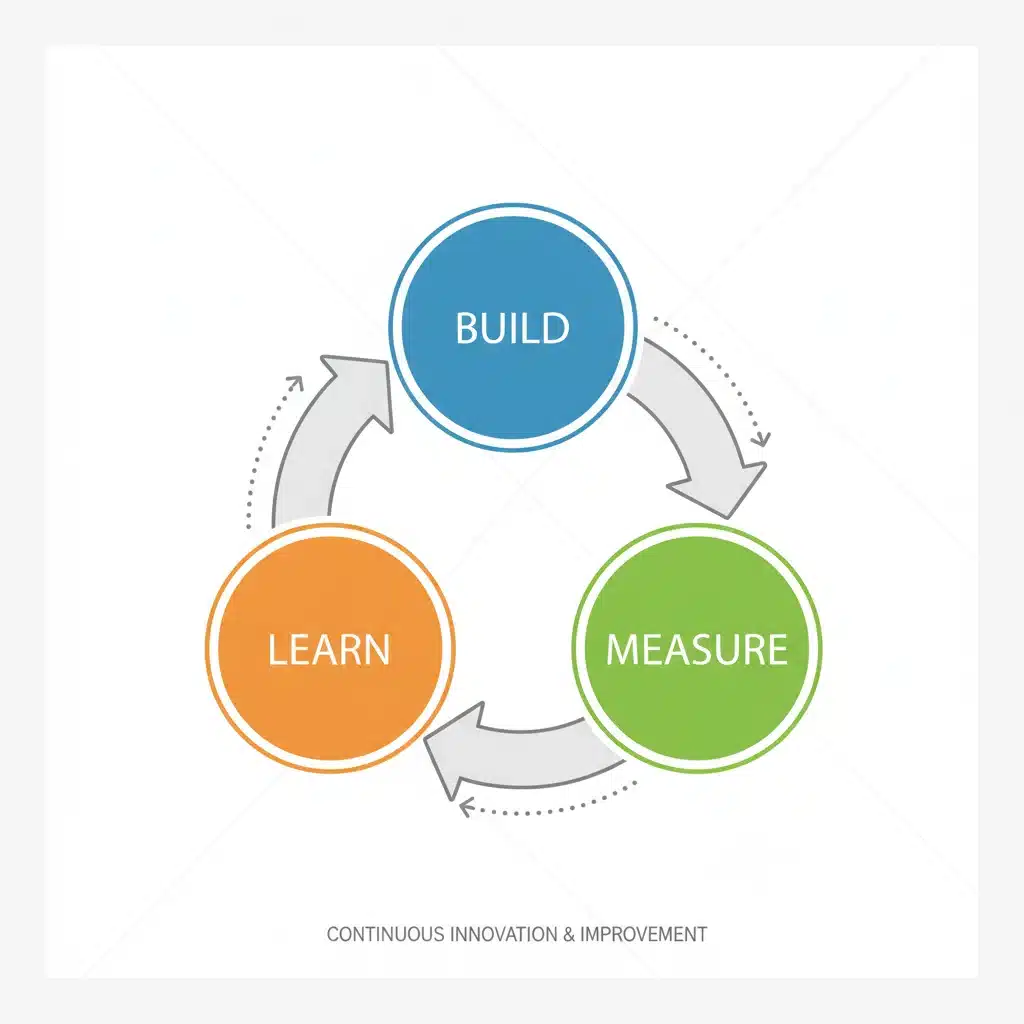
- Build, Measure, Learn Cycle: Embrace the lean startup methodology. The MVP is built to measure user interaction and learn from it, not to be perfect.
Choose Your Technology Stack Wisely
- Speed to Market: Prioritize technologies that allow for rapid development and deployment. Off-the-shelf solutions, low-code/no-code platforms, or existing APIs can accelerate your MVP launch.
- Scalability Considerations: While an MVP isn’t about massive scale, choose a stack that won’t entirely box you in as you grow. Future scalability should be a consideration, even if not the primary driver.
- Cost-Effectiveness: Startups operate with limited resources. Select technologies that are cost-effective for initial development and iteration.
The goal of the MVP is to get a functional product into the hands of real users as quickly as possible to begin the critical feedback loop. This iterative approach is fundamental to finding product-market fit.
Step 3: Launch & Acquire Early Adopters (Fueling the Product-Market Fit Engine)
With your MVP ready, the next critical step is to launch it and acquire early adopters. These are the visionary customers who are willing to take a chance on an incomplete product because they deeply feel the problem you’re solving. Their feedback is invaluable for refining your path to product-market fit.
Strategic Early Adopter Acquisition
- Leverage Your Network: Start with your immediate network – friends, family, former colleagues who fit your target persona.
- Community Engagement: Identify online communities (forums, Reddit, LinkedIn groups, Slack channels) where your target audience congregates. Engage authentically, offer value, and then gently introduce your MVP.
- Content Marketing: Create valuable content (blog posts, short videos, infographics) that addresses the pain points your product solves. This attracts the right audience organically.
- Beta Programs & Waiting Lists: Generate excitement by offering exclusive access to your beta program. A waiting list can create anticipation and provide a pool of interested users.
- Targeted Ads: Use highly specific social media or search engine ads to reach your defined niche. Focus on problem-centric messaging rather than feature lists.
Onboarding & First Impressions
- Seamless Experience: Even for an MVP, the onboarding process should be as smooth and intuitive as possible. First impressions matter immensely.
- Clear Value Proposition: Ensure users immediately understand what your product does and how it solves their problem.
- Direct Communication Channels: Make it easy for early adopters to provide feedback. Implement in-app chat, dedicated email addresses, or direct messaging channels.
Setting Expectations
Be transparent with early adopters that they are using an MVP. This manages expectations and makes them feel like partners in the development process, fostering goodwill and more constructive feedback. The primary goal here is not mass adoption, but rather to gather rich, actionable insights that will propel you toward achieving strong product-market fit.

Step 4: Collect & Analyze User Feedback (The Iteration Engine for Product-Market Fit)
The launch of your MVP is just the beginning. The real work towards product-market fit lies in diligently collecting, analyzing, and acting upon user feedback. This step is a continuous loop that refines your product and strategy.
Qualitative Feedback Collection
- User Interviews (Again): Conduct follow-up interviews with early adopters. Ask about their experiences, what they liked, what they struggled with, and what they would change. Focus on understanding their ‘why.’
- Usability Testing: Observe users interacting with your product. Identify points of confusion, frustration, or unexpected behavior. This provides invaluable insights into the user experience.
- Open-Ended Surveys: While quantitative surveys are useful, include open-ended questions to capture nuanced opinions and suggestions.
- Support Tickets & Direct Communications: Pay close attention to customer support inquiries and direct messages. These often highlight critical pain points or unmet needs.
Quantitative Feedback & Analytics
- Key Performance Indicators (KPIs): Track metrics that indicate engagement and value. This might include daily/weekly active users (DAU/WAU), session duration, feature usage, conversion rates for key actions, and churn rate.
- Cohort Analysis: Analyze the behavior of different groups of users over time to understand trends and identify areas for improvement.
- A/B Testing: Experiment with different versions of features, messaging, or onboarding flows to see what resonates best with users.
- Product Analytics Tools: Leverage tools like Google Analytics, Mixpanel, Amplitude, or Hotjar to understand user journeys, drop-off points, and engagement patterns within your product.
Synthesizing Feedback for Actionable Insights
- Thematic Analysis: Group similar feedback points together to identify recurring themes and patterns.
- Prioritization Frameworks: Use frameworks like RICE (Reach, Impact, Confidence, Effort), MoSCoW (Must-have, Should-have, Could-have, Won’t-have), or a simple impact/effort matrix to prioritize which feedback to act on first.
- Customer Feedback Loop: Establish a clear process for how feedback is collected, reviewed by the product team, translated into actionable items, and then communicated back to users (where appropriate).
This systematic approach to feedback ensures that every iteration brings you closer to a product that truly resonates with your market, solidifying your product-market fit.
Step 5: Iterate & Refine Your Product (The Path to Stronger Product-Market Fit)
Armed with rich feedback from Step 4, the next crucial phase is to iterate and refine your product. This is where you translate insights into improvements, continually molding your offering until it perfectly aligns with market demand. This iterative cycle is the heart of achieving product-market fit.
Prioritize Based on Feedback & Data
- Focus on Core Value: Always prioritize changes that enhance your product’s core value proposition and address critical pain points identified by early adopters.
- Address Friction Points: Smooth out any rough edges in the user experience. Frustration leads to churn.
- Data-Driven Decisions: Use quantitative data to validate qualitative insights. For example, if many users complain about a specific feature, check if analytics show low engagement or high drop-off rates at that point.
- Roadmap Adjustment: Be flexible with your product roadmap. It’s a living document that should evolve based on what you learn from your users.
Agile Development & Quick Cycles
- Small, Frequent Releases: Instead of large, infrequent updates, aim for smaller, more frequent releases. This allows you to test changes quickly and get immediate feedback.
- Cross-Functional Teams: Foster collaboration between product, engineering, design, and marketing teams to ensure everyone is aligned on the iterative goals and user feedback.
- Hypothesis-Driven Development: Frame each iteration as a hypothesis: “We believe that adding feature X will solve problem Y for Z users, which we will measure by metric A.” Then, build, measure, and learn.
Testing & Validation
- Internal QA: Rigorous internal quality assurance is essential before any release.
- Beta Testing (Continued): Continue to leverage a segment of your early adopters for beta testing new features or significant changes.
- Monitor Impact: After each iteration, closely monitor the relevant KPIs. Did the change improve the metrics you aimed to affect? Did it inadvertently create new problems?
This continuous cycle of building, measuring, and learning is what drives your product closer to product-market fit. It’s a marathon, not a sprint, and each iteration brings you closer to that perfect alignment.
Step 6: Measure Product-Market Fit & Scale Strategically
After significant iteration, you’ll reach a point where you need to assess whether you’ve truly achieved product-market fit. This isn’t a subjective feeling; it’s something you can measure and then leverage for strategic scaling.
Key Metrics to Measure Product-Market Fit
- Retention Rate: This is arguably the most important metric. If users are sticking around, it’s a strong indicator that your product is solving a persistent problem for them. High retention (especially cohort retention) signals strong product-market fit.
- Net Promoter Score (NPS): How likely are your users to recommend your product to others? A high NPS (generally above 30-50 for startups) suggests users are not just satisfied, but enthusiastic.
- Sean Ellis Test: Ask users, “How would you feel if you could no longer use [product]?” If more than 40% answer “Very disappointed,” you’re likely on the path to strong product-market fit.
- Customer Acquisition Cost (CAC) vs. Customer Lifetime Value (LTV): Once you start acquiring customers at scale, a healthy LTV:CAC ratio (e.g., 3:1 or higher) indicates that your product is valuable enough for users to justify the cost of acquiring them, a hallmark of product-market fit.
- Organic Growth & Referrals: If users are actively referring others and you’re seeing organic growth without heavy marketing spend, it’s a powerful signal that your product is viral and has found its market.
- Usage Frequency & Depth: Are users not just logging in, but actively engaging with core features frequently and deeply? This shows your product is integrated into their workflow or daily life.
Scaling Your Business Strategically
Once you have validated strong product-market fit through these metrics, it’s time to shift your focus from intense iteration to strategic scaling:
- Expand Marketing & Sales: Invest more heavily in acquisition channels that have proven effective during your early adopter phase.
- Optimize Onboarding & User Experience: Refine the user journey for broader audiences, ensuring it’s intuitive for those who aren’t early adopters.
- Build Out Adjacent Features: Based on continuous feedback, expand your product’s functionality to serve a broader set of needs within your target market or to attract new, closely related segments.
- Team Growth: Scale your team across all departments – engineering, sales, marketing, customer support – to support increased demand.
- Infrastructure & Operations: Ensure your technical infrastructure can handle increased load and that your operational processes are efficient and scalable.
Remember, product-market fit is not a static state. As markets evolve, so too must your product. Continuous monitoring of these metrics and an ongoing commitment to understanding your users will ensure your startup maintains and strengthens its product-market fit over time.
Common Pitfalls to Avoid on Your Product-Market Fit Journey
While the 6-step framework provides a clear path, the journey to product-market fit is fraught with potential missteps. U.S. startups, particularly, can fall prey to certain traps. Being aware of these pitfalls can help you navigate the process more effectively:
1. Building in a Vacuum (Ignoring Customer Feedback)
One of the most dangerous mistakes is to build a product based solely on internal assumptions or the founders’ vision, without continuous, rigorous interaction with potential users. Thinking you know best without validating your hypotheses with the market is a recipe for disaster. Always prioritize listening to your target audience. Your product must solve *their* problems, not just the ones you imagine.
2. Premature Scaling
Scaling too early, before achieving solid product-market fit, is a common cause of startup failure. This often involves pouring significant resources into marketing, sales, and hiring when the core product still isn’t resonating with users. The result is often high customer acquisition costs, high churn, and unsustainable growth. Validate your fit first, then scale.
3. Chasing Every Feature Request (Feature Creep)
While listening to users is crucial, it’s equally important to filter and prioritize feedback. Indiscriminately adding every requested feature can lead to a bloated, complex product that loses its core focus and fails to do anything exceptionally well. Stick to your core value proposition and build features that align with it, especially in the early stages of finding product-market fit.
4. Misinterpreting Data
Data is powerful, but it can be misleading if not interpreted correctly. For example, high engagement might simply mean users are struggling to find what they need, rather than enjoying the product. Always cross-reference quantitative data with qualitative insights to understand the ‘why’ behind the numbers. Don’t let vanity metrics distract you from true product-market fit.
5. Giving Up Too Soon or Too Late
Finding product-market fit takes time and persistence. Some startups give up too quickly when initial iterations don’t immediately hit the mark. Conversely, some cling to a failing product for too long, refusing to pivot when the market clearly isn’t responding. Knowing when to pivot, persevere, or even pull the plug is a critical, albeit difficult, skill for founders.
6. Neglecting the Business Model
A great product that solves a problem but has an unsustainable business model won’t achieve lasting product-market fit. Your pricing strategy, distribution channels, and revenue model must align with your target market’s willingness to pay and your operational costs. Product-market fit encompasses not just the product, but its viability as a business.
By being mindful of these common pitfalls, U.S. startups can increase their chances of successfully navigating the demanding journey to product-market fit and building a resilient, thriving business in 2026 and beyond.
Conclusion: The Relentless Pursuit of Product-Market Fit in 2026
The journey to achieving product-market fit is undoubtedly one of the most challenging yet rewarding endeavors for any U.S. startup. In the rapidly evolving landscape of 2026, it demands more than just innovation; it requires a systematic, data-driven, and customer-centric approach. This 6-step framework provides a robust roadmap, guiding you from deep market understanding and problem identification to strategic scaling and continuous refinement.
Remember, product-market fit is not a destination but a continuous state of alignment. Markets shift, customer needs evolve, and competition intensifies. Therefore, the principles of relentless learning, rapid iteration, and unwavering customer focus must be embedded into the very DNA of your startup. By embracing this framework, U.S. startups can significantly increase their odds of success, transforming promising ideas into market-leading products that not only solve real problems but also build enduring value.
As you embark on or continue your pursuit of product-market fit, arm yourself with patience, adaptability, and an insatiable curiosity about your users. The startups that thrive in 2026 will be those that master the art and science of connecting their solutions with the genuine needs of their market, consistently delivering exceptional value. Your success hinges on it.