Navigating 2026 Gift Tax Exclusions: Strategic Wealth Transfer Explained

Navigating the 2026 Gift Tax Exclusions: Strategic Giving for Wealth Transfer
As we approach 2026, the landscape of estate and gift tax planning is poised for significant changes. For individuals and families focused on effective wealth transfer, understanding the 2026 Gift Tax Exclusions is not just beneficial, but absolutely critical. These exclusions provide powerful tools to move assets to beneficiaries while minimizing or even eliminating tax liabilities. This comprehensive guide will delve into the intricacies of these exclusions, offering strategic insights and practical advice to help you navigate the evolving financial terrain.
The concept of gift tax can often seem daunting, shrouded in complex IRS regulations and ever-shifting thresholds. However, with proper planning and a clear understanding of the rules, you can leverage these exclusions to your advantage. Whether you’re considering annual gifts, contributing to educational expenses, or planning for larger lifetime transfers, the **2026 Gift Tax Exclusions** will play a pivotal role in shaping your financial legacy. Ignoring these changes could lead to missed opportunities or, worse, unintended tax burdens. Therefore, staying informed and proactive is key to successful wealth management.
Understanding the Basics of Gift Tax and Its Purpose
Before we dive into the specifics of the **2026 Gift Tax Exclusions**, it’s essential to grasp the fundamental principles of gift tax. The U.S. federal gift tax is a tax on the transfer of property by one individual to another while receiving nothing, or less than full value, in return. Its primary purpose is to prevent individuals from avoiding estate taxes by giving away all their assets before death. The tax applies to gifts of property, including cash, real estate, stocks, and other assets.
The Internal Revenue Service (IRS) imposes this tax on the donor (the person making the gift), not the recipient. However, the donor can choose to have the recipient pay the tax in some circumstances, though this is less common. Understanding this donor-centric approach is fundamental to comprehending how the exclusions work. The IRS sets specific limits on how much an individual can give away without incurring gift tax, and these limits are what we refer to as exclusions and exemptions.
It’s important to differentiate between the annual gift tax exclusion and the lifetime gift tax exemption. The annual exclusion allows you to give a certain amount to as many individuals as you wish each year without using up any of your lifetime exemption or incurring gift tax. The lifetime exemption, on the other hand, is a much larger amount that can be gifted over your lifetime (or at death as part of your estate) before any federal gift or estate tax is due. Both of these figures are subject to change, and 2026 is a particularly significant year for these adjustments.
The Significance of 2026 for Gift and Estate Tax Planning
The year 2026 holds particular significance for gift and estate tax planning due to the scheduled sunset of certain provisions from the Tax Cuts and Jobs Act (TCJA) of 2017. Under the TCJA, the federal gift and estate tax exemption amounts were significantly increased. However, these higher exemption amounts are set to expire at the end of 2025. This means that, as of January 1, 2026, the exemption amounts are projected to revert to their pre-TCJA levels, adjusted for inflation.
This anticipated reduction in the lifetime exemption amount makes understanding and strategically utilizing the 2026 Gift Tax Exclusions more critical than ever. High-net-worth individuals, in particular, need to evaluate their current estate plans and consider making substantial gifts before the end of 2025 to lock in the higher exemption. However, even after the sunset, the annual exclusion will remain a powerful tool for ongoing wealth transfer, making its understanding equally vital for strategic financial planning in 2026 and beyond.
The change also impacts portability rules, which allow a surviving spouse to use any unused portion of a deceased spouse’s exemption. While portability is expected to continue, the reduced exemption amounts will naturally mean less unused exemption to port. Therefore, comprehensive planning that considers both the annual exclusion and the lifetime exemption in the context of the 2026 changes is paramount for preserving wealth across generations.
The Annual Gift Tax Exclusion in 2026
What is the Annual Gift Tax Exclusion?
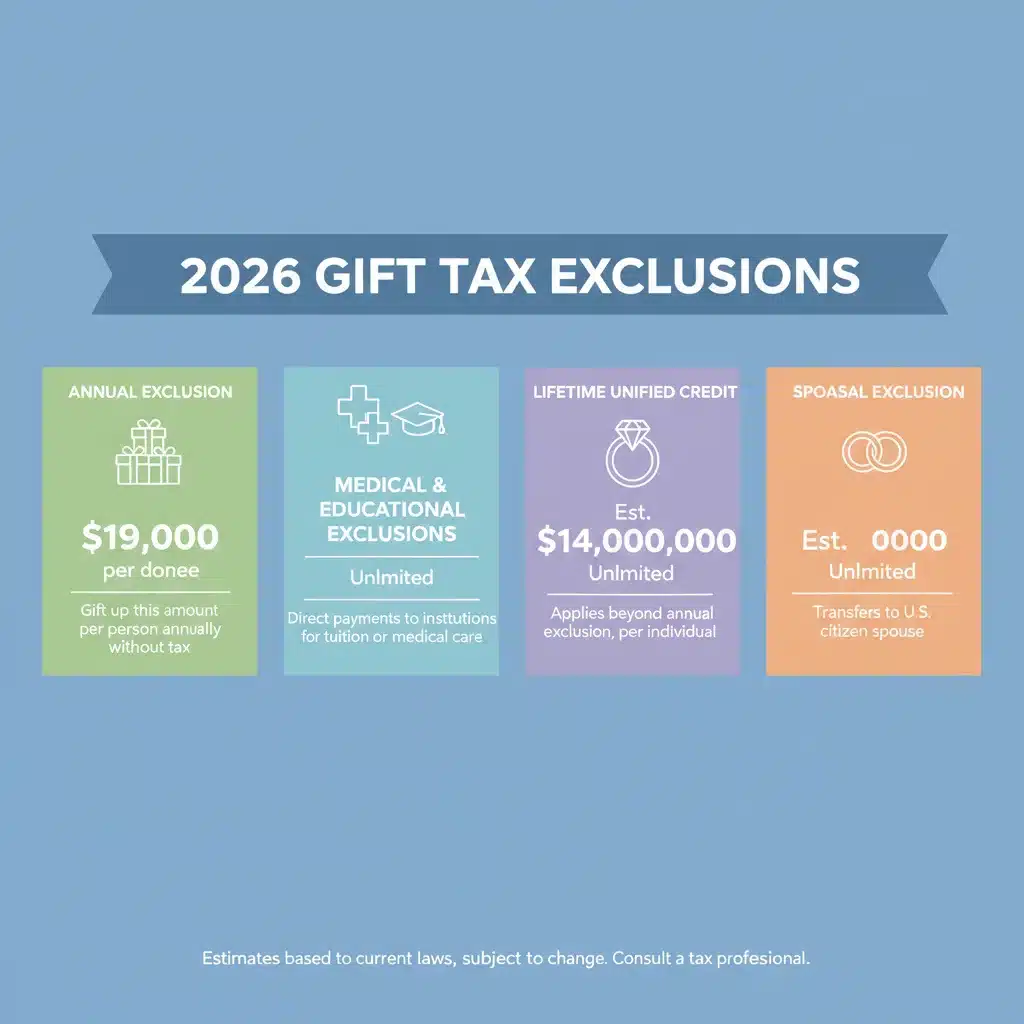
The annual gift tax exclusion is perhaps the most widely used and simplest tool for tax-free wealth transfer. It allows an individual to give a certain amount of money or property each year to any number of recipients without incurring gift tax or using up any of their lifetime exemption. For 2024, this amount is $18,000 per donee. While the exact figure for 2026 will be adjusted for inflation, it is expected to be around this level, likely slightly higher.
The beauty of the annual exclusion lies in its simplicity and its compounding effect. A married couple, for instance, can combine their annual exclusions, allowing them to give twice the amount to each recipient. This means a couple could gift over $36,000 (based on 2024 figures) to each child, grandchild, or any other individual every year, completely tax-free and without any reporting requirements to the IRS, provided the gift falls within the exclusion limit.
Strategic Use of the Annual Exclusion
Leveraging the annual exclusion effectively is a cornerstone of long-term wealth transfer strategies. Here are some ways to maximize its benefits:
- Regular Gifting: Consistent annual gifts can significantly reduce the size of your taxable estate over time. For example, gifting $18,000 to two children and four grandchildren for ten years can remove over $1 million from your estate without touching your lifetime exemption.
- Funding 529 Plans: Contributions to 529 education savings plans are considered gifts and can be covered by the annual exclusion. You can even front-load five years’ worth of annual exclusions into a 529 plan in a single year (e.g., five times $18,000 for a total of $90,000 in 2024), provided you don’t make any further gifts to that beneficiary for the next four years. This is an excellent way to accelerate education funding.
- Spousal Gift Splitting: If you are married, you and your spouse can elect to split gifts, effectively doubling the annual exclusion amount per donee. This requires filing Form 709, United States Gift (and Generation-Skipping Transfer) Tax Return, even if no tax is due.
- Gifts to Irrevocable Trusts: Annual exclusion gifts can be made to irrevocable trusts, often using ‘Crummey powers’ to ensure the gifts qualify as present interests, which is a requirement for the annual exclusion. This allows you to remove assets from your estate while maintaining some control over their distribution.
Understanding these strategies and how they interact with the **2026 Gift Tax Exclusions** is critical. The annual exclusion is a ‘use-it-or-lose-it’ opportunity each year, so consistent planning is essential.

The Lifetime Gift and Estate Tax Exemption in 2026
The Anticipated Reduction
Perhaps the most talked-about aspect of the 2026 Gift Tax Exclusions is the anticipated reduction in the federal lifetime gift and estate tax exemption. As mentioned, the higher exemption amounts established by the TCJA are scheduled to sunset at the end of 2025. This means that for gifts made and estates settled on or after January 1, 2026, the exemption amount is expected to revert to approximately $5 million per individual, adjusted for inflation since 2011. While the exact figure will depend on inflation, it is widely anticipated to be in the range of $6.5 million to $7 million per individual, a significant decrease from the estimated $13.61 million per individual in 2024.
This reduction has profound implications for high-net-worth individuals and families. The window of opportunity to utilize the current higher exemption amounts is closing rapidly. This makes proactive planning before 2026 an urgent priority for many.
Strategic Use of the Lifetime Exemption Before 2026
For those with significant assets, making substantial gifts before the end of 2025 is a critical strategy to consider. The IRS has issued anti-clawback regulations, confirming that gifts made under the higher exemption amounts will not be ‘clawed back’ (taxed) if the exemption amount is lower at the time of death. This provides a strong incentive to utilize the higher exemption while it’s available.
Strategies for utilizing the lifetime exemption include:
- Large Outright Gifts: Directly gifting assets to beneficiaries can remove them from your taxable estate.
- Funding Irrevocable Trusts: Establishing various types of irrevocable trusts, such as irrevocable life insurance trusts (ILITs), grantor retained annuity trusts (GRATs), or intentionally defective grantor trusts (IDGTs), allows you to transfer assets out of your estate while potentially retaining some income or control, depending on the trust structure.
- Gifts of Appreciating Assets: Gifting assets that are expected to appreciate significantly in value can be particularly effective. Not only do you remove the current value of the asset from your estate, but also all future appreciation, which can be substantial over time.
- Generation-Skipping Transfer (GST) Tax Exemption: This exemption is also tied to the gift and estate tax exemption. Utilizing it before 2026 can allow you to transfer wealth to grandchildren or later generations free of GST tax.
Consulting with an experienced estate planning attorney and financial advisor is crucial to determine the most appropriate strategy for your specific situation, especially when dealing with complex trusts and significant wealth transfers.
Other Important Gift Tax Exclusions and Considerations
Beyond the annual and lifetime exclusions, several other provisions allow for tax-free transfers. Understanding these can further enhance your wealth transfer strategy, especially in the context of the **2026 Gift Tax Exclusions**.
Direct Payment of Medical and Educational Expenses
One of the most powerful and often underutilized exclusions is the ability to pay certain medical and educational expenses directly to the provider for another individual. These payments are not considered gifts for tax purposes, regardless of the amount, and do not count against your annual exclusion or lifetime exemption. However, there are strict rules:
- Medical Expenses: Payments must be made directly to the medical care provider (e.g., hospital, doctor, dentist) for qualified medical expenses. Reimbursements to the individual are not eligible.
- Educational Expenses: Payments must be made directly to the educational organization (e.g., college, university, private school) for tuition. Payments for room and board, books, or other living expenses are not eligible.
This exclusion offers a fantastic way to support family members without dipping into your other gift tax allowances.
Gifts to Spouses
The unlimited marital deduction allows you to transfer an unlimited amount of assets to your spouse, either during your lifetime or at death, without incurring any federal gift or estate tax, provided your spouse is a U.S. citizen. This is a fundamental principle of estate planning for married couples and remains unaffected by the **2026 Gift Tax Exclusions** changes.
Gifts to Charities
Gifts made to qualified charitable organizations are also exempt from gift tax. This charitable deduction encourages philanthropic giving and can be a significant component of your overall estate plan, allowing you to support causes you care about while potentially reducing your taxable estate.
Portability of the Deceased Spousal Unused Exclusion (DSUE) Amount
Portability allows a surviving spouse to use any unused portion of their deceased spouse’s federal estate tax exemption. This can effectively double the exemption available to the surviving spouse. While the concept of portability is expected to continue after 2025, the actual amount portable will be based on the reduced exemption levels. This makes it even more crucial for spouses to coordinate their estate plans and ensure that the DSUE amount is properly elected on the deceased spouse’s estate tax return (Form 706), even if no tax is due.
Potential Legislative Changes and Their Impact on 2026 Gift Tax Exclusions
While the sunset of the TCJA provisions is currently scheduled, it’s important to acknowledge that legislative changes can occur. Congress could extend the higher exemption amounts, modify the sunset provisions, or introduce new tax legislation that further alters the landscape of gift and estate tax. Staying abreast of potential legislative developments is crucial for effective long-term planning.
Financial advisors and estate planning professionals closely monitor these legislative discussions. Any new proposals or changes could impact the strategies discussed here. Therefore, maintaining an open dialogue with your advisors and being prepared to adapt your plans is a hallmark of sophisticated wealth management. The uncertainty surrounding future tax laws underscores the importance of acting strategically now, especially in the lead-up to 2026, to utilize existing favorable provisions.
The Role of Professional Advice in Navigating 2026 Gift Tax Exclusions
Navigating the complexities of gift and estate tax law, especially with the impending changes in 2026 Gift Tax Exclusions, is not a task to be undertaken lightly. The decisions you make now can have significant long-term financial implications for your family and your legacy.
Engaging a team of experienced professionals is indispensable. This team typically includes:
- Estate Planning Attorney: An attorney can draft the necessary legal documents, such as wills, trusts, and powers of attorney, ensuring they align with your wealth transfer goals and comply with current tax laws. They can also advise on the legal implications of various gifting strategies.
- Financial Advisor: A financial advisor can help you assess your overall financial situation, identify assets suitable for gifting, and integrate your gift tax planning into your broader investment and retirement strategies. They can also provide projections on how different gifting scenarios might impact your financial future.
- Tax Advisor/CPA: A tax professional can help you understand the specific tax implications of your gifts, ensure proper reporting to the IRS (e.g., filing Form 709), and advise on strategies to minimize tax liabilities.
These professionals work collaboratively to create a holistic and customized plan that addresses your unique circumstances, goals, and risk tolerance. Their expertise becomes even more valuable as the **2026 Gift Tax Exclusions** bring about significant shifts in the tax landscape.
Practical Steps to Prepare for 2026 Gift Tax Exclusions
Given the anticipated changes, here are some practical steps you should consider taking now to prepare for the **2026 Gift Tax Exclusions**:
- Review Your Current Estate Plan: Dust off your existing wills, trusts, and other estate documents. Do they still reflect your wishes and current financial situation? Are they optimized for the potential changes in 2026?
- Assess Your Assets: Gain a clear understanding of your net worth and the types of assets you hold. Identify assets that are suitable for gifting, such as those with high appreciation potential or those that are non-income producing.
- Calculate Your Lifetime Exemption Usage: If you’ve made significant gifts in the past, review your past gift tax returns (Form 709) to understand how much of your lifetime exemption you’ve already used. This will help you determine how much remains available before the 2026 reduction.
- Consider Making Large Gifts Before 2026: If you have substantial wealth and wish to transfer it to beneficiaries, explore making large gifts before the end of 2025 to take advantage of the higher federal lifetime exemption. This is a primary strategy for many high-net-worth individuals.
- Maximize Annual Exclusions: Continue to utilize the annual gift tax exclusion each year. This is a consistent and effective way to reduce your taxable estate over time, regardless of changes to the lifetime exemption.
- Explore Other Exclusions: Remember to leverage the direct payment for medical and educational expenses exclusion whenever possible.
- Communicate with Beneficiaries: Discuss your intentions with your beneficiaries, especially if you plan to make significant gifts. Transparency can prevent misunderstandings and ensure your wishes are carried out smoothly.
- Stay Informed: Keep an eye on legislative developments that could impact gift and estate tax laws. Your financial and legal advisors will be key resources for this.
- Schedule a Consultation: Proactively schedule a meeting with your estate planning attorney, financial advisor, and tax professional to discuss your options and formulate a personalized strategy.
Taking these steps now will position you to effectively manage your wealth and achieve your legacy goals, regardless of the precise form the **2026 Gift Tax Exclusions** ultimately take.
Conclusion: Proactive Planning for a Secure Financial Future
The upcoming changes to the 2026 Gift Tax Exclusions represent a pivotal moment for wealth transfer planning. While the anticipated reduction in the lifetime exemption presents challenges, it also underscores the importance of proactive and strategic financial management. By understanding the annual exclusion, leveraging the current higher lifetime exemption before its sunset, and utilizing other available tax-free gifting avenues, you can significantly impact the amount of wealth you pass on to future generations.
Effective estate planning is an ongoing process, not a one-time event. It requires regular review, adaptation to changing circumstances, and a keen awareness of legislative developments. As we move closer to 2026, the guidance of experienced legal and financial professionals will be invaluable in navigating these complexities and ensuring your wealth transfer strategy is robust, tax-efficient, and aligned with your long-term objectives. Don’t wait until the last minute; start planning today to secure your financial legacy.