2026 College Savings: Mastering 529 Plans & Tax Benefits

The 2026 Guide to College Savings: Mastering 529 Plans with Recent State-Specific Tax Benefits and Investment Options offers crucial insights into optimizing educational funding through strategic financial planning and updated regulatory advantages.
As we navigate the complexities of 2026, the cost of higher education continues to be a significant concern for families across the United States. Preparing for these expenses requires foresight and strategic financial planning. This comprehensive resource, The 2026 Guide to College Savings: Mastering 529 Plans with Recent State-Specific Tax Benefits and Investment Options, will equip you with the knowledge to make informed decisions, ensuring a brighter future for your loved ones.
Understanding 529 Plans in 2026: The Foundation of College Savings
A 529 plan remains one of the most effective tools for saving for college and other qualified education expenses. These state-sponsored investment accounts offer significant tax advantages, making them a cornerstone of any robust college savings strategy. In 2026, these plans continue to evolve, with new features and updated regulations that can impact your financial approach.
At its core, a 529 plan allows your money to grow tax-free, and withdrawals for qualified education expenses are also tax-free at the federal level. This dual tax advantage can lead to substantial savings over time compared to traditional taxable investment accounts. Understanding the nuances of these plans, including contribution limits and eligible expenses, is paramount for maximizing their benefits.
Types of 529 Plans
- College Savings Plans: These are investment accounts offering various portfolios, similar to a 401(k) or IRA. Your contributions grow based on market performance.
- Prepaid Tuition Plans: Less common, these plans allow you to purchase future tuition credits at today’s prices, primarily for in-state public colleges.
Choosing between these types depends on your risk tolerance, the age of your beneficiary, and your specific financial goals. Most families opt for college savings plans due to their flexibility and broader investment opportunities. As we delve deeper, we’ll explore how recent changes in 2026 might influence this choice.
The flexibility of 529 plans extends beyond just tuition. Qualified expenses include room and board, books, supplies, and even certain equipment necessary for enrollment. This broad definition ensures that a wide range of educational costs can be covered, providing comprehensive financial support for students. The sustained relevance of 529 plans in 2026 underscores their importance in long-term financial planning for education.
Navigating State-Specific Tax Benefits for 529 Plans in 2026
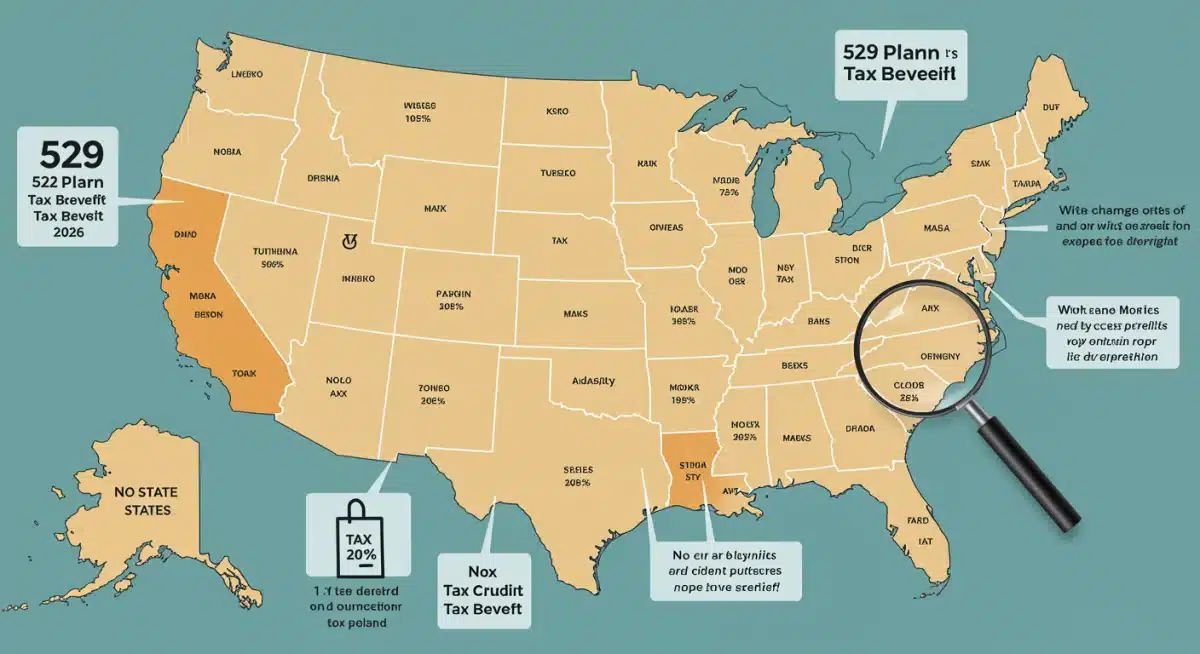
While 529 plans offer federal tax advantages, many states sweeten the deal with their own impressive tax benefits. These state-specific incentives can significantly boost your savings, making it crucial to understand what your state, or even other states, might offer. In 2026, several states have either introduced new benefits or modified existing ones, creating a dynamic landscape for savers.
These state benefits often come in the form of tax deductions or credits for contributions made to a 529 plan. The specifics vary wildly, from deductions for contributions to any state’s plan to those exclusively for your home state’s plan. Some states even offer matching grant programs, effectively giving you free money towards college savings.
Key State-Specific Benefits to Consider
- Income Tax Deductions: Many states allow you to deduct a portion of your 529 contributions from your state taxable income. This reduces your current year’s tax burden.
- Tax Credits: A few states offer tax credits, which directly reduce the amount of tax you owe, often more valuable than a deduction.
- Matching Grant Programs: Some states provide grants to low and middle-income families who contribute to their 529 plans, offering a direct financial boost.
It’s important to research the 529 plan offered by your state of residence, as well as those of other states. Sometimes, a plan from another state might offer better investment options or lower fees, even if it means foregoing a state income tax deduction. However, the immediate tax savings from a home-state plan can often outweigh these other factors.
For 2026, particular attention should be paid to legislative updates in states like New York, Illinois, and Virginia, which have historically offered generous deductions, and new initiatives in states like Oregon and Rhode Island that are exploring enhanced matching programs. Staying informed about these changes is key to maximizing your 529 plan benefits 2026.
Evolving Investment Options within 529 Plans for 2026
The investment landscape within 529 plans is far from static. Plan administrators continually update their offerings, introducing new fund options, adjusting asset allocations, and responding to market trends. For 2026, investors can expect to see a continued emphasis on diversified portfolios, sustainable investing options, and potentially more personalized investment paths.
Most 529 plans offer age-based portfolios, which automatically adjust their asset allocation from aggressive to conservative as the beneficiary approaches college age. This hands-off approach is popular for its simplicity and built-in risk management. However, many plans also provide static portfolios, allowing investors to choose their own risk level and asset mix.
New Trends in 529 Investment Strategies
- Increased ESG Offerings: Environmental, Social, and Governance (ESG) funds are becoming more prevalent, allowing savers to align their investments with their values.
- Alternative Investment Access: Some plans are exploring limited access to alternative investments, such as real estate or private equity, though these are typically reserved for more sophisticated investors.
- Customized Portfolios: A growing trend is the ability to create more customized portfolios, offering greater control over individual fund selections beyond standard age-based or static options.
When selecting investment options, consider your risk tolerance, the time horizon until college, and the overall performance and fees associated with each option. While past performance is no guarantee of future results, it can provide insight into a fund manager’s strategy. Always review the program disclosure statement for detailed information on fees and investment objectives.
The continued diversification of investment choices within 529 plans in 2026 reflects a broader trend in financial markets. This evolution aims to provide savers with more tools to achieve their college funding goals, catering to a wider range of financial philosophies and risk appetites. Carefully evaluating these options is a critical step in mastering your 529 plan.
Strategic Contributions and Withdrawals: Maximizing Your 529 Plan
Optimizing a 529 plan involves more than just opening an account and making regular contributions. Strategic planning around contribution amounts, timing, and withdrawal methods can significantly enhance your overall benefits. In 2026, understanding these strategies is more important than ever, especially with potential shifts in personal finance regulations.
When contributing, consider front-loading your plan if your financial situation allows. The IRS permits a lump-sum contribution of up to five years’ worth of the annual gift tax exclusion without incurring gift tax, currently $18,000 per individual in 2024 (this amount typically adjusts for inflation). This allows more time for your investments to grow tax-free.
Smart Contribution and Withdrawal Tactics
- Gift Tax Exclusion Bundling: Contribute a larger sum upfront by utilizing the five-year gift tax exclusion rule, accelerating tax-free growth.
- State Tax Deduction Timing: If your state offers a deduction, time your contributions to maximize your annual state income tax savings.
- Coordination with Other Aid: Understand how 529 withdrawals can interact with financial aid eligibility. While generally favorable, careful planning can prevent unintended impacts.
When it comes to withdrawals, ensure they are for qualified education expenses to maintain their tax-free status. Keep meticulous records of all expenses. If you withdraw funds for non-qualified expenses, the earnings portion will be subject to income tax and a 10% federal penalty. However, recent changes in 2024 allow for penalty-free rollovers of unused 529 funds to a Roth IRA, up to certain limits, offering an excellent new flexibility.
This Roth IRA rollover option, now a feature in 2026, provides a valuable safety net for families whose beneficiaries choose not to attend college or receive significant scholarships. It adds a new layer of flexibility and reduces the risk associated with over-saving in a 529 plan. This strategic flexibility is a major enhancement to 529 plan benefits 2026.
The Impact of Legislative Changes and Economic Factors on 529 Plans in 2026
The financial landscape is always subject to change, and 529 plans are no exception. Legislative decisions at both federal and state levels, alongside broader economic trends, can significantly influence the appeal and effectiveness of these savings vehicles. In 2026, we continue to monitor key factors that could shape the future of college savings.
Federally, there’s always the possibility of changes to contribution limits, qualified expense definitions, or the tax treatment of withdrawals. While the core tax benefits of 529 plans have remained stable for years, vigilance is key. State legislatures, as mentioned, are more dynamic, frequently adjusting their tax incentives or introducing new programs to encourage college savings.
External Factors Shaping 529 Plans
- Inflation: Rising tuition costs and general inflation can erode purchasing power, making consistent and aggressive saving in 529 plans even more critical.
- Interest Rate Environment: The prevailing interest rate environment can impact the performance of fixed-income portions of 529 portfolios and the overall cost of student loans.
- State Budget Priorities: State-specific tax benefits and matching grants are often tied to state budget health and legislative priorities, which can fluctuate.
Economically, inflation remains a persistent concern. The rising cost of tuition and living expenses means that families need to save more aggressively to keep pace. Investment returns within 529 plans become even more important in such environments. Conversely, a strong economy might lead to greater state revenues, potentially enabling more generous state-level 529 benefits.
Staying informed about these broader trends and legislative developments is crucial. Financial advisors specializing in college planning can provide invaluable guidance, helping families adapt their strategies to capitalize on new opportunities and mitigate risks. The proactive management of your 529 plan in 2026 ensures you are leveraging all available advantages.
Beyond Tuition: Expanded Uses for 529 Plans in 2026
While primarily known for college tuition savings, 529 plans have seen their utility expand significantly in recent years. These changes have made them even more versatile financial tools for education. In 2026, the broadened scope of qualified expenses and new flexibility options continue to enhance the appeal of 529 plans for a wider array of educational pursuits.
One of the most notable expansions allows 529 funds to be used for K-12 tuition expenses, up to $10,000 per year per student. This offers a valuable tax-advantaged way for families to save for private elementary and secondary school costs. This flexibility provides a substantial benefit for families considering private education from an early age.
Expanded Uses and Flexibilities
- K-12 Tuition: Use up to $10,000 annually per beneficiary for private elementary and secondary school tuition.
- Apprenticeship Programs: Funds can cover expenses for registered apprenticeship programs, including fees, books, supplies, and equipment.
- Student Loan Repayment: Up to $10,000 can be used to repay qualified student loans for the beneficiary or their siblings, a significant relief for many graduates.
The ability to use 529 funds for apprenticeship programs is particularly relevant in 2026, as vocational training and skilled trades gain increasing recognition as viable and rewarding career paths. This expansion acknowledges the diverse educational journeys individuals may take beyond traditional four-year universities.
Furthermore, the allowance for student loan repayment provides a crucial safety valve. If a beneficiary graduates with loans, or if there are leftover funds in the 529 plan, this option can provide much-needed financial relief. These expanded uses solidify the 529 plan’s role as a comprehensive educational savings vehicle, making 529 plan benefits 2026 more encompassing than ever before.
| Key Aspect | 2026 Impact/Benefit |
|---|---|
| State Tax Benefits | Diverse deductions/credits across states, some with new matching grants. Crucial for maximizing local savings. |
| Investment Options | Evolving portfolios with more ESG funds and customized choices to suit various risk profiles. |
| Roth IRA Rollover | Unused 529 funds can be rolled into a Roth IRA (up to limits), providing flexibility and a safety net. |
| Expanded Uses | Funds now cover K-12 tuition, apprenticeship programs, and up to $10,000 for student loan repayment. |
Frequently Asked Questions About 529 Plans in 2026
In 2026, 529 plans continue to offer federal tax-free growth on investments and tax-free withdrawals for qualified education expenses. This means your savings compound without federal taxes, and you won’t pay federal income tax when using the funds for college costs.
Yes, as of 2026, you can use up to $10,000 per year per beneficiary from your 529 plan to pay for K-12 private school tuition. This flexibility extends the benefits of 529 plans beyond just higher education expenses.
Starting in 2026, unused 529 funds can be rolled over to a Roth IRA for the beneficiary, subject to certain limits and conditions. This provides a valuable option if the beneficiary doesn’t use all the funds for education.
No, not all states offer tax deductions or credits for 529 plan contributions. State-specific benefits vary significantly, with some states offering generous deductions or credits, while others offer none. It’s essential to research your state’s specific rules.
Many 529 plans are continually updating their investment offerings in 2026, including more ESG (Environmental, Social, and Governance) funds and potentially more customized portfolio options to cater to diverse investor preferences and risk tolerances.
Conclusion
As we’ve explored throughout The 2026 Guide to College Savings: Mastering 529 Plans with Recent State-Specific Tax Benefits and Investment Options, 529 plans remain an indispensable tool for families navigating the rising costs of education. From their foundational federal tax advantages to the intricate web of state-specific benefits and the continuously evolving investment landscape, these plans offer a powerful mechanism for securing educational futures. The expanded uses, including K-12 tuition, apprenticeship programs, and the new Roth IRA rollover option, further solidify their versatility. By staying informed about legislative changes, understanding economic impacts, and strategically managing contributions and withdrawals, you can maximize the potential of your 529 plan, ensuring that financial preparedness paves the way for academic success. Proactive planning and informed decision-making are your greatest assets in this journey.