College Savings Plans 2026: 529 vs. ESA Comparison

As the cost of higher education continues its relentless ascent, planning for your child’s future college expenses has never been more critical. With 2026 rapidly approaching, understanding the various options available for college savings plans is paramount for parents and guardians. This comprehensive guide delves into the two most popular and effective vehicles for education funding: 529 plans and Education Savings Accounts (ESAs). We will meticulously compare their features, benefits, drawbacks, and tax implications to help you make an informed decision that aligns with your financial goals and your child’s educational aspirations.
The Imperative of Early College Savings Plans
The decision to start saving for college is one of the most significant financial steps a family can take. The rising tuition fees, coupled with living expenses, textbooks, and other associated costs, can quickly accumulate into a daunting sum. Proactive planning through dedicated college savings plans allows families to leverage the power of compound interest, significantly reducing the burden of future student loan debt. Early investment provides a longer horizon for your money to grow, making even small, consistent contributions incredibly impactful over time. Without a solid strategy, families often find themselves scrambling, leading to increased stress and potentially limiting educational opportunities for their children.
Moreover, the landscape of financial aid is competitive. While scholarships and grants can provide substantial relief, they often don’t cover the entire cost of attendance. Student loans, while accessible, come with interest and repayment obligations that can follow graduates for decades. By establishing robust college savings plans, you’re not just saving money; you’re investing in your child’s future freedom and financial stability, allowing them to pursue their dreams without the crushing weight of excessive debt.
Understanding the Basics: What are College Savings Plans?
At their core, college savings plans are specialized investment accounts designed to help families save for qualified education expenses. These plans typically offer tax advantages, which can significantly boost your savings over the long term. The two primary types we’ll explore, 529 plans and ESAs, each have unique structures and benefits, catering to different financial situations and preferences. Deciding which plan is best for your family requires a thorough understanding of these nuances.
529 Plans: A Deep Dive into the Dominant College Savings Vehicle
When discussing college savings plans, 529 plans often come to mind first, and for good reason. Named after Section 529 of the Internal Revenue Code, these state-sponsored plans have become the most popular choice for education savings due to their generous contribution limits, tax benefits, and flexibility. Understanding the intricacies of 529 plans is crucial for anyone serious about funding higher education.
Types of 529 Plans: Savings vs. Prepaid
There are two main types of 529 plans:
- 529 College Savings Plans: These are investment accounts that allow your contributions to grow tax-deferred. Withdrawals for qualified education expenses are tax-free. They are offered by individual states, but you are generally not restricted to your home state’s plan. You can invest in a plan offered by any state.
- 529 Prepaid Tuition Plans: These plans allow you to purchase future tuition credits at today’s prices. They are generally less common and often have residency requirements, limiting participation to residents of the sponsoring state. They typically cover tuition and mandatory fees at in-state public colleges, and sometimes offer a conversion rate for private or out-of-state institutions.
For the purpose of this comparison, we will primarily focus on the more widely available and flexible 529 College Savings Plans.
Key Benefits of 529 Plans
- Tax-Free Growth and Withdrawals: This is arguably the biggest advantage. Your investments grow free from federal income tax, and qualified withdrawals for education expenses are also federal income tax-free. Many states also offer state income tax deductions or credits for contributions, further enhancing their appeal.
- High Contribution Limits: Most 529 plans have very high lifetime contribution limits, often exceeding $300,000 or even $500,000 per beneficiary. This allows families to save substantial amounts for even the most expensive educational pursuits.
- Owner Control: Unlike custodial accounts (like UGMA/UTMA), the account owner (usually the parent) retains control over the assets. The beneficiary does not gain control of the funds at the age of majority, providing peace of mind that the money will be used for its intended purpose.
- Flexibility: If your chosen beneficiary decides not to attend college, or receives a scholarship, you can change the beneficiary to another qualified family member without tax penalties. You can also roll over funds to another 529 plan.
- Broad Definition of Qualified Expenses: Qualified education expenses are extensive, including tuition, fees, books, supplies, equipment, room and board (if enrolled at least half-time), and even up to $10,000 per year for K-12 tuition expenses, and student loan repayment.
- Minimal Impact on Financial Aid: Funds in a 529 plan are generally considered an asset of the account owner (typically the parent) for financial aid purposes. This usually results in a smaller impact on financial aid eligibility compared to assets held directly by the student.
Potential Drawbacks of 529 Plans
- Investment Options: While improving, investment options within 529 plans can sometimes be limited to a selection of predetermined portfolios, often age-based or static. This might not appeal to investors seeking complete control over individual stock or fund selections.
- Non-Qualified Withdrawals: If you withdraw funds for non-qualified expenses, the earnings portion of the withdrawal will be subject to federal income tax and a 10% federal penalty tax, as well as any applicable state income taxes.
- State-Specific Benefits: While you can invest in any state’s plan, you only receive state income tax benefits (if offered) for contributing to your home state’s plan.
- Fees: 529 plans can have various fees, including annual maintenance fees, administrative fees, and underlying fund expenses. These can vary significantly between plans and impact overall returns.
Education Savings Accounts (ESAs): A Look at the Alternative
The Education Savings Account (ESA), often referred to as a Coverdell ESA, is another excellent option for college savings plans, though it operates with different rules and limitations than a 529 plan. ESAs offer tax-free growth and withdrawals for qualified education expenses, similar to 529s, but with a few key distinctions that make them suitable for certain families.
Key Benefits of ESAs
- Tax-Free Growth and Withdrawals: Like 529 plans, contributions to an ESA are not tax-deductible, but the earnings grow tax-free, and withdrawals for qualified education expenses are tax-free at the federal level.
- Broader Definition of Qualified Expenses: One significant advantage of ESAs is their broader definition of qualified education expenses, which includes not only college costs but also a wider range of K-12 expenses. This can include tuition, fees, books, supplies, equipment, academic tutoring, special needs services, and even computer technology and internet access for elementary and secondary education.
- Investment Control: Unlike most 529 plans, the account holder of an ESA typically has much greater control over investment choices. You can invest in almost any stock, bond, mutual fund, or ETF, similar to an IRA. This flexibility appeals to investors who prefer to manage their own portfolio.
- Age Limit: The beneficiary must be under 18 when contributions are made, and funds must be used by the time the beneficiary turns 30, unless rolled over to another family member’s ESA or a 529 plan.
Potential Drawbacks of ESAs
- Lower Contribution Limits: This is the most significant limitation. Annual contributions to an ESA are capped at $2,000 per beneficiary. This significantly restricts the total amount you can save compared to a 529 plan.
- Income Limitations: Eligibility to contribute to an ESA is subject to income limitations. For 2023, the ability to contribute is phased out for single filers with modified adjusted gross income (MAGI) between $95,000 and $110,000, and for joint filers with MAGI between $190,000 and $220,000.
- Age Restrictions: Contributions must cease once the beneficiary turns 18, and the funds must be distributed by the time the beneficiary turns 30, or they become taxable and subject to a penalty.
- One Beneficiary Per Account: Each ESA can only have one designated beneficiary. If you have multiple children, you’ll need separate ESA accounts for each.
529 vs. ESA: A Head-to-Head Comparison for 2026
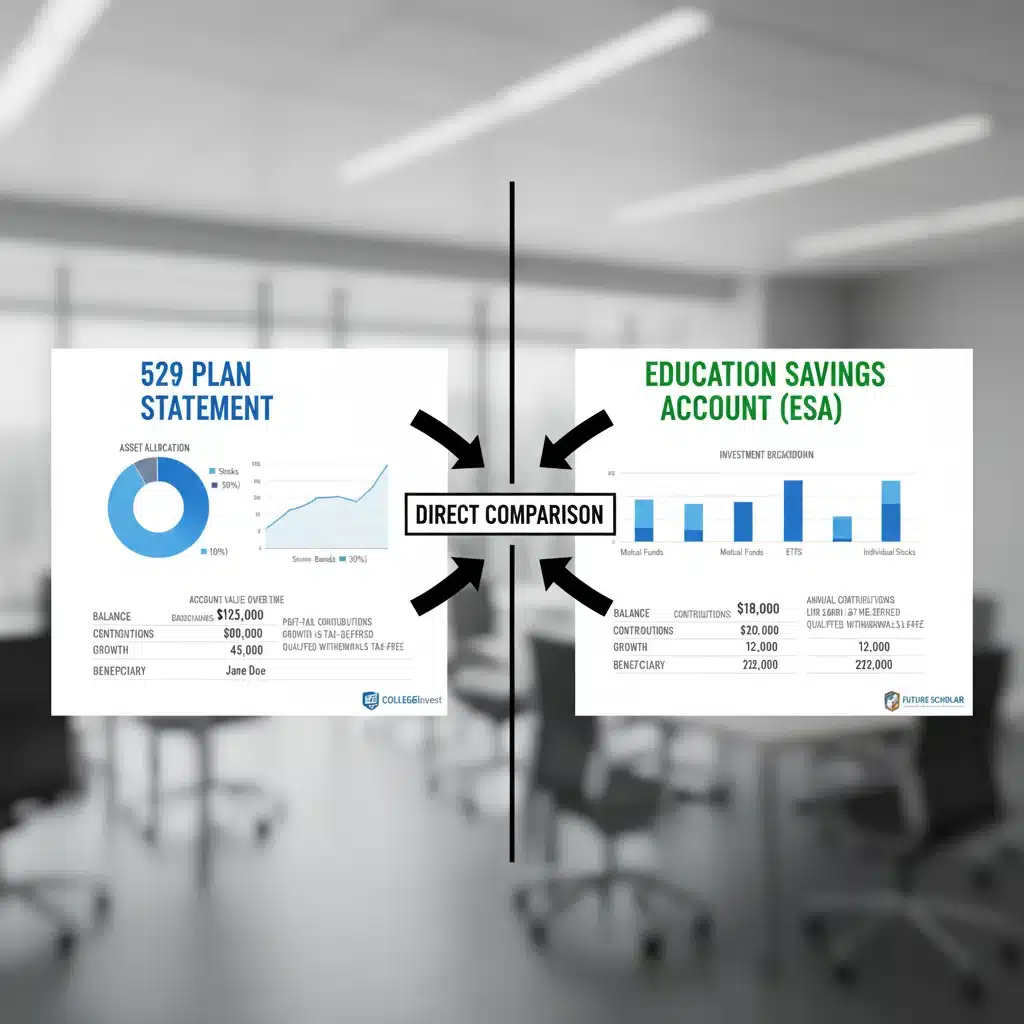
To help you decide between these two powerful college savings plans, let’s directly compare their key features:
| Feature | 529 Plan | Education Savings Account (ESA) |
|---|---|---|
| Contribution Limits | Very high (often $300k-$500k+ lifetime) | $2,000 per beneficiary per year |
| Income Limitations | None | Yes (phase-out for higher earners) |
| Investment Control | Limited to plan’s pre-selected portfolios | Broad control (stocks, bonds, mutual funds, ETFs) |
| Qualified Expenses | College tuition, fees, room/board, books, supplies, equipment, K-12 tuition ($10k/year), student loan repayment | College tuition, fees, room/board, books, supplies, equipment, AND a broader range of K-12 expenses (tutoring, computers, etc.) |
| Tax Benefits | Federal tax-free growth & withdrawals; potential state tax deductions/credits | Federal tax-free growth & withdrawals |
| Beneficiary Age Limit for Contributions | None | Must be under 18 (contributions cease at 18) |
| Funds Usage Deadline | None | Must be used by beneficiary’s 30th birthday (or rolled over) |
| Impact on Financial Aid | Parental asset (minimal impact) | Parental asset (minimal impact) |
| Account Owner Control | Owner retains control | Owner retains control |
Choosing the Right College Savings Plan for Your Family
The optimal choice between a 529 plan and an ESA depends heavily on your specific financial situation, income level, and savings goals. Here’s a breakdown to help you navigate the decision:
When a 529 Plan is Likely Best:
- You plan to save a significant amount: If you anticipate contributing more than $2,000 annually per child, a 529 plan is the clear winner due to its high contribution limits.
- You have a higher income: Since 529 plans have no income restrictions, they are accessible to all income levels, unlike ESAs.
- You prefer a hands-off investment approach: If you’re comfortable with professionally managed portfolios and don’t want to actively select individual investments, a 529 plan’s streamlined options are convenient.
- You want state tax benefits: If your state offers a tax deduction or credit for 529 contributions, this can be a compelling reason to choose your home state’s plan.
- You’s primarily focused on college expenses: While 529s cover K-12 tuition, their primary strength lies in funding post-secondary education.
When an ESA Might Be a Better Fit:
- You have a lower income: If your income falls within the eligibility limits, an ESA is a viable option.
- You want greater investment control: For those who enjoy managing their own investment portfolio and want access to a wider range of investment vehicles, an ESA offers this flexibility.
- You want to save for K-12 expenses beyond just tuition: If you anticipate significant expenses for elementary or secondary education, such as tutoring, private school fees, or specialized equipment, the broader definition of qualified expenses in an ESA can be very beneficial.
- You have a smaller savings goal: If you anticipate only saving up to $2,000 per year per child, the ESA’s limit won’t be an issue.
- You want to supplement a 529 plan: Some families choose to open both a 529 plan and an ESA, using the ESA for K-12 expenses or specific investments, and the 529 for the bulk of college savings.
Hybrid Strategies: Combining 529s and ESAs
It’s important to remember that you don’t necessarily have to choose just one. Many families find success by employing a hybrid strategy, utilizing both a 529 plan and an ESA. For instance:
- You could fund a 529 plan with larger contributions for future college tuition and use an ESA for more immediate K-12 educational needs, taking advantage of its broader definition of qualified expenses for younger children.
- If you max out the $2,000 annual contribution limit for an ESA and still want to save more, a 529 plan can serve as the primary vehicle for additional college savings plans.
- The investment flexibility of an ESA might appeal for a smaller portion of your savings, while the bulk is in a more diversified 529 portfolio.

Important Considerations for 2026 and Beyond
As you plan for 2026, keep these additional factors in mind:
- State Tax Benefits: Always research your home state’s 529 plan. Many states offer income tax deductions or credits for contributions, which can be a significant bonus. Even if your state’s plan isn’t the best performing, the tax benefits might make it worthwhile.
- Investment Performance: While past performance is not indicative of future results, review the historical performance and underlying investment options of any plan you consider. Diversification within your chosen plan is key.
- Fees: Be mindful of the fees associated with any college savings plans. High fees can erode your returns over time. Compare administrative fees, program management fees, and underlying fund expense ratios across different plans.
- Changing Regulations: Tax laws and education savings regulations can change. Stay informed about any updates that might affect 529 plans or ESAs.
- Impact on Financial Aid: While both 529s and ESAs generally have a minimal impact on financial aid eligibility when owned by a parent, it’s wise to understand how these assets are treated on the FAFSA (Free Application for Federal Student Aid) and CSS Profile.
- Gift Tax Exclusion: For 529 plans, you can contribute a large sum (up to five years’ worth of annual gift tax exclusion) in a single year without incurring gift tax, allowing for significant front-loading of savings.
Getting Started with Your College Savings Plan
Once you’ve weighed the pros and cons of 529 plans and ESAs, the next step is to take action. Here’s a general guide:
- Assess Your Financial Situation: Determine how much you can realistically contribute regularly.
- Research Plans: If considering a 529, compare plans from different states, not just your own. Look at investment options, fees, and past performance. For an ESA, choose a brokerage that offers the investment flexibility you desire.
- Open an Account: The process is usually straightforward and can often be done online.
- Set Up Contributions: Establish automatic contributions to ensure consistency and leverage dollar-cost averaging.
- Monitor and Adjust: Periodically review your chosen college savings plans. As your child grows, or as market conditions change, you may need to adjust your investment strategy or contribution amounts.
Conclusion: Investing in Education for a Brighter Future
The journey to fund a college education is a marathon, not a sprint. By understanding the distinct advantages and limitations of both 529 plans and Education Savings Accounts, you can make an informed decision that best serves your family’s needs for 2026 and beyond. Whether you opt for the robust contribution limits and state tax benefits of a 529, the investment control and K-12 flexibility of an ESA, or a combination of both, the most important step is to start saving now.
Proactive planning through dedicated college savings plans not only eases the financial burden but also empowers your child to pursue their academic dreams without compromise. Invest wisely, plan strategically, and secure a brighter educational future for the next generation.