
From Idea to IPO: A 5-Year Strategic Roadmap for U.S. Tech Startups in 2026
The dream of every ambitious founder is to see their vision transform into a public entity, making a significant impact on the market and generating substantial returns for early investors. For U.S. tech startups, the path to an Initial Public Offering (IPO) is both exhilarating and challenging, demanding meticulous planning, strategic execution, and unwavering resilience. This comprehensive guide outlines a pragmatic 5-year strategic roadmap designed to navigate the intricate journey from a nascent idea to a successful tech startup IPO by 2026. We will delve into critical phases, funding strategies, operational excellence, and market positioning essential for achieving this monumental milestone.
Understanding the IPO Landscape for U.S. Tech Startups
Before embarking on this ambitious journey, it’s crucial to understand the current IPO landscape. The U.S. market, particularly for tech, is dynamic, influenced by economic cycles, investor sentiment, and regulatory changes. A successful tech startup IPO in 2026 will require not just a strong product, but also a robust business model, consistent growth, and impeccable financial health. The recent shifts in market conditions emphasize the need for sustainable profitability alongside rapid expansion. Founders must prepare for rigorous scrutiny from underwriters, regulatory bodies like the SEC, and potential investors.
The allure of an IPO extends beyond capital infusion; it offers enhanced visibility, increased credibility, and liquidity for early investors and employees. However, it also comes with increased public scrutiny, stringent reporting requirements, and a shift in focus from purely growth-driven metrics to a balance of growth and profitability. This roadmap aims to equip U.S. tech startups with the foresight and strategies needed to successfully navigate these complexities and achieve their tech startup IPO aspirations.
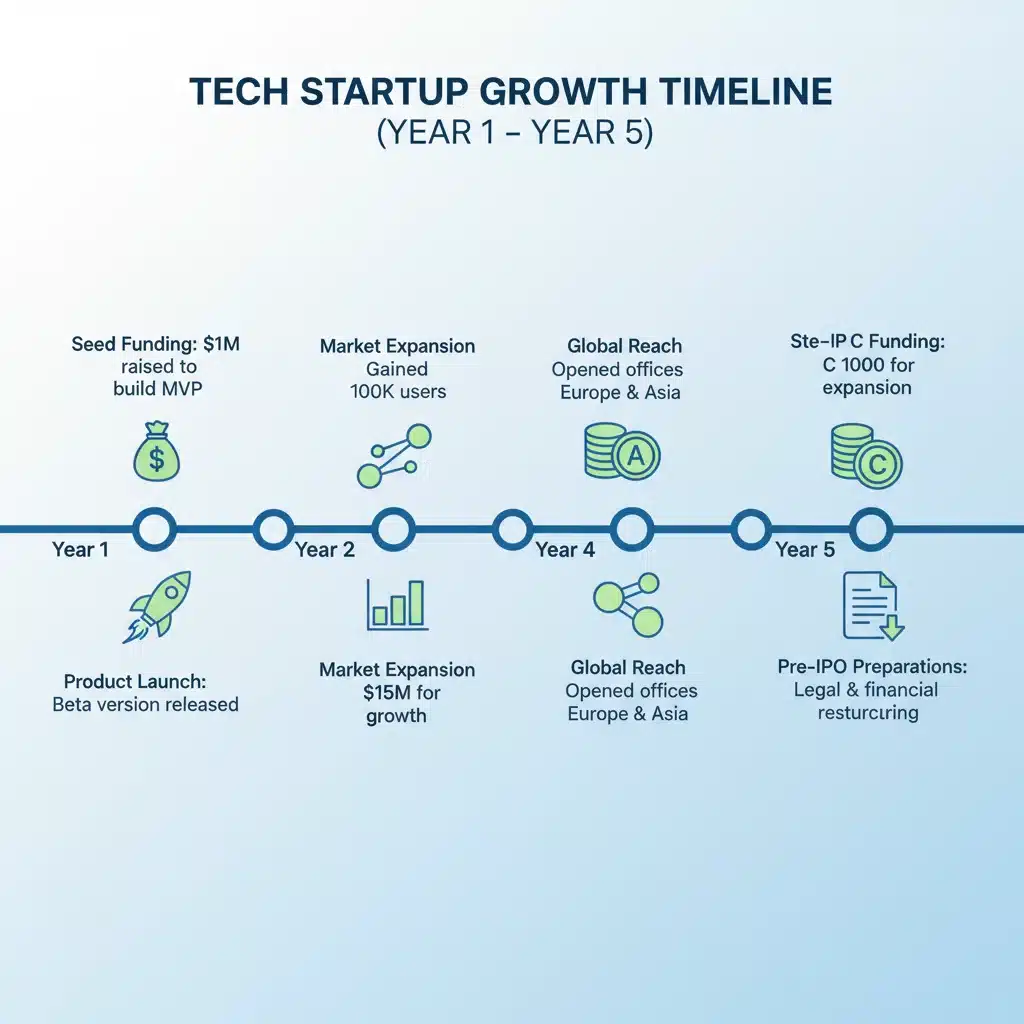
Year 1: Foundation, Validation, and Seed Funding
Building the Core Idea and Team (Months 1-6)
The first year is all about establishing a solid foundation. This begins with refining the core idea, identifying a significant market problem, and developing an innovative solution. Market research is paramount here – understanding the target audience, competitive landscape, and potential market size. A clear value proposition and a well-defined Minimum Viable Product (MVP) are essential outputs of this phase.
- Idea Validation: Conduct extensive customer interviews, surveys, and pilot programs to validate the problem-solution fit.
- Team Formation: Assemble a lean, agile, and passionate founding team with complementary skills. This initial team will be the backbone of the tech startup IPO journey.
- Legal Structure: Establish the appropriate legal entity (e.g., C-Corp in Delaware for U.S. tech startups aiming for venture capital and IPO). Address intellectual property protection from day one.
- Business Plan: Develop a comprehensive business plan outlining market opportunity, product strategy, go-to-market plan, financial projections, and long-term vision. This document will be critical for attracting early investment.
MVP Development and Initial Traction (Months 7-12)
With a validated idea and a strong team, the focus shifts to building the MVP and achieving initial traction. This involves rapid prototyping, iterative development, and gathering early user feedback to refine the product.
- MVP Launch: Release the MVP to a small, targeted group of early adopters. Focus on core features and a seamless user experience.
- User Feedback Loop: Implement robust mechanisms for collecting and analyzing user feedback. This iterative process is crucial for product-market fit.
- Early Metrics: Track key performance indicators (KPIs) such as user engagement, retention, and initial revenue (if applicable). These early metrics will be vital for demonstrating potential to seed investors.
- Seed Funding: Secure initial capital from angel investors, incubators, or accelerators. This funding will fuel product development and early growth. A compelling pitch deck, demonstrating market opportunity and team strength, is essential for this stage of a tech startup.
Year 2: Product-Market Fit and Series A Funding
Scaling the Product and User Base (Months 13-18)
Year two is about proving product-market fit and beginning to scale. Based on MVP feedback, the product should evolve to meet broader market needs and achieve significant user adoption.
- Product Enhancement: Continuously iterate on the product, adding features that address user pain points and enhance value.
- User Acquisition: Implement initial marketing and sales strategies to expand the user base. Experiment with different channels to find cost-effective acquisition methods.
- Customer Success: Build a foundation for customer success to ensure high retention rates and positive word-of-mouth.
- Operational Foundations: Start putting in place basic operational processes and tools to support growth, even if rudimentary.
Demonstrating Scalability and Securing Series A (Months 19-24)
By the end of year two, the tech startup should have clear evidence of product-market fit and a scalable business model, making it attractive for Series A funding.
- Key Metrics Achievement: Demonstrate strong growth in user base, engagement, and revenue. Show clear unit economics and customer lifetime value (CLTV) that outweigh customer acquisition costs (CAC).
- Team Expansion: Begin strategically expanding the team, particularly in engineering, sales, and marketing, to support growth initiatives.
- Series A Funding: Secure a significant Series A round from venture capital firms. This capital is crucial for accelerating product development, scaling operations, and expanding market reach. A strong narrative, backed by data, is key for attracting this level of investment for a tech startup IPO trajectory.
Year 3: Hyper-Growth, Market Expansion, and Series B Funding
Accelerating Growth and Market Penetration (Months 25-36)
Year three is often characterized by hyper-growth. The focus shifts to aggressive market penetration, expanding product offerings, and solidifying market position.
- Market Expansion: Explore new geographical markets or customer segments. Adapt the product and marketing strategies to suit diverse audiences.
- Product Diversification: Consider expanding the product suite or adding new features that unlock additional revenue streams.
- Strategic Partnerships: Forge strategic alliances with complementary businesses to accelerate growth, gain access to new customers, or enhance product capabilities.
- Data-Driven Decisions: Implement advanced analytics to gain deeper insights into user behavior, market trends, and operational efficiency. This data will inform critical strategic decisions.
Building a Robust Organization and Securing Series B (Months 31-36)
As the company grows, so does the need for a more structured organization and sophisticated financial management. This period prepares the tech startup for more significant investment.
- Organizational Structure: Develop a more defined organizational structure with clear reporting lines and departmental responsibilities. Hire experienced leadership for key functions.
- Financial Controls: Implement robust financial planning and analysis (FP&A) processes, budgeting, and forecasting. Begin preparing for public company financial standards.
- Series B Funding: Secure Series B funding to fuel continued hyper-growth, further market expansion, and potential acquisitions. This round often focuses on demonstrating a clear path to market leadership.
Year 4: Operational Excellence, Governance, and Pre-IPO Readiness
Optimizing Operations and Enhancing Governance (Months 37-48)
With substantial funding and rapid growth, Year 4 focuses on refining internal processes, strengthening corporate governance, and ensuring the company is operating efficiently at scale.
- Operational Efficiency: Streamline workflows, automate processes, and invest in technology infrastructure to support scalability and reduce operational costs.
- Talent Management: Focus on attracting, retaining, and developing top talent. Implement comprehensive HR policies, compensation structures, and performance management systems.
- Corporate Governance: Establish a strong board of directors with independent members, form audit and compensation committees, and implement robust internal controls. This is critical for tech startup IPO readiness.
- Legal and Compliance: Strengthen legal and compliance functions, ensuring adherence to all relevant industry regulations and data privacy laws. Prepare for the increased scrutiny that comes with being a public company.
Scaling Profitability and Preparing for Public Markets (Months 43-48)
By the end of year four, the company should be demonstrating a clear path to profitability (if not already profitable) and have all the necessary internal structures in place for public market readiness.
- Path to Profitability: Refine business model and pricing strategies to optimize margins and demonstrate a clear path to sustainable profitability. Investors increasingly value profitable growth.
- Financial Reporting Systems: Implement public company-grade financial reporting systems and processes, ensuring GAAP compliance and audit readiness.
- Internal Audit Function: Consider establishing an internal audit function or engaging external experts to review internal controls and financial reporting.
- Pre-IPO Funding (Optional): Depending on market conditions and capital needs, consider a Series C or D round to further strengthen the balance sheet and provide additional runway before the tech startup IPO.
Year 5: The IPO Year – Execution and Public Debut
Final Preparations and Underwriter Selection (Months 49-54)
The final year is dedicated to the intensive process of preparing for and executing the IPO. This phase requires meticulous coordination and a strong partnership with financial and legal advisors.
- Underwriter Selection: Engage reputable investment banks to serve as underwriters for the IPO. They will guide the company through the public offering process, market the shares, and help determine pricing.
- Legal and Financial Due Diligence: Undergo thorough legal and financial due diligence by underwriters and their legal counsel. This involves extensive review of all company records, contracts, and financial statements.
- S-1 Registration Statement: Work closely with legal counsel and underwriters to draft and file the S-1 Registration Statement with the SEC. This document provides comprehensive information about the company to potential investors. This is a monumental step for any tech startup aiming for an IPO.
- Roadshow Preparation: Prepare for the IPO roadshow, where management will meet with institutional investors to present the company’s story, business model, and growth prospects.

The Public Debut and Post-IPO Life (Months 55-60)
The culmination of years of hard work, the IPO itself is a milestone, but it’s also the beginning of a new chapter as a public company.
- Pricing and Allocation: Based on investor feedback from the roadshow and market conditions, the underwriters and company management will determine the final IPO price and allocate shares to investors.
- Listing Day: The shares begin trading on a public exchange (e.g., NASDAQ or NYSE). This is a celebratory moment, but also marks the start of new responsibilities.
- Post-IPO Compliance: Adhere to ongoing SEC reporting requirements (e.g., 10-K, 10-Q, 8-K filings), Sarbanes-Oxley Act (SOX) compliance, and stock exchange rules.
- Investor Relations: Establish a robust investor relations function to manage communications with public shareholders, analysts, and the financial community. This continuous engagement is vital for maintaining investor confidence and managing expectations for the tech startup.
- Strategic Vision for Public Company: Articulate and execute a clear strategic vision for growth and value creation as a public entity, balancing short-term performance with long-term objectives.
Key Considerations Throughout the 5-Year Journey
Talent Acquisition and Retention
Your team is your most valuable asset. Attracting and retaining top talent, especially in a competitive tech landscape, is crucial. Offer competitive compensation, a compelling company culture, growth opportunities, and equity incentives that align with the tech startup IPO goal.
Culture and Values
As the company scales, maintaining a strong, positive culture becomes challenging but essential. Clearly defined values should guide decision-making and employee behavior, fostering an environment of innovation, collaboration, and accountability.
Technology and Innovation
Continuously invest in research and development to stay ahead of technological trends and competitive threats. Innovation is the lifeblood of a tech startup; it must be ingrained in the company’s DNA from idea to IPO.
Financial Discipline
From day one, cultivate a culture of financial discipline. Understand your burn rate, manage cash flow effectively, and make data-driven decisions about resource allocation. As you approach a tech startup IPO, financial transparency and robust controls are non-negotiable.
Market Dynamics and Adaptability
The tech market is constantly evolving. Be prepared to adapt your product, strategy, and even business model in response to new technologies, changing customer needs, and competitive pressures. Flexibility is key to surviving and thriving on the path to an IPO.
Regulatory Environment
Stay abreast of changes in the regulatory landscape, particularly concerning data privacy (e.g., CCPA, state-specific regulations), antitrust, and industry-specific compliance. Proactive compliance can prevent costly issues down the line for a U.S. tech startup.
Conclusion: The Reward of a Successful Tech Startup IPO
The journey from an initial idea to a successful tech startup IPO is arduous, demanding relentless effort, strategic foresight, and a bit of luck. However, for those U.S. tech startups that meticulously plan and execute this 5-year roadmap, the rewards are immense. A public debut not only provides significant capital for future growth and innovation but also validates the founders’ vision, creates wealth for employees and investors, and establishes the company as a prominent player in the global technology arena.
By focusing on strong foundations, achieving product-market fit, demonstrating hyper-growth, prioritizing operational excellence, and meticulously preparing for public markets, U.S. tech startups can confidently chart their course towards a successful IPO by 2026. This roadmap serves as a guide, but remember that adaptability and resilience are perhaps the most critical traits for any founder aiming to take their company public. The dream of a tech startup IPO is within reach for those who dare to plan, build, and conquer.