Q4 2026 Outlook: Geopolitical Events Reshaping US Manufacturing Strategies
As we approach the final quarter of 2026, the global landscape continues to be defined by an intricate web of geopolitical events that are sending ripples across all sectors of the economy. For US manufacturing, these ripples are not merely transient disturbances; they are fundamental forces reshaping long-term strategies, investment decisions, and operational frameworks. The era of predictable global supply chains and stable international trade relations has given way to a new reality where resilience, self-sufficiency, and strategic partnerships are paramount. This comprehensive analysis delves into the pivotal geopolitical events influencing US manufacturing in Q4 2026, examining how companies are adapting, innovating, and positioning themselves for future success in an increasingly complex world.
The Shifting Sands of Global Trade: A New Era for US Manufacturing Geopolitics
The geopolitical chessboard is in constant flux, and its movements directly impact the intricate dance of global manufacturing. In Q4 2026, several key geopolitical developments are exerting significant pressure on US manufacturing, compelling a fundamental re-evaluation of established practices. Trade disputes, while not new, have intensified and broadened in scope, moving beyond tariffs to encompass technology export controls, intellectual property protection, and even currency manipulation. These measures, often driven by national security concerns or economic competition, force US manufacturers to reconsider their reliance on specific international markets for both sourcing raw materials and selling finished goods.
Furthermore, regional conflicts and political instabilities in critical resource-rich areas are creating unprecedented supply chain vulnerabilities. The disruption of shipping lanes, the volatility of commodity prices, and the uncertainty of energy supplies stemming from these conflicts directly affect production costs and delivery timelines for US-based factories. Manufacturers are increasingly cognizant that a localized conflict thousands of miles away can have immediate and severe consequences for their domestic operations. This heightened awareness is driving a strategic imperative to de-risk supply chains and build greater redundancy.
The rise of economic nationalism and protectionist policies in various countries is another defining characteristic of the current geopolitical climate. While some nations are actively pursuing policies to bolster their domestic industries, others are implementing barriers to foreign competition. This trend complicates market access for US manufacturers and often necessitates localized production or strategic partnerships to navigate these new trade barriers. The emphasis on ‘friend-shoring’ or ‘ally-shoring’ – moving production to politically aligned countries – is a direct response to these evolving trade dynamics, prioritizing geopolitical stability over purely economic efficiency.
Technological decoupling, particularly between major global powers, is perhaps one of the most profound geopolitical influences on US manufacturing. Concerns over data security, intellectual property theft, and the weaponization of technology are leading to a fragmentation of global technology ecosystems. This means US manufacturers are facing increasing pressure to develop and utilize domestic or allied-sourced critical technologies, from advanced semiconductors to artificial intelligence components. This push for technological independence, while fostering domestic innovation, also presents significant challenges in terms of investment, talent acquisition, and the potential for increased production costs. The strategic importance of maintaining a competitive edge in critical technological sectors has never been higher, directly impacting investment in R&D and advanced manufacturing capabilities within the US.
Resilience and Redundancy: The New Imperatives for Supply Chains
The lessons learned from recent global disruptions, exacerbated by ongoing geopolitical tensions, have firmly established resilience and redundancy as non-negotiable elements of modern supply chain management. For US manufacturing geopolitics, this means a significant shift away from the ‘just-in-time’ model that prioritized cost efficiency above all else. Instead, ‘just-in-case’ strategies are gaining traction, emphasizing the ability to withstand shocks and recover quickly from disruptions.
One of the most visible manifestations of this shift is the accelerated trend of reshoring and nearshoring. US manufacturers are actively evaluating the benefits of bringing production back to domestic shores or to neighboring countries. While the initial investment can be substantial, the reduced exposure to geopolitical risks, shorter lead times, and enhanced control over quality and labor practices are proving to be compelling advantages. Government incentives, such as tax breaks and subsidies for domestic production in critical sectors, are further catalyzing this movement, aligning national security interests with economic development goals.

Diversification of supplier bases is another critical strategy being adopted by US manufacturers. Relying heavily on a single region or country for key components or raw materials is now seen as an unacceptable risk. Companies are actively seeking out multiple suppliers across different geographies, even if it means slightly higher unit costs. This ‘multi-sourcing’ approach creates a buffer against localized disruptions, ensuring that production can continue even if one supply route is compromised. The emphasis is on building a robust network of suppliers that can collectively absorb shocks and maintain continuity of operations.
Inventory management strategies are also evolving. While historically lean inventories were praised for their cost-saving potential, the current geopolitical climate necessitates a more pragmatic approach. Manufacturers are building strategic reserves of critical components and raw materials, recognizing that the cost of holding extra inventory is often less than the cost of production stoppages due to supply chain failures. This involves sophisticated forecasting and risk assessment models to determine optimal inventory levels for different materials, balancing cost against the probability and impact of potential disruptions.
Furthermore, digital transformation plays a crucial role in enhancing supply chain resilience. Technologies such as artificial intelligence, blockchain, and advanced analytics are being deployed to provide greater visibility across the entire supply chain, from raw material extraction to final product delivery. This enhanced visibility allows manufacturers to identify potential bottlenecks, track goods in real-time, and react swiftly to emerging threats. Predictive analytics, in particular, can help anticipate geopolitical risks and their potential impact on supply chains, enabling proactive mitigation strategies.
Innovation and Automation: Driving Domestic Competitiveness
In response to the pressures of US manufacturing geopolitics, innovation and automation are no longer just about efficiency; they are strategic imperatives for maintaining domestic competitiveness and achieving greater self-sufficiency. The focus has shifted towards creating advanced manufacturing ecosystems within the United States that can produce high-quality, complex goods efficiently, even with higher labor costs.
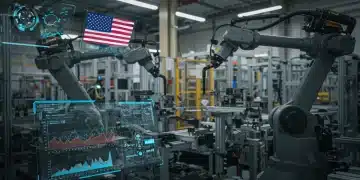
Investment in advanced robotics and automation is accelerating across US manufacturing sectors. Robotics can perform repetitive or dangerous tasks, improving safety and precision, and crucially, reducing reliance on a large, low-cost labor force. This allows US manufacturers to compete more effectively on quality, speed, and customization, rather than solely on price. Collaborative robots (cobots) are also becoming more prevalent, working alongside human employees to augment capabilities and increase productivity, addressing labor shortages in skilled areas.
The adoption of Industry 4.0 technologies, including the Internet of Things (IoT), big data analytics, and cloud computing, is transforming factory floors into smart, interconnected environments. These technologies enable real-time monitoring of production processes, predictive maintenance, and optimized resource allocation, leading to significant gains in efficiency and reductions in waste. Smart factories are more agile and adaptable, capable of quickly reconfiguring production lines to meet changing market demands or geopolitical circumstances.
Additive manufacturing, or 3D printing, is also playing an increasingly vital role. This technology allows for the on-demand production of complex parts and prototypes, reducing reliance on traditional manufacturing processes that often involve long lead times and extensive tooling. For US manufacturing, 3D printing offers the potential for localized production of critical components, reducing supply chain vulnerabilities and fostering greater design flexibility. It is particularly valuable for specialized parts in industries such as aerospace, medical devices, and defense.
The push for domestic innovation extends to materials science and engineering. There is a concerted effort to develop and utilize advanced materials that are lighter, stronger, and more sustainable, reducing reliance on imported exotic materials. Research and development in areas like nanotechnology, advanced composites, and sustainable materials are critical for enhancing the competitiveness and self-reliance of US manufacturing.
Talent and Workforce Development: The Human Element in a Geopolitically Charged Era
Amidst the technological advancements and strategic reorientations driven by US manufacturing geopolitics, the human element remains indispensable. A skilled and adaptable workforce is the bedrock of a resilient manufacturing sector. However, the rapidly changing technological landscape and the demands of advanced manufacturing require a significant evolution in workforce development strategies.
There is a growing emphasis on upskilling and reskilling programs to equip the existing workforce with the competencies needed for Industry 4.0. This includes training in robotics operation and maintenance, data analytics, cybersecurity, and advanced manufacturing processes. Partnerships between manufacturers, educational institutions, and government agencies are crucial for developing curricula that meet the current and future needs of the industry. Apprenticeship programs, in particular, are seeing a resurgence as an effective way to transfer practical skills and build a pipeline of qualified talent.
Attracting new talent into manufacturing is also a priority. The industry is actively working to shed outdated perceptions and showcase itself as a high-tech, innovative, and rewarding career path. Initiatives aimed at promoting STEM education from an early age, particularly for underrepresented groups, are vital for cultivating the next generation of engineers, technicians, and skilled workers. The narrative is shifting towards highlighting manufacturing’s role in national security, technological leadership, and sustainable development, making it an attractive option for those seeking impactful careers.

Furthermore, the geopolitical environment itself underscores the importance of a domestically sourced workforce. Relying less on foreign talent for critical manufacturing roles, especially in sensitive sectors, enhances national security and reduces vulnerabilities related to international travel restrictions or visa complexities. This doesn’t mean isolating; rather, it’s about building a robust domestic talent pool while still welcoming global expertise where it adds significant value.
The ongoing push for diversity, equity, and inclusion within the manufacturing workforce is also gaining momentum. A diverse workforce brings a wider range of perspectives, fosters innovation, and strengthens problem-solving capabilities – all critical attributes for navigating the complexities of US manufacturing geopolitics. Companies are investing in creating inclusive environments that attract and retain talent from all backgrounds, recognizing that a representative workforce is a stronger workforce.
Strategic Partnerships and Alliances: Navigating a Fractured World
In an era defined by US manufacturing geopolitics, no nation or company can operate in isolation. Strategic partnerships and alliances are becoming increasingly vital for navigating a fractured global landscape, ensuring access to critical resources, sharing technological advancements, and collectively mitigating risks.
For US manufacturers, this translates into a renewed focus on strengthening relationships with allies who share similar values and strategic interests. ‘Friend-shoring’ extends beyond simply relocating production; it involves forging deeper collaborations on research and development, standard-setting, and joint ventures. This approach aims to create resilient economic blocs that can collectively withstand geopolitical pressures and protect shared supply chains for critical goods.
Public-private partnerships within the United States are also gaining prominence. Government agencies are increasingly working hand-in-hand with private industry to identify critical vulnerabilities, co-invest in strategic manufacturing capabilities, and develop policies that support domestic production. This collaborative approach is particularly evident in sectors deemed essential for national security, such as semiconductors, pharmaceuticals, and defense. These partnerships help de-risk private investment in areas that might otherwise be deemed too costly or uncertain.
Beyond traditional alliances, manufacturers are exploring innovative partnership models, including cross-industry collaborations. For example, a company specializing in advanced materials might partner with a robotics manufacturer to develop specialized automation solutions, or a software firm might collaborate with a traditional factory to implement AI-driven predictive maintenance. These diverse partnerships foster a more dynamic and adaptive manufacturing ecosystem, capable of responding to evolving geopolitical demands.
Furthermore, the strategic use of trade agreements and diplomatic efforts continues to be a powerful tool in shaping the environment for US manufacturing. While some agreements have faced challenges, the ongoing negotiation and enforcement of fair trade practices, intellectual property protections, and market access provisions are crucial for leveling the playing field and creating stable conditions for international commerce. Diplomacy plays a critical role in de-escalating tensions and fostering cooperation, which directly benefits the stability required for global manufacturing operations.
Regulatory Landscape and Policy Support: A Foundation for Growth
The impact of US manufacturing geopolitics is also profoundly felt in the regulatory landscape and the policy support provided by the government. Recognizing the strategic importance of a robust domestic manufacturing base, policymakers are actively crafting legislation and implementing programs designed to bolster the sector’s resilience and competitiveness.
Key policy initiatives in Q4 2026 are focused on incentivizing reshoring and domestic investment. This includes tax credits for companies that bring manufacturing jobs back to the US, grants for establishing new advanced manufacturing facilities, and subsidies for research and development in critical technologies. The aim is to make domestic production economically viable and attractive, even in sectors where international competition is fierce.
Export controls and import restrictions are being strategically deployed to protect national security interests and prevent the outflow of critical technologies. While these measures can create complexities for businesses, they are viewed as necessary tools to safeguard intellectual property and maintain technological superiority. Manufacturers must navigate these evolving regulations carefully, ensuring compliance while still pursuing global market opportunities.
Investment in infrastructure is another critical area of policy support. Modernizing ports, improving transportation networks, and upgrading energy grids are essential for efficient manufacturing operations. A reliable and cost-effective infrastructure reduces logistical bottlenecks and lowers operational costs, making the US a more attractive location for manufacturing investment. Policies promoting renewable energy sources also contribute to long-term cost stability and environmental sustainability, further enhancing the appeal of domestic production.
Furthermore, regulatory frameworks are being adapted to support the adoption of new technologies and advanced manufacturing processes. This includes developing clear guidelines for AI ethics, data privacy in industrial settings, and the safe integration of robotics. By creating a predictable and supportive regulatory environment, the government aims to foster innovation and accelerate the transition to a more advanced, resilient manufacturing sector.
Conclusion: Charting a Resilient Course for US Manufacturing
The Q4 2026 outlook for US manufacturing is undeniably shaped by a dynamic and often turbulent geopolitical landscape. The era of globalization, as we once knew it, is undergoing a profound transformation, compelling US manufacturers to adapt with agility and foresight. The strategic imperatives are clear: build resilient and diversified supply chains, invest heavily in domestic innovation and automation, cultivate a highly skilled workforce, forge strategic partnerships, and leverage supportive government policies.
The challenges presented by US manufacturing geopolitics are significant, ranging from escalating trade tensions and regional conflicts to technological decoupling and the ongoing quest for critical resource independence. However, these challenges are also catalysts for unprecedented innovation and strategic realignment. US manufacturers are not merely reacting; they are proactively shaping their future, moving towards greater self-sufficiency, enhanced competitiveness, and a more robust industrial base.
As we move deeper into the 21st century, the ability of US manufacturing to thrive will depend on its capacity to integrate geopolitical intelligence into every facet of its strategic planning. This includes continuous risk assessment, flexible operational models, and a commitment to long-term investment in both technology and human capital. By embracing these principles, US manufacturing can not only navigate the complexities of the current global environment but emerge stronger, more innovative, and more resilient than ever before, securing its vital role in both national prosperity and global stability.