College Savings 2026: 529 Plans vs. Tax Credits

The journey towards higher education is an exciting, yet often daunting, prospect for many families. As we look towards college savings 2026, the landscape of financial aid, tuition costs, and savings vehicles continues to evolve. Understanding the best strategies to fund a college education is paramount, and two of the most popular and effective tools are 529 plans and educational tax credits. This comprehensive guide will delve deep into both, offering a comparison and analysis to help you make informed decisions for your family’s future.
The cost of college has been on a steady upward trajectory for decades, making proactive planning more critical than ever. Whether your child is a toddler or already in high school, starting to think about college savings 2026 now can significantly impact the financial burden you’ll face down the line. This article aims to demystify the complexities surrounding college funding, providing actionable insights into how 529 plans and various tax credits can work together to optimize your savings strategy.
Understanding the Basics of College Savings 2026
Before we dive into the specifics of 529 plans and tax credits, it’s essential to grasp the fundamental principles of college savings 2026. The earlier you start, the more time your money has to grow, thanks to the power of compound interest. Even small, consistent contributions can accumulate into a substantial sum over time. However, simply saving isn’t enough; you need to save smart, taking advantage of tax-advantaged accounts and government incentives.
The Rising Cost of Higher Education
It’s no secret that college tuition and associated costs have soared. According to recent reports, the average cost of tuition and fees for the 2023-2024 academic year was over $11,000 for in-state public colleges and nearly $40,000 for private colleges. These figures do not include room, board, books, and other living expenses. Projecting these trends to college savings 2026, it’s clear that families need robust strategies to keep pace.
This escalating cost highlights the urgent need for effective savings vehicles. Without proper planning, many students are left with significant student loan debt, which can impact their financial future for years after graduation. Our goal is to equip you with the knowledge to navigate these challenges successfully.
529 Plans: A Cornerstone of College Savings 2026
When discussing college savings 2026, 529 plans almost always come up first. These state-sponsored investment plans are specifically designed to help families save for future education costs. They offer a powerful combination of tax benefits and flexibility, making them an attractive option for many.
What is a 529 Plan?
A 529 plan is an investment vehicle that allows you to save money for qualified education expenses on a tax-advantaged basis. There are two main types of 529 plans:
- Education Savings Plans: These are the most common type, allowing you to invest in a variety of mutual funds or other investment vehicles. The earnings grow tax-free, and withdrawals for qualified education expenses are also tax-free.
- Prepaid Tuition Plans: These plans allow you to lock in tuition rates at eligible in-state public colleges and universities. They are less common and often have more restrictions than education savings plans.
Key Benefits of 529 Plans for College Savings 2026
- Tax-Free Growth and Withdrawals: This is arguably the biggest advantage. Your investments grow tax-free, and as long as the withdrawals are used for qualified education expenses, they are also tax-free at the federal level. Many states also offer state income tax deductions or credits for contributions.
- Qualified Expenses: What constitutes a ‘qualified education expense’ is broad. It includes tuition, fees, books, supplies, equipment, and even room and board for students enrolled at least half-time. In recent years, the definition has expanded to include K-12 tuition (up to $10,000 per year per beneficiary) and even student loan repayment (up to $10,000 lifetime per beneficiary). This flexibility makes 529 plans incredibly versatile for college savings 2026.
- Owner Control: Unlike some other savings vehicles, the account owner (usually the parent) retains control over the funds. If the beneficiary decides not to attend college, or if there are leftover funds, the beneficiary can be changed to another eligible family member without penalty.
- Financial Aid Impact: Funds in a 529 plan are generally considered an asset of the parent (or account owner) for federal financial aid purposes. This means they have a relatively minor impact on financial aid eligibility compared to assets held directly by the student.
- High Contribution Limits: Most 529 plans have very high lifetime contribution limits, often well into the hundreds of thousands of dollars, allowing for substantial savings for multiple children or even graduate school.
Choosing the Right 529 Plan
With numerous state-sponsored 529 plans available, choosing the right one can feel overwhelming. Here are some factors to consider for your college savings 2026 strategy:
- State Tax Benefits: If your state offers a tax deduction or credit for contributions to its 529 plan, this can be a significant incentive to choose your home state’s plan.
- Investment Options: Look at the range of investment options offered. Do they align with your risk tolerance and investment goals?
- Fees: Compare administrative fees, underlying fund expenses, and other charges. Lower fees mean more of your money goes towards savings.
- Performance: While past performance is not indicative of future results, it’s worth reviewing the historical performance of the plan’s investment options.
- Residency Requirements: Most plans are open to residents of any state, but some may offer additional benefits to in-state residents.
Educational Tax Credits: Boosting Your College Savings 2026
Beyond direct savings vehicles like 529 plans, the U.S. tax code offers several educational tax credits that can significantly reduce your tax liability when paying for college. These credits are particularly valuable because they directly reduce the amount of tax you owe, dollar for dollar, rather than just reducing your taxable income.
American Opportunity Tax Credit (AOTC)
The AOTC is one of the most generous educational tax credits available, especially for the initial years of higher education. For college savings 2026, understanding its parameters is crucial:
- Maximum Credit: Up to $2,500 per eligible student per year.
- Eligibility: Available for the first four years of post-secondary education at an eligible institution. The student must be pursuing a degree or other recognized educational credential and be enrolled at least half-time for at least one academic period beginning in the tax year.
- Qualified Expenses: Includes tuition, fees, and course materials. Room and board are not included.
- Refundability: Up to 40% ($1,000) of the credit is refundable, meaning if the credit reduces your tax liability to $0, you could still receive up to $1,000 back as a refund.
- Income Limitations: The credit is subject to modified adjusted gross income (MAGI) limitations, which can change annually. For 2023, the credit began to phase out for single filers with MAGI over $80,000 ($160,000 for married filing jointly) and was fully phased out at $90,000 ($180,000 for married filing jointly). It’s important to check the latest IRS guidelines for college savings 2026.
Lifetime Learning Credit (LLC)
The LLC is another valuable credit, offering more flexibility in terms of the type of education it covers, though it is less generous than the AOTC.
- Maximum Credit: Up to $2,000 per tax return per year. This is a per-taxpayer credit, not a per-student credit.
- Eligibility: Available for undergraduate, graduate, or professional degree courses, or courses taken to acquire job skills. There is no limit on the number of years it can be claimed, and the student does not need to be pursuing a degree or enrolled at least half-time.
- Qualified Expenses: Includes tuition and fees required for enrollment or attendance. Course materials are generally not included unless they are required to be purchased from the institution.
- Refundability: The LLC is non-refundable, meaning it can reduce your tax liability to $0, but you won’t get any part of it back as a refund.
- Income Limitations: Like the AOTC, the LLC is subject to MAGI limitations, which are typically lower than those for the AOTC. For 2023, the credit began to phase out for single filers with MAGI over $80,000 ($160,000 for married filing jointly) and was fully phased out at $90,000 ($180,000 for married filing jointly). Again, always consult the latest IRS publications for college savings 2026.
Other Potential Tax Benefits
While 529 plans and the AOTC/LLC are the primary focus, other tax benefits can complement your college savings 2026 strategy:
- Student Loan Interest Deduction: If you or your dependent takes out student loans, you may be able to deduct up to $2,500 in student loan interest paid each year. This is an above-the-line deduction, meaning you don’t need to itemize to claim it.
- Tuition and Fees Deduction (Expired/Temporary): This deduction has been a temporary provision and is not always available. It’s crucial to check current tax laws for its applicability in college savings 2026. When available, it allowed taxpayers to deduct up to $4,000 in tuition and fees.
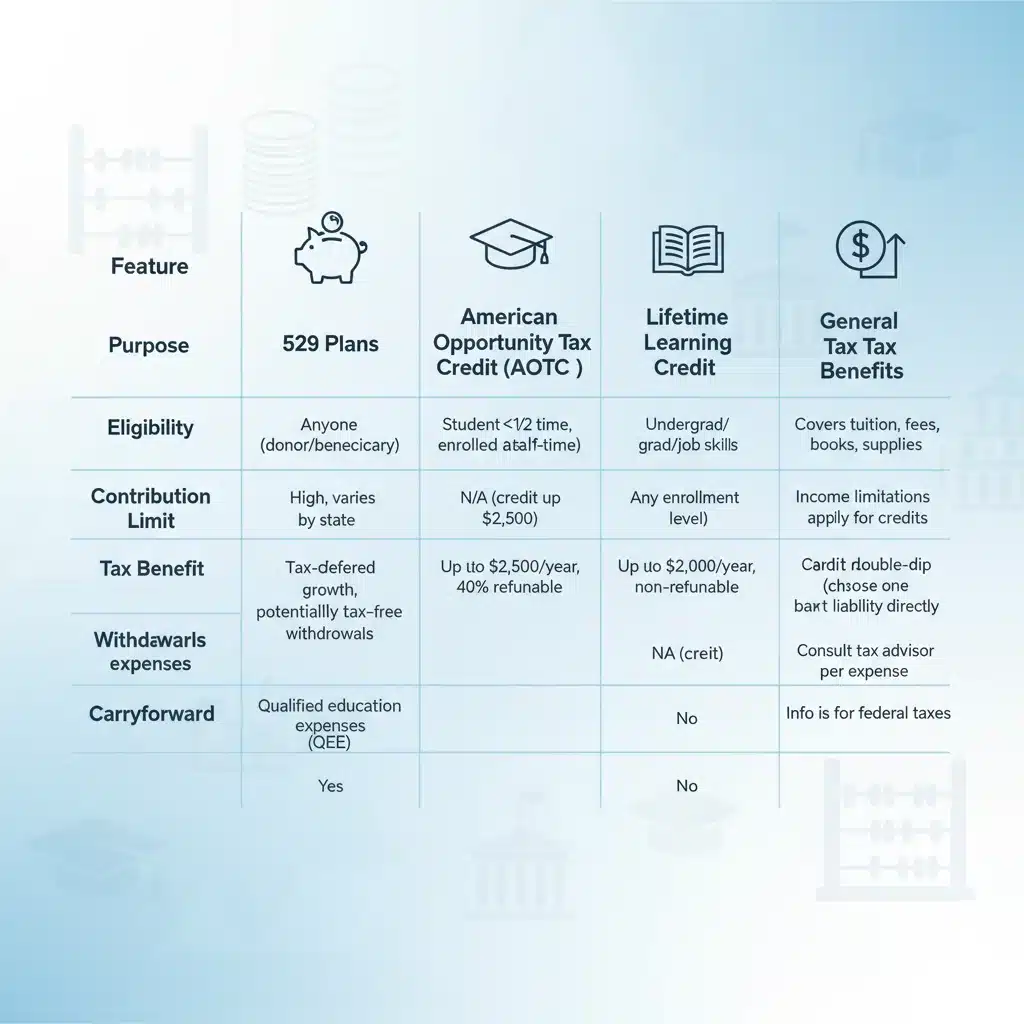
Comparing 529 Plans and Educational Tax Credits for College Savings 2026
Now that we’ve explored both 529 plans and educational tax credits individually, let’s compare them to understand how they fit into a holistic college savings 2026 strategy.
Key Differences and Synergies
- Purpose and Timing:
- 529 Plans: Primarily for saving *before* college, allowing investments to grow over time. The benefits are realized upon withdrawal for qualified expenses.
- Tax Credits: Primarily for *during* college, reducing your tax liability in the year you incur and pay for educational expenses.
- Tax Benefit Type:
- 529 Plans: Tax-free growth and withdrawals for qualified expenses. Some states offer deductions for contributions.
- Tax Credits: Direct dollar-for-dollar reduction of tax liability. AOTC can be partially refundable.
- Qualified Expenses:
- 529 Plans: Broader definition, including tuition, fees, books, supplies, equipment, room & board, and even K-12 tuition/student loan repayment.
- Tax Credits: Generally more restrictive, often limited to tuition and fees. Room and board are typically excluded.
- Income Limitations:
- 529 Plans: Generally no income limitations for contributions or withdrawals, though gift tax rules apply to large contributions.
- Tax Credits: Strict MAGI phase-out limits that can disqualify higher-income earners.
- Impact on Financial Aid:
- 529 Plans: Counted as a parental asset (if owned by parent), having a minimal impact on federal financial aid eligibility.
- Tax Credits: Do not directly impact financial aid eligibility, but receiving certain tax credits might influence the amount of need-based aid you receive indirectly by affecting your overall financial picture.
Can You Use Both?
Yes, absolutely! In fact, using both 529 plans and educational tax credits is often the most effective strategy for college savings 2026. However, you cannot double-dip on the same expenses. For example, if you pay $10,000 in tuition, you cannot use $5,000 from a 529 plan tax-free and then claim an AOTC for the same $5,000. You must allocate the expenses. You can, however, use 529 funds for expenses not covered by a tax credit (like room and board) while simultaneously claiming a tax credit for tuition and fees paid with other funds.
Example Scenario for College Savings 2026:
- A student incurs $15,000 in qualified education expenses: $10,000 for tuition and fees, and $5,000 for room and board.
- The family has a 529 plan and is eligible for the AOTC.
- They could pay the $5,000 for room and board using tax-free 529 withdrawals.
- They could then pay the $10,000 for tuition and fees from other sources (e.g., current income, student’s savings) and claim the AOTC (up to $2,500) on those expenses. This way, both benefits are maximized.
Strategic Planning for College Savings 2026
Developing a robust strategy for college savings 2026 requires careful consideration of your financial situation, income levels, and expected educational costs. Here are some strategic tips:
1. Start Early and Be Consistent
The magic of compound interest is your greatest ally. Even small, regular contributions to a 529 plan can grow significantly over 10-18 years. Automate your contributions to ensure consistency.
2. Understand Your State’s 529 Benefits
Research your state’s 529 plan to see if it offers state income tax deductions or credits for contributions. This can provide an immediate return on your investment. If your state’s plan isn’t competitive, remember you can invest in any state’s 529 plan.
3. Project Future College Costs
Use online college cost calculators to estimate what college might cost when your child is ready to attend. Factor in inflation and potential tuition increases. This will give you a target savings goal for your college savings 2026 plan.
4. Consider Income Levels for Tax Credits
Keep an eye on your MAGI, especially in the years your child will be attending college. If your income is close to the phase-out limits for the AOTC or LLC, strategic financial planning (e.g., maximizing retirement contributions to lower MAGI) might help you qualify for these valuable credits.
5. Coordinate with Other Financial Aid
Understand how 529 plans and tax credits interact with other forms of financial aid, such as scholarships, grants, and federal student loans. Generally, scholarships and grants reduce the amount of qualified education expenses you pay, which can impact the amount of expenses eligible for tax credits. However, 529 plans are usually viewed favorably in the financial aid calculation process.
6. Review and Adjust Annually
Your financial situation, college costs, and tax laws can change. Make it a habit to review your college savings 2026 strategy annually. Adjust contributions, investment allocations within your 529 plan, and re-evaluate your eligibility for tax credits.
Potential Pitfalls and How to Avoid Them
While 529 plans and educational tax credits are powerful tools, there are some common mistakes to avoid:
- Non-Qualified Withdrawals from 529 Plans: If you withdraw money from a 529 plan for non-qualified expenses, the earnings portion of the withdrawal will be subject to income tax and a 10% federal penalty tax (and potentially state taxes/penalties). Be diligent about using funds only for qualified expenses.
- Missing Tax Credit Requirements: Ensure you meet all eligibility criteria for the AOTC or LLC, including enrollment status, degree pursuit, and income limits. Incorrectly claiming a credit can lead to penalties.
- Not Maximizing State Benefits: Some families overlook their state’s 529 plan benefits, potentially missing out on valuable tax deductions or credits.
- Ignoring Investment Risk: While 529 plans offer various investment options, it’s crucial to choose an allocation that aligns with your timeline and risk tolerance. As your student gets closer to college, consider shifting to more conservative investments to protect your capital.
- Failing to Plan for All Expenses: Remember that college costs go beyond just tuition and fees. Factor in room, board, books, travel, and personal expenses when setting your savings goals.

The Future of College Savings: What to Expect for 2026 and Beyond
The landscape of higher education finance is constantly evolving. While 529 plans and current tax credits are likely to remain cornerstones for college savings 2026, it’s wise to stay informed about potential legislative changes. Historically, there have been discussions around expanding 529 plan uses, modifying tax credit structures, or introducing new federal programs.
For instance, the SECURE Act 2.0, passed in late 2022, introduced a significant change allowing unused 529 plan funds to be rolled over to a Roth IRA for the beneficiary, subject to certain conditions. This adds another layer of flexibility and reduces the fear of over-saving in a 529 plan. Such changes underscore the importance of staying updated with financial news and consulting with a financial advisor.
The Role of Financial Advisors
Given the complexities of tax laws, investment options, and financial aid rules, working with a qualified financial advisor can be incredibly beneficial. An advisor specializing in educational planning can help you:
- Assess your current financial situation and future goals for college savings 2026.
- Develop a personalized savings strategy that integrates 529 plans, tax credits, and other financial aid.
- Choose the most appropriate 529 plan and investment options.
- Understand the impact of your savings on financial aid eligibility.
- Navigate tax implications and ensure compliance with IRS rules.
- Adjust your plan as your circumstances or tax laws change.
Conclusion: Optimizing Your College Savings 2026 Strategy
Preparing for the financial demands of higher education in college savings 2026 requires a multi-faceted approach. By strategically utilizing 529 plans for their tax-free growth and broad coverage of expenses, and by leveraging educational tax credits like the AOTC and LLC to reduce your tax burden, families can significantly ease the financial strain of college.
Starting early, understanding the nuances of each tool, and regularly reviewing your plan are key to success. Remember that you can use both 529 plans and tax credits in a coordinated manner, allocating expenses appropriately to maximize the benefits of each. With careful planning and informed decisions, you can build a solid financial foundation that paves the way for a brighter educational future for your loved ones.
Don’t let the rising cost of college deter your dreams. Empower yourself with knowledge, take advantage of the resources available, and start building your robust college savings 2026 plan today. The investment in education is one of the most rewarding, and with the right strategy, it can be an achievable goal for every family.