U.S. Startup Legal Structure: Avoid 2026 Compliance Pitfalls

Optimizing Your U.S. Startup’s Legal Structure for 2026: Avoiding 5 Common Compliance Pitfalls
The journey of a U.S. startup is often characterized by innovation, rapid growth, and the relentless pursuit of market disruption. However, beneath the veneer of groundbreaking ideas and ambitious visions lies a critical, yet often underestimated, foundation: its legal structure. For 2026 and beyond, the legal landscape for startups continues to evolve, presenting both opportunities and significant compliance pitfalls. Choosing and maintaining the optimal startup legal structure is not merely a formality; it is a strategic imperative that dictates everything from personal liability and taxation to fundraising potential and long-term sustainability. Ignoring this crucial aspect can lead to costly legal battles, missed opportunities, and even the premature demise of an otherwise promising venture.
This comprehensive guide delves into the nuances of establishing and maintaining an effective startup legal structure in the U.S., specifically tailored for the challenges and opportunities anticipated in 2026. We will explore the various legal entities available, their advantages and disadvantages, and, most importantly, identify and provide actionable strategies to avoid five of the most common and damaging compliance pitfalls that startups encounter. By understanding these complexities, founders can make informed decisions, protect their assets, attract investors, and build a resilient foundation for future success.
The Critical Role of Your Startup Legal Structure
Before diving into specific pitfalls, it’s essential to grasp why the startup legal structure holds such paramount importance. Your choice of legal entity affects:
- Personal Liability Protection: The extent to which your personal assets are shielded from business debts and lawsuits.
- Taxation: How your business’s profits and losses are taxed, both at the federal and state levels, and the implications for founders and investors.
- Capital Raising: The ease with which you can attract angel investors, venture capitalists, and other forms of funding. Different structures are more appealing to different investor types.
- Administrative Burden: The ongoing compliance requirements, paperwork, and regulatory filings.
- Credibility and Perception: How your business is viewed by customers, partners, and potential employees.
- Future Growth and Exit Strategies: The flexibility to scale, merge, acquire, or be acquired.
The landscape for 2026 suggests increased regulatory scrutiny, particularly in areas like data privacy, cybersecurity, and environmental, social, and governance (ESG) factors. Therefore, selecting a startup legal structure that can adapt to these evolving demands is more vital than ever.
Understanding U.S. Legal Entity Options for Startups
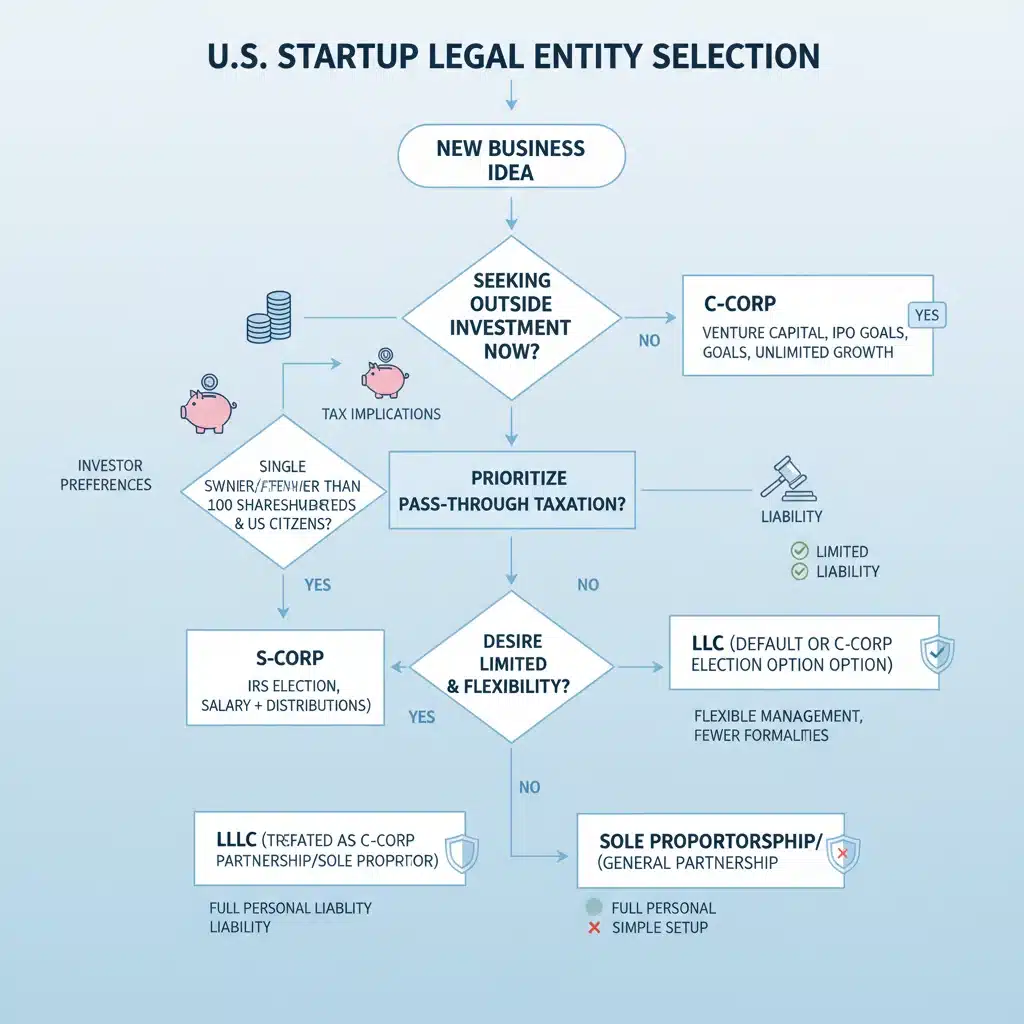
In the U.S., startups primarily choose from a few core legal structures, each with distinct characteristics:
1. Sole Proprietorship
Description: The simplest form, where the business and owner are legally indistinguishable. No formal action is required to form one beyond obtaining necessary local licenses.
Pros: Easy to set up, minimal administrative burden, direct pass-through taxation.
Cons: No liability protection (personal assets are at risk), difficult to raise capital, business dissolves if the owner dies or retires.
When to Consider: Very early-stage, low-risk businesses with minimal capital needs, often as a temporary initial step.
2. Partnership (General, Limited, Limited Liability)
Description: Involves two or more individuals or entities agreeing to share in the profits or losses of a business. General Partnerships (GPs) offer no liability protection for partners, while Limited Partnerships (LPs) and Limited Liability Partnerships (LLPs) offer varying degrees of protection for some or all partners.
Pros: Relatively easy to set up (especially GPs), shared workload and resources, pass-through taxation.
Cons: General partners have unlimited personal liability (in GPs), potential for disputes among partners, can be complex to manage equity and exits.
When to Consider: Businesses with multiple founders who prefer pass-through taxation and have a clear partnership agreement, but often not ideal for high-growth, venture-backed startups.
3. Limited Liability Company (LLC)
Description: A hybrid entity combining the pass-through taxation of a partnership or sole proprietorship with the limited liability of a corporation. Owners are called members.
Pros: Excellent personal liability protection, flexible taxation (can be taxed as a sole proprietorship, partnership, or even a corporation), fewer corporate formalities than a C-Corp.
Cons: Can be less appealing to venture capital investors (who often prefer C-Corps for equity structures), may face self-employment taxes, complex to manage if there are many members.
When to Consider: Many early-stage startups, particularly those not immediately seeking venture capital, or those with a clear path to profitability without external equity funding. Ideal for service-based businesses, real estate, or small businesses.
4. C Corporation (C-Corp)
Description: A separate legal entity from its owners (shareholders). It provides the strongest liability protection and is designed for scalability and attracting external investment.
Pros: Strongest liability protection, unlimited growth potential, ideal for attracting venture capital and angel investors (due to flexible equity structures and ability to issue different classes of stock), potential for public offering, no self-employment taxes for owners on distributions.
Cons: Subject to "double taxation" (corporate profits are taxed, and then dividends to shareholders are taxed again), more complex setup and ongoing compliance (board meetings, shareholder meetings, extensive record-keeping).
When to Consider: Startups seeking venture capital, planning for significant growth, potential IPO, or those with a large number of shareholders.
5. S Corporation (S-Corp)
Description: A special tax election available to eligible C-Corps or LLCs. It allows profits and losses to be passed through directly to the owners’ personal income without being subject to corporate tax rates, thus avoiding double taxation. It still retains the limited liability protection of a corporation.
Pros: Avoids double taxation, maintains limited liability, can allow owners to save on self-employment taxes by taking a reasonable salary and then distributions.
Cons: Strict eligibility requirements (e.g., limited to 100 shareholders, only one class of stock, shareholders must be U.S. citizens or residents), less flexible for certain investment structures, requires more administrative upkeep than an LLC.
When to Consider: Profitable startups that do not anticipate seeking venture capital and want to avoid double taxation while maintaining corporate liability protection, or LLCs that have become profitable and want to optimize tax efficiency.
5 Common Compliance Pitfalls for U.S. Startups in 2026
Even with the right startup legal structure, compliance is an ongoing challenge. Here are five critical pitfalls to avoid:
Pitfall 1: Neglecting Initial Formation Formalities and Ongoing Maintenance
Many founders, eager to launch, rush through the initial legal formation process or, worse, neglect it entirely. This can lead to severe consequences, including loss of personal liability protection and legal challenges down the line.
What it looks like:
- Failing to file Articles of Incorporation (for C-Corps/S-Corps) or Articles of Organization (for LLCs) correctly with the state.
- Not drafting a comprehensive Operating Agreement (for LLCs) or Bylaws (for Corporations) that clearly define ownership, management, voting rights, and dispute resolution.
- Not having proper employment agreements, non-disclosure agreements (NDAs), or intellectual property assignment agreements in place.
- Ignoring annual report filings, state registration renewals, or franchise tax payments.
- Not holding and documenting regular board of directors’ meetings (for Corporations) or member meetings (for LLCs) where significant decisions are made.
- Commingling personal and business funds, which can "pierce the corporate veil" and expose personal assets.
Why it’s a pitfall for 2026: States are increasingly automating compliance checks, and penalties for non-compliance are becoming more stringent. Furthermore, investors conduct thorough due diligence, and a poorly maintained legal structure is a major red flag that can derail funding rounds.
How to avoid it:
- Engage Legal Counsel Early: A qualified business attorney can ensure proper formation and advise on ongoing compliance requirements.
- Create Comprehensive Governing Documents: Invest time in drafting detailed Operating Agreements or Bylaws. These are your company’s constitution.
- Set Up Reminders: Use calendar alerts or compliance software to track filing deadlines for annual reports, tax payments, and other state-specific requirements.
- Maintain Separate Finances: Always keep business and personal finances strictly separate. Open a dedicated business bank account immediately.
- Document Everything: Keep meticulous records of all important business decisions, meetings, and transactions.
Pitfall 2: Misclassifying Workers and Ignoring Employment Laws
As startups grow, they often rely on a mix of employees and independent contractors. Misclassifying workers is a widespread and costly mistake, especially with evolving labor laws.
What it looks like:
- Treating an independent contractor like an employee (e.g., dictating work hours, providing equipment, micromanaging tasks) to avoid payroll taxes and benefits.
- Failing to comply with minimum wage, overtime, and break laws for employees.
- Not having proper employment agreements, non-disclosure agreements (NDAs), or intellectual property assignment agreements in place.
- Ignoring state-specific labor laws regarding sick leave, parental leave, or harassment training.
Why it’s a pitfall for 2026: Regulatory bodies (like the IRS and Department of Labor) are intensifying enforcement on worker classification. Class action lawsuits from misclassified workers are a significant threat, leading to back wages, penalties, and legal fees. The "gig economy" has led to more scrutiny in this area.
How to avoid it:
- Understand Classification Tests: Familiarize yourself with the IRS and state-specific tests for distinguishing employees from independent contractors. When in doubt, err on the side of caution or seek legal advice.
- Draft Clear Agreements: Ensure all contractors have clear independent contractor agreements and all employees have robust employment agreements.
- Stay Updated on Labor Laws: Labor laws are dynamic. Regularly consult legal counsel or HR experts to ensure compliance with federal, state, and local regulations.
- Implement HR Best Practices: Even small startups benefit from basic HR policies regarding hiring, onboarding, performance reviews, and termination.
Pitfall 3: Inadequate Intellectual Property (IP) Protection
A startup’s intellectual property – its innovations, brand, and proprietary information – is often its most valuable asset. Failing to protect it properly can lead to competitors stealing ideas, brand dilution, and loss of competitive advantage.
What it looks like:
- Not filing for patents for novel inventions or processes.
- Failing to register trademarks for your company name, logo, and product names.
- Not having employees and contractors sign IP assignment agreements, ensuring that all work created belongs to the company.
- Disclosing sensitive information without proper Non-Disclosure Agreements (NDAs).
- Failing to implement internal security measures to protect trade secrets.
Why it’s a pitfall for 2026: In a globalized, digital economy, IP theft is rampant. Without proper protection, your core value proposition is vulnerable. Investors scrutinize IP portfolios heavily, as it represents a significant portion of a startup’s valuation.
How to avoid it:
- Conduct IP Audits: Regularly assess what IP your startup generates (inventions, software, designs, brand elements) and prioritize what needs protection.
- File for Patents and Trademarks: Work with IP attorneys to strategically file for patents and register trademarks in relevant jurisdictions.
- Mandate IP Assignment Agreements: Ensure every employee, contractor, and founder signs an agreement assigning all IP created during their tenure to the company.
- Utilize NDAs: Use NDAs when sharing confidential information with third parties, investors, or potential partners.
- Implement Trade Secret Protocols: Limit access to sensitive information, use strong passwords, and educate employees on data security.

Pitfall 4: Non-Compliance with Data Privacy and Cybersecurity Regulations
In an increasingly data-driven world, startups collect, process, and store vast amounts of personal and sensitive information. Neglecting data privacy and cybersecurity compliance can result in massive fines, reputational damage, and loss of customer trust.
What it looks like:
- Failing to have a clear and compliant privacy policy on your website or app.
- Collecting more data than necessary or using it for purposes not disclosed to users.
- Not implementing adequate security measures to protect customer data from breaches.
- Ignoring state-specific privacy laws (e.g., CCPA in California, CPRA for 2023, and emerging laws in other states) or federal regulations (e.g., HIPAA for healthcare, COPPA for children’s data).
- Lack of a data breach response plan.
Why it’s a pitfall for 2026: Data privacy is a global priority. The U.S. is seeing a patchwork of increasingly stringent state laws, and federal legislation is always a possibility. Regulators are actively enforcing these laws, and consumers are more aware and litigious about their data rights. A data breach can be an existential threat to a startup.
How to avoid it:
- Develop a Robust Privacy Policy: Clearly articulate what data you collect, why, how it’s used, and with whom it’s shared. Ensure it’s easily accessible.
- Implement "Privacy by Design": Integrate privacy considerations into your product development and operational processes from the outset.
- Invest in Cybersecurity: Implement strong cybersecurity protocols, including encryption, multi-factor authentication, regular security audits, and employee training.
- Understand Applicable Regulations: Identify which data privacy laws apply to your business based on your target audience and data collection practices.
- Create a Data Breach Response Plan: Have a clear plan in place for how to respond to a data breach, including notification procedures.
Pitfall 5: Unclear Founder Agreements and Equity Vesting Schedules
Many startups begin with an informal handshake among founders. However, without clear agreements, disputes over equity, roles, and responsibilities can quickly escalate, leading to co-founder fallout and business paralysis.
What it looks like:
- No formal founder agreement outlining roles, responsibilities, decision-making processes, and dispute resolution mechanisms.
- Failing to implement an equity vesting schedule, meaning founders receive all their shares upfront. If a founder leaves early, they walk away with a significant portion of the company, potentially de-incentivizing remaining founders and future hires.
- Lack of clarity on intellectual property ownership created before or during the startup’s formation.
- No "buy-sell" provisions for what happens if a founder leaves, becomes disabled, or dies.
Why it’s a pitfall for 2026: Co-founder disputes are a leading cause of startup failure. Investors will demand to see robust founder agreements and vesting schedules, as they want to ensure founders are committed and that equity is fairly distributed and earned over time. A messy founder situation is a major deterrent to investment.
How to avoid it:
- Draft a Comprehensive Founder Agreement: This legally binding document should cover all aspects of the co-founder relationship, including equity splits, roles, decision-making, and exit strategies.
- Implement Equity Vesting: Typically, a 4-year vesting schedule with a 1-year cliff is standard. This means founders earn their equity over time, with the first 25% vesting after one year, and the remainder vesting monthly thereafter.
- Address IP Ownership: Ensure the founder agreement explicitly states that all IP created by founders for the business belongs to the business.
- Plan for Contingencies: Include clauses for what happens if a founder leaves voluntarily, is terminated, or becomes unable to work.
- Seek Legal Review: Have an attorney review the founder agreement to ensure it is legally sound and protects all parties and the company.
Beyond the Pitfalls: Proactive Legal Strategy for 2026
Avoiding these common pitfalls is just the beginning. A truly optimized startup legal structure for 2026 requires a proactive and continuous legal strategy. This includes:
- Regular Legal Audits: Periodically review your legal structure, contracts, and compliance practices to ensure they align with current laws and your business’s evolving needs.
- Staying Ahead of Regulatory Changes: Especially in rapidly evolving sectors, new regulations can emerge quickly. Subscribe to legal newsletters, attend industry seminars, and maintain open communication with your legal counsel.
- Building a Strong Advisory Network: Surround yourself with experienced legal, financial, and business advisors who can provide guidance as your startup scales.
- Considering International Implications: If your startup plans to expand globally, understand the legal and tax implications in other jurisdictions from the outset.
- Ethical AI and Technology Governance: For tech startups, particularly those leveraging AI, understanding and implementing ethical AI principles and responsible data governance will be crucial for public trust and regulatory compliance in 2026.
Conclusion
The success of a U.S. startup in 2026 hinges not only on its innovative product or service but also on the strength and resilience of its legal foundation. By meticulously selecting and maintaining the right startup legal structure and proactively addressing potential compliance pitfalls, founders can significantly mitigate risks, attract necessary capital, and create a sustainable pathway to long-term growth. Don’t view legal compliance as a mere cost center, but rather as an essential investment in your startup’s future. Engage with legal experts early, stay informed, and build your venture on solid legal ground to navigate the complexities of the modern business world successfully.