Navigating 2026 Startup Funding: 3 Key Changes for Seed Rounds in the U.S.

Navigating the 2026 Startup Funding Landscape in the U.S.: 3 Key Changes to Secure Your Seed Round
The year 2026 is rapidly approaching, and for founders seeking seed-stage capital in the United States, understanding the evolving landscape of startup funding 2026 is not just advantageous, but critical. The venture capital world is dynamic, influenced by macroeconomic shifts, technological breakthroughs, and regulatory adjustments. For startups aiming to secure their crucial seed round, being prepared for these changes will be the differentiator between securing investment and struggling to gain traction.
Gone are the days when a compelling pitch deck and a solid team were sufficient. While these remain foundational, the context in which they are presented and evaluated is undergoing significant transformation. This comprehensive guide will delve into three pivotal changes anticipated in the U.S. startup funding 2026 landscape, offering actionable insights for founders to strategically position themselves for success.
The stakes are high. Seed funding is the lifeblood for early-stage companies, enabling them to build out their product, scale their team, and achieve critical milestones. Missing the mark on understanding investor sentiment, regulatory nuances, or technological imperatives could prove fatal. Therefore, a deep dive into what 2026 holds is not just prudent, but essential for any ambitious entrepreneur.
1. Evolving Investor Priorities: Beyond Hypergrowth at All Costs
One of the most significant shifts impacting startup funding 2026 will be the continued evolution of investor priorities. The ‘grow at all costs’ mentality that characterized much of the 2010s and early 2020s is giving way to a more nuanced approach. Venture capitalists (VCs) are increasingly scrutinizing unit economics, profitability pathways, and sustainable business models, even at the seed stage.
Focus on Sustainable Growth and Profitability
In the past, VCs often overlooked early profitability in favor of rapid user acquisition or market share dominance. While growth remains important, the narrative has shifted. Founders seeking seed rounds in 2026 will need to articulate a clear path to sustainable growth, demonstrating not just potential, but also a realistic understanding of operational efficiency and capital allocation. This means having a strong grasp of your customer acquisition costs (CAC), lifetime value (LTV), and burn rate. Investors are looking for evidence that a startup can achieve significant milestones without an endlessly increasing capital injection.
This doesn’t mean profitability is expected at the seed stage, but a credible roadmap towards it is. Presenting a well-thought-out financial model that projects future revenue streams, cost structures, and a clear path to positive cash flow will be paramount. Startups that can demonstrate early signs of product-market fit coupled with a disciplined approach to spending will stand out.
The Rise of Impact and ESG Considerations
Environmental, Social, and Governance (ESG) factors are no longer just buzzwords; they are becoming integral to investment decisions. While more pronounced in later-stage funding, ESG considerations are trickling down to seed rounds. VCs are increasingly aware of their portfolio’s broader impact and are seeking companies that align with sustainable and ethical practices. This includes everything from a diverse and inclusive founding team to environmentally conscious product development or supply chains.
Founders should be prepared to articulate their company’s positive impact, even if it’s not their primary mission. How does your product or service contribute to a better society? What are your internal policies regarding diversity and inclusion? These questions, once secondary, are now becoming central to investor due diligence for startup funding 2026. Integrating ESG principles into your business model from the outset can serve as a significant competitive advantage.
Sector-Specific Deep Dives and Specialization
The days of generalist VCs writing checks across a broad spectrum of industries are waning. The 2026 landscape will see even greater specialization among venture capital firms. Many firms are honing in on specific sectors such as AI, climate tech, biotech, fintech, or SaaS, developing deep expertise and networks within those niches. This means founders need to meticulously research which VCs are truly aligned with their industry and technological approach.
Approaching a VC firm that specializes in climate tech with a pure SaaS product (unless it has a strong climate tech angle) is likely to be a wasted effort. Tailoring your pitch to the specific interests and investment thesis of a specialized firm will significantly increase your chances of securing a seed round. This requires more targeted outreach and a deeper understanding of the VC’s portfolio and investment criteria.
2. Regulatory Shifts and Compliance Demands
The regulatory environment for startups and investors is becoming increasingly complex, a trend that will undoubtedly continue to shape startup funding 2026. From data privacy to artificial intelligence governance, new rules and expectations are emerging, requiring startups to be proactive about compliance.
Increased Scrutiny on Data Privacy and Security
With regulations like GDPR and CCPA setting precedents, and new state-level and potentially federal data privacy laws on the horizon, startups handling personal data will face heightened scrutiny. VCs are becoming more cautious about investing in companies that pose significant regulatory risks due to lax data practices. A data breach or non-compliance can lead to hefty fines and reputational damage, directly impacting a startup’s valuation and viability.
Founders must demonstrate a robust approach to data privacy and security from day one. This includes implementing strong data protection protocols, understanding consent mechanisms, and being transparent about data usage. Having a clear data governance strategy will become a non-negotiable for seed-stage investors. This might involve hiring a fractional data privacy officer or consulting with legal experts early on to build a compliant infrastructure.
Emerging AI Regulations and Ethical AI Frameworks
As artificial intelligence permeates every industry, governments globally are grappling with how to regulate its development and deployment. The U.S. is no exception. While comprehensive federal AI legislation might still be a few years away, discussions around ethical AI, bias detection, transparency, and accountability are already influencing investor thinking. Startups leveraging AI will need to consider these ethical implications and potential regulatory hurdles.
VCs will increasingly favor AI startups that can articulate a commitment to ethical AI development, demonstrating how they address potential biases in their algorithms, ensure transparency in decision-making, and prioritize user safety and privacy. Founders should be prepared to discuss their AI ethics framework, even if nascent, as it will be a key differentiator in attracting startup funding 2026 in the AI space.
Impact of Securities Regulations on Fundraising
While seed rounds typically fall under exemptions like Regulation D (Rule 506(b) or 506(c)), the broader regulatory environment for private markets is always subject to change. Potential adjustments to accredited investor definitions, reporting requirements, or even new frameworks for tokenized securities could impact how startups raise capital. Staying abreast of these developments, potentially through legal counsel, is crucial.
Founders should work closely with legal advisors to ensure their fundraising efforts are fully compliant with current and anticipated securities laws. Any misstep in this area can lead to significant legal challenges and scare off potential investors. Transparency and meticulous record-keeping around investor communications and offering documents will be more important than ever.
3. Technological Advancements Driving New Investment Theses
Technology is always a primary driver of venture capital investment, and 2026 will be no different. However, the specific technologies attracting significant seed funding are continually evolving. Founders must identify these emerging sectors and articulate how their solutions leverage these advancements to create defensible competitive advantages.
The Continued Dominance and Evolution of AI/ML
Artificial Intelligence and Machine Learning will remain at the forefront of technological innovation and investment for startup funding 2026. However, the focus will shift from foundational AI research to applications that solve specific, high-value problems across various industries. Expect increased investment in specialized AI models, AI-powered automation, predictive analytics, and ethical AI solutions.
Founders building AI-driven products will need to demonstrate not just technical prowess, but also a clear understanding of the market need they are addressing, the economic impact of their solution, and how they plan to differentiate themselves in an increasingly crowded AI landscape. Simply stating ‘we use AI’ will not be enough; investors will demand to know ‘how’ and ‘why’ your AI solution is superior and creates tangible value.
Web3, Blockchain, and Decentralized Technologies Maturation
While the initial hype cycle around Web3 and blockchain has somewhat cooled, the underlying technologies are maturing and finding real-world applications. Expect seed funding in 2026 to target Web3 projects that offer genuine utility, solve existing problems more efficiently, or create entirely new markets with decentralized frameworks. This includes decentralized finance (DeFi) infrastructure, enterprise blockchain solutions, verifiable digital identity, and new forms of digital ownership (beyond speculative NFTs).
Investors will be looking for startups that move beyond theoretical concepts to demonstrate tangible products, user adoption, and a clear business model. Understanding the regulatory landscape around digital assets and offering a compliant solution will also be crucial for securing investment in this space.

Sustainability Tech (Climate Tech and Greentech) on the Rise
The urgency of climate change and the global push towards sustainability are fueling massive investment into climate tech and greentech startups. This sector encompasses a broad range of innovations, from renewable energy and energy storage to sustainable agriculture, carbon capture, water management, and circular economy solutions. VCs are increasingly allocating capital to companies addressing these critical global challenges.
Founders in this space need to not only demonstrate technological innovation but also a clear understanding of market dynamics, policy incentives, and scalability. The potential for both financial returns and positive environmental impact makes this a highly attractive area for startup funding 2026. Articulating the dual benefit – profit and planet – will be a powerful narrative for investors.
Advanced Computing and Frontier Technologies
Beyond AI, other frontier technologies like quantum computing, advanced robotics, synthetic biology, and new materials science are slowly but surely moving from research labs to commercialization. While often requiring longer development cycles and larger capital outlays, seed investors are increasingly looking for early opportunities in these high-potential, high-risk areas. These investments are often driven by a vision of fundamentally transforming industries.
For founders in these highly technical fields, demonstrating strong scientific backing, a clear intellectual property strategy, and a roadmap for commercialization will be essential. Building a team with deep expertise and a compelling long-term vision will be critical to attracting seed capital in these nascent but transformative sectors.
Preparing Your Startup for 2026 Seed Funding Success
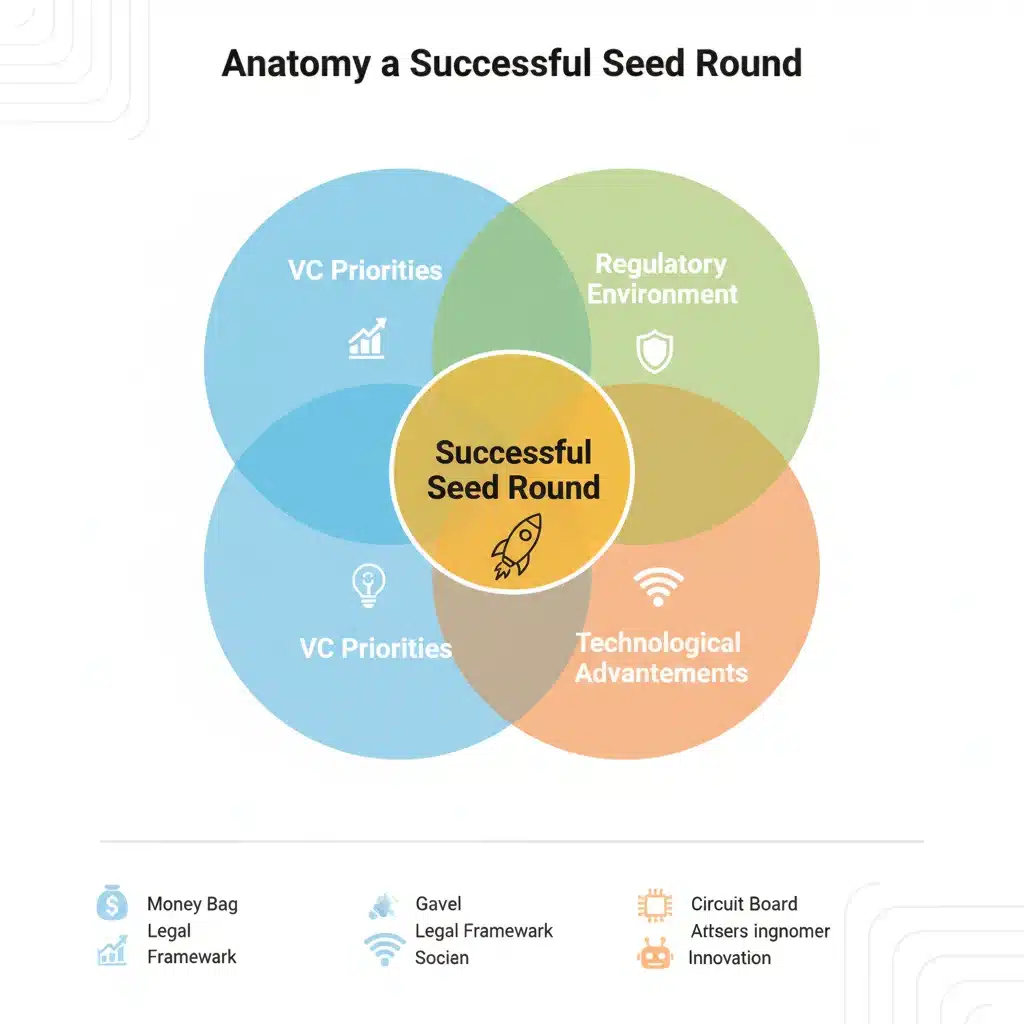
Given these three major shifts – evolving investor priorities, regulatory demands, and technological advancements – how can founders best prepare their startups for securing seed funding in 2026? It boils down to a strategic and holistic approach.
Refine Your Business Model for Sustainability
Move beyond simply projecting growth. Develop a business model that emphasizes sustainable unit economics, a clear path to profitability (even if long-term), and efficient capital utilization. Show investors you understand how to build a resilient company, not just a fast-growing one. This includes a deep understanding of your market, your competitive advantage, and a realistic go-to-market strategy.
Embrace Proactive Compliance and Ethical Frameworks
Integrate data privacy, security, and ethical considerations into your product development and operational processes from day one. For AI-driven startups, develop an ethical AI framework. For all startups, understand the regulatory landscape relevant to your industry and ensure your operations are compliant. This proactive stance will mitigate risks and build investor confidence.
Align with Emerging Technological Investment Theses
Understand which technological sectors are attracting the most significant seed funding. If your startup operates in one of these areas (like specialized AI, impactful Web3, or climate tech), clearly articulate how you are leveraging these advancements. If not, demonstrate how your technology creates a unique and defensible position in your chosen market. Your tech should solve a real problem, not just be a cool idea.
Build a Diverse and Resilient Team
Investors are increasingly looking at team composition. A diverse team – in terms of background, gender, ethnicity, and thought – is often seen as more innovative, resilient, and better equipped to navigate complex challenges. Highlight your team’s strengths, relevant experience, and shared vision. A strong, cohesive team remains a cornerstone of any successful seed round.
Develop a Robust Narrative and Data-Driven Pitch
Your pitch needs to tell a compelling story, but it must be backed by solid data. Demonstrate product-market fit with early metrics (even if small), customer testimonials, or pilot program results. Clearly articulate the problem you’re solving, your unique solution, your market opportunity, and your competitive differentiation. Be prepared to answer tough questions about your financials, your strategy, and your long-term vision.
Conclusion: The Future of Seed Funding is Strategic and Impactful
The startup funding 2026 landscape in the U.S. is poised for significant evolution. The days of simply chasing vanity metrics are giving way to a more mature and discerning investment environment. Founders who prioritize sustainable growth, proactive regulatory compliance, and strategic alignment with cutting-edge technological trends will be best positioned to secure their seed rounds.
Success in 2026 will not just be about having a great idea, but about demonstrating a thoughtful, resilient, and impactful approach to building a company. By understanding and adapting to these three key changes – evolving investor priorities, regulatory shifts, and technological advancements – entrepreneurs can confidently navigate the complexities of early-stage fundraising and lay a strong foundation for future growth. The future of innovation depends on it.