Pre-Seed Strategies 2026: Secure $500K in 6 Months

Embarking on the entrepreneurial journey in 2026 requires more than just a groundbreaking idea; it demands a meticulously crafted plan to secure initial capital. This guide delves into critical pre-seed strategies for 2026, offering actionable insights for securing your first $500,000 in just six months.
Understanding the 2026 Pre-Seed Landscape
The pre-seed funding environment in 2026 is characterized by rapid technological advancements and a heightened focus on sustainable, impactful solutions. Investors are increasingly looking beyond mere innovation to evaluate a startup’s potential for long-term market disruption and robust unit economics from the outset. This shift necessitates a more polished approach to early-stage fundraising.
Founders must recognize that the bar for entry has been raised. Gone are the days when a nascent idea on a napkin could easily attract significant capital. Today, evidence of market validation, a clear problem-solution fit, and a foundational team are paramount. Understanding these nuances is the first step toward tailoring your strategy for success.
The Evolving Investor Mindset
In 2026, pre-seed investors are more sophisticated and data-driven than ever. They seek clear indicators of product-market fit potential, often through early user feedback or pilot program results. Furthermore, environmental, social, and governance (ESG) factors are playing an increasingly significant role in investment decisions, even at the earliest stages.
- Impact-driven Investment: Investors prioritize startups addressing significant societal or environmental challenges.
- Data-backed Hypotheses: Qualitative and quantitative data supporting market demand are crucial.
- Team Resilience: A strong, adaptable founding team with diverse skill sets is highly valued.
Navigating this landscape requires founders to anticipate investor concerns and proactively address them in their pitch and business model. Demonstrating a clear vision for scalability and a pathway to profitability, even if distant, will set you apart.
Phase 1: Foundation and Validation (Months 1-2)
The initial two months are critical for building a solid foundation and rigorously validating your core assumptions. This phase is not about building a perfect product, but about proving that your solution addresses a real, pressing need for a defined target audience. Skipping this step often leads to wasted resources and investor skepticism.
Effective validation involves direct engagement with potential customers, competitive analysis, and a clear articulation of your unique value proposition. This groundwork informs every subsequent step in your fundraising journey and significantly strengthens your appeal to pre-seed investors.
Deep Market Research and Problem-Solution Fit
Before writing a single line of code or designing a complex interface, immerse yourself in understanding your market. Identify the precise pain points your target customers experience and how your proposed solution uniquely alleviates them. This isn’t just about surveys; it’s about in-depth interviews and observational studies.
- Customer Interviews: Conduct at least 50 qualitative interviews with your ideal users.
- Competitive Analysis: Understand existing solutions and identify your differentiation.
- Market Sizing: Quantify the total addressable market (TAM), serviceable available market (SAM), and serviceable obtainable market (SOM).
The goal is to emerge from this period with undeniable evidence that a problem exists, that people care about it, and that your solution has the potential to be adopted. This data forms the bedrock of your pre-seed pitch.
Minimum Viable Product (MVP) Development and Testing
With validation in hand, focus on creating an MVP that demonstrates your core value proposition without unnecessary features. The MVP should be functional enough to solicit meaningful feedback and ideally, attract early adopters. This rapid iteration process is key to refining your offering.
The MVP doesn’t need to be flawless; it needs to be effective in illustrating your solution’s potential. Gather feedback systematically, analyze usage patterns, and be prepared to pivot or iterate based on what you learn. This agile approach showcases your ability to respond to market demands.
Phase 2: Strategic Positioning and Pitch Preparation (Months 3-4)
Once your foundation is solid, the next two months are dedicated to packaging your startup into an attractive proposition for investors. This involves crafting a compelling narrative, developing a robust financial model, and creating a pitch deck that resonates with the 2026 investor mindset. Your story must be clear, concise, and inspiring.
This phase also involves identifying potential investors whose portfolios align with your industry and stage. Personalizing your outreach and understanding their investment theses will significantly increase your chances of securing meetings.
Crafting Your Compelling Narrative and Pitch Deck
Your pitch deck is your startup’s resume. It needs to be visually appealing, data-rich, and tell a compelling story. In 2026, investors expect a professional, concise pitch that highlights not just the what, but the why and the how of your business. Focus on problem, solution, market, team, traction, and ask.
- Problem & Solution: Clearly articulate the pain point and your unique fix.
- Market Opportunity: Present a clear, well-researched market size.
- Team: Highlight the experience and complementary skills of your founders.
- Traction & Milestones: Showcase early wins, user growth, or pilot results.
- Financial Projections: Provide realistic, data-backed projections for the next 3-5 years.
Practice your pitch relentlessly, seeking feedback from mentors and advisors. Your ability to articulate your vision with confidence and clarity is as important as the content itself.
Developing a Realistic Financial Model
A strong financial model is non-negotiable. It should project revenue, expenses, and cash flow for at least the next three to five years, demonstrating a clear path to profitability. Investors will scrutinize your assumptions, so ensure they are well-researched and defensible.
Focus on key metrics relevant to your business model, such as customer acquisition cost (CAC), lifetime value (LTV), and churn rate. Transparency in your assumptions and a willingness to discuss the underlying drivers of your projections will build trust with potential investors.
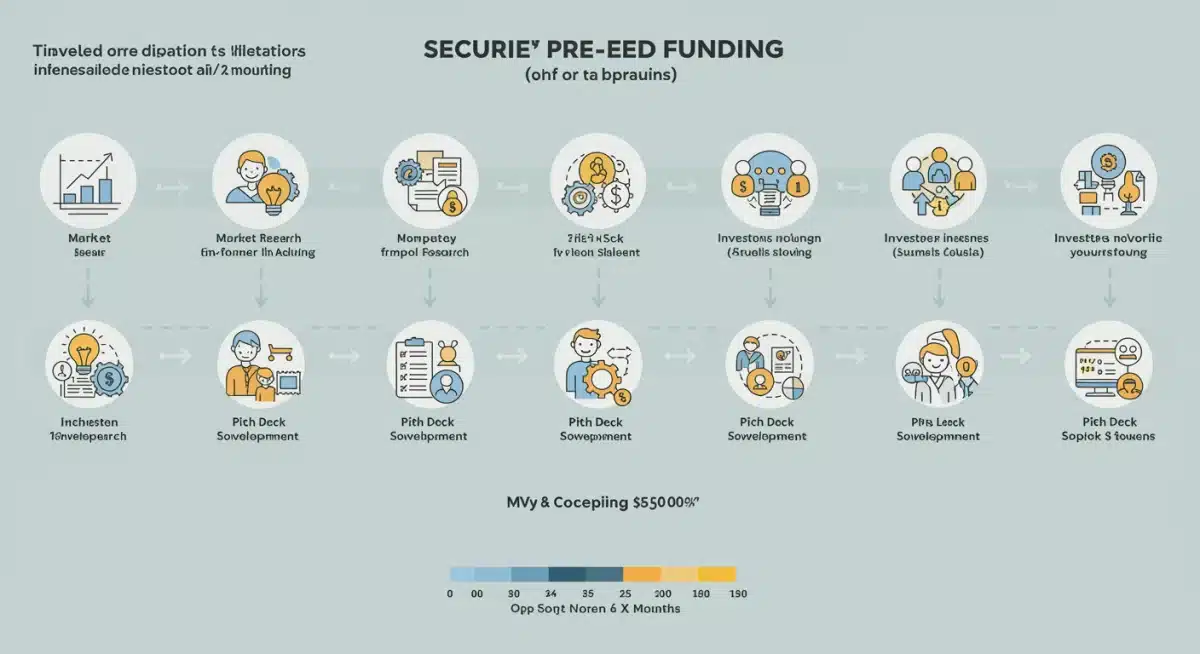
Phase 3: Investor Outreach and Engagement (Months 5-6)
With your pitch deck, financial model, and validated MVP in hand, the final two months are dedicated to active investor outreach. This is a numbers game, but it’s also about quality over quantity. Target investors who are genuinely interested in your sector and stage, and personalize every interaction.
Networking is paramount. Leverage your existing connections, attend relevant industry events, and seek introductions from mutual contacts. A warm introduction is always more effective than a cold email.
Targeting the Right Investors
Not all pre-seed investors are created equal. Research angel investors, venture capitalists (VCs), and accelerators that have a track record of investing in companies similar to yours. Look at their past investments, their typical check size, and their geographic focus. This targeted approach saves valuable time and increases your conversion rate.
- Angel Investors: Often provide capital and mentorship, ideal for early stages.
- Micro VCs: Specialized funds focusing on pre-seed and seed rounds.
- Accelerators: Offer funding, mentorship, and structured programs in exchange for equity.
Understanding an investor’s thesis and portfolio companies allows you to tailor your pitch to their specific interests, demonstrating why your startup is a perfect fit for their investment strategy.
Mastering the Art of the Pitch Meeting
Every pitch meeting is an opportunity to sell your vision. Be prepared to answer tough questions, demonstrate your passion, and show a deep understanding of your market. Listen actively to investor feedback, even if it’s critical, as it can provide valuable insights for refining your approach.
Follow up promptly and professionally after each meeting. Provide any requested information quickly and keep investors updated on your progress. Building relationships, even with those who don’t invest immediately, can prove beneficial in the long run.
Legal & Due Diligence Readiness
As you approach potential funding, ensuring your legal framework is robust and ready for due diligence is crucial. This includes proper incorporation, intellectual property protection, and clear agreements with co-founders and early employees. Neglecting these aspects can significantly delay or even derail a funding round.
Having all your legal documents in order demonstrates professionalism and minimizes risk for investors. Proactive preparation in this area will streamline the closing process once interest is secured.
Essential Legal Preparations
Before engaging with investors, incorporate your company correctly, ideally as a C-Corp if you plan on raising venture capital. Secure all intellectual property (IP), including patents, trademarks, and copyrights. Ensure co-founder agreements clearly outline equity distribution, roles, and responsibilities.
- Incorporation: Choose the right legal entity for your startup.
- IP Protection: File necessary patents, trademarks, and copyrights.
- Founders’ Agreements: Document equity splits, vesting schedules, and roles.
Consult with legal counsel specializing in startup law to ensure compliance and protect your interests. This investment upfront will save considerable headaches down the line.
Preparing for Due Diligence
Once an investor expresses serious interest, they will conduct due diligence. This involves a thorough review of your financials, legal documents, team background, and market analysis. Organize all relevant documents in a secure, accessible data room.
Be transparent and responsive during this process. Any red flags or inconsistencies can lead to a loss of trust or a reduction in valuation. A well-prepared data room signifies your professionalism and readiness for investment.
Post-Funding: Strategic Growth and Milestone Achievement
Securing pre-seed funding is not the finish line; it’s the starting gun. The next six months post-funding are equally critical for demonstrating progress and setting the stage for future rounds. This involves meticulous execution of your business plan, hitting key milestones, and maintaining transparent communication with your new investors.
Focus on using the capital efficiently to accelerate product development, acquire early customers, and build out your team. Every dollar spent should align with your strategic objectives and contribute to tangible growth.
Executing Your Business Plan and Milestones
Immediately after funding, activate your detailed business plan. Prioritize key milestones that demonstrate substantial progress towards product-market fit and scalability. These milestones should be measurable and aligned with the projections you presented to investors.
Regularly track your progress against these milestones and be prepared to adjust your strategy as new information emerges. Agility and responsiveness are crucial in the fast-paced startup environment.
Building and Scaling Your Team
With capital secured, strategically hire key talent to support your growth. Focus on individuals who not only possess the necessary skills but also align with your company culture and vision. A strong team is a significant asset that will drive your startup forward.
Invest in building a cohesive and motivated team. Provide clear roles, responsibilities, and growth opportunities. A positive and productive work environment is essential for retaining talent and achieving ambitious goals.
| Key Strategy | Brief Description |
|---|---|
| Market Validation | Rigorous testing of problem-solution fit with target customers before significant development. |
| Compelling Pitch Deck | A concise, data-backed narrative highlighting market opportunity, team, and traction. |
| Targeted Investor Outreach | Focusing on investors whose portfolio and thesis align with your startup’s sector and stage. |
| Legal Readiness | Ensuring all legal documents and IP protections are in order for smooth due diligence. |
Frequently Asked Questions About Pre-Seed Funding
While variable, a focused strategy can secure pre-seed funding within 3 to 6 months. This timeline assumes thorough preparation, including market validation, MVP development, and a polished pitch deck, before engaging with investors. Efficiency in execution is key to meeting these aggressive timelines.
In 2026, investors prioritize a strong founding team, clear evidence of market validation (even if pre-revenue), a defensible solution to a significant problem, and a realistic path to scalability. Increasingly, they also consider the startup’s potential for positive societal or environmental impact.
An MVP (Minimum Viable Product) is crucial for pre-seed funding. It demonstrates your ability to execute, provides tangible proof of your solution, and allows for early user feedback. It doesn’t need to be perfect, but it must showcase your core value proposition effectively to potential investors.
Common mistakes include lacking thorough market validation, having an incomplete or unconvincing team, presenting unrealistic financial projections, failing to protect intellectual property, and approaching investors who are not a good fit for your startup’s stage or industry. Preparation is key to avoiding these pitfalls.
Differentiation comes from a unique problem-solution approach, a deeply understood niche, proprietary technology, strong initial traction, and a compelling team story. Clearly articulate your unique value proposition and demonstrate why your team is uniquely positioned to succeed in your chosen market.
Conclusion
Securing your first $500,000 in pre-seed funding within six months in 2026 is an ambitious yet achievable goal with the right strategy. It demands meticulous preparation, from rigorous market validation and MVP development to crafting a compelling narrative and engaging strategically with investors. By focusing on a strong foundation, clear communication, and continuous adaptation, founders can navigate the evolving investment landscape and set their startups on a trajectory for long-term success. The journey is challenging, but with a disciplined approach to these pre-seed strategies, your vision can become a funded reality.