Fed Rates & Bitcoin in 2026: A 3-Month Price Forecast
The Federal Reserve’s interest rate decisions significantly influence Bitcoin’s price by altering market liquidity and investor risk appetite, with a 3-month forecast for 2026 suggesting continued sensitivity to monetary policy shifts.
Understanding the Impact of Fed Interest Rate Decisions on Bitcoin’s Price in 2026: A 3-Month Forecast is crucial for any cryptocurrency investor. As the global financial landscape continues to evolve, the Federal Reserve’s monetary policy plays an increasingly significant role in shaping asset valuations, including the volatile realm of digital currencies. This article will delve into the intricate connections between central bank actions and Bitcoin’s future trajectory, offering insights for the coming months.
The Fed’s Monetary Policy and Crypto Markets
The Federal Reserve, as the central bank of the United States, wields immense power over global financial markets through its monetary policy decisions. These decisions, primarily concerning interest rates and quantitative easing or tightening, directly affect the cost of borrowing and the overall availability of capital. In turn, these factors influence investor behavior, particularly their appetite for riskier assets like Bitcoin.
When the Fed raises interest rates, it typically signals a tightening of monetary conditions. This makes traditional, less volatile investments, such as government bonds, more attractive, as they offer higher yields. Consequently, capital tends to flow out of risk-on assets, which often include cryptocurrencies. Conversely, lower interest rates or quantitative easing tend to inject liquidity into the financial system, making riskier assets more appealing as investors seek higher returns in a low-yield environment.
Historical Correlations and Bitcoin’s Sensitivity
Historically, Bitcoin has shown a notable, albeit sometimes complex, correlation with broader macroeconomic trends and the Fed’s policy shifts. During periods of aggressive rate hikes, Bitcoin has often faced downward pressure. For instance, the tightening cycles seen in previous years led to significant corrections in the crypto market. While Bitcoin is often touted as a hedge against inflation or traditional financial systems, its price performance has frequently mirrored that of growth stocks and other speculative assets, which are particularly sensitive to interest rate changes.
- Rate Hikes: Tend to reduce market liquidity and investor risk appetite, often leading to Bitcoin price declines.
- Rate Cuts/Quantitative Easing: Typically increase liquidity and encourage risk-taking, potentially boosting Bitcoin’s value.
- Inflation Control: The Fed’s primary mandate to control inflation often dictates the pace and direction of interest rate adjustments.
The market’s reaction is not always immediate or linear. Expectations of future Fed actions can often be priced into the market well in advance, leading to pre-emptive movements in Bitcoin’s price. Understanding these nuances is key to forecasting its short-term performance.
In essence, the Fed’s stance on monetary policy acts as a significant gravitational force on Bitcoin. Its decisions on interest rates directly influence the availability and cost of capital, thereby shaping the investment landscape and investor preferences for assets across the risk spectrum, including digital currencies.
Analyzing Recent Fed Updates in 2026
As we navigate 2026, the Federal Reserve’s recent communications have been under intense scrutiny by financial markets worldwide. The central bank’s primary focus remains on achieving its dual mandate of maximum employment and price stability. Recent inflation data, employment figures, and global economic conditions are the key drivers behind the Fed’s current policy trajectory.
In its most recent meetings, the Federal Open Market Committee (FOMC) has provided updated projections for economic growth, inflation, and unemployment. These projections, coupled with the Fed Chair’s statements, offer crucial insights into the likely path of interest rates over the next few months. Market participants are keenly dissecting every word to anticipate whether the Fed will maintain, raise, or lower its benchmark federal funds rate.
Key Economic Indicators Influencing Fed Decisions
Several economic indicators are particularly influential in shaping the Fed’s decisions:
- Inflation Data: The Consumer Price Index (CPI) and Personal Consumption Expenditures (PCE) index are closely watched for signs of persistent or easing inflationary pressures.
- Employment Reports: Non-farm payrolls, unemployment rates, and wage growth figures provide a snapshot of the labor market’s health.
- GDP Growth: Gross Domestic Product reports indicate the overall health and momentum of the economy.
Recent updates suggest a nuanced approach from the Fed. While inflation has shown some signs of moderation, it may not yet be consistently at the Fed’s target level of 2%. Similarly, the labor market, while robust, might be showing early indicators of cooling. This delicate balance means the Fed is likely to remain data-dependent, adjusting its policy as new economic information becomes available.
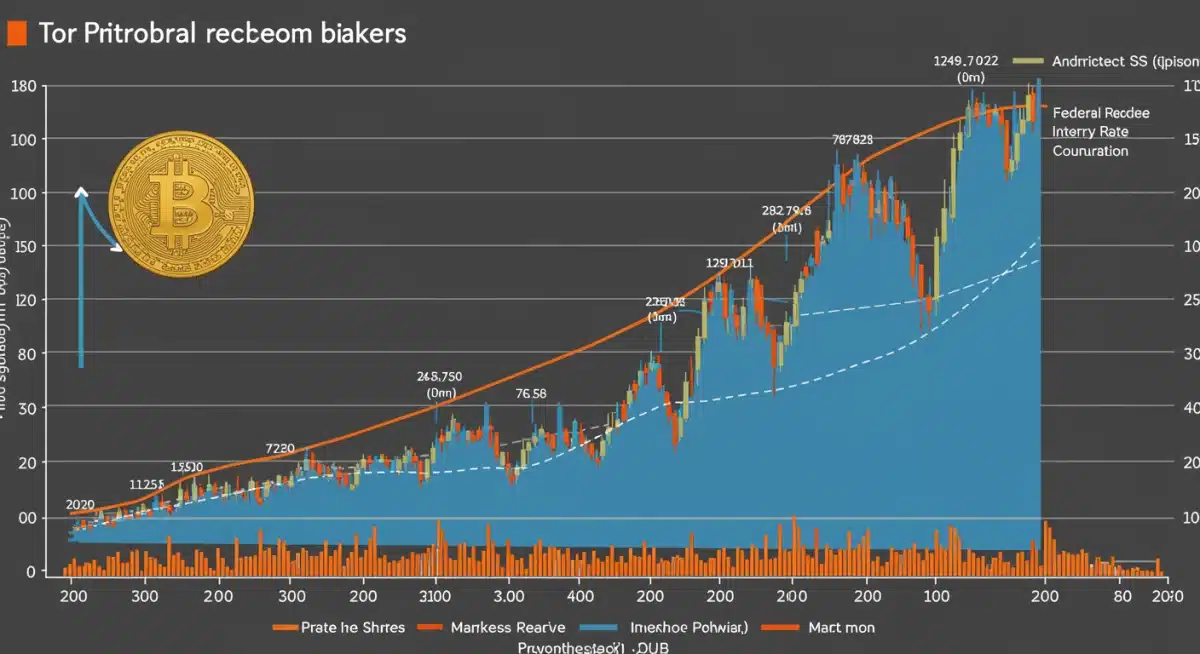

The market has largely priced in certain expectations for the Fed’s next few moves. Any deviation from these expectations, either more hawkish (aggressive rate hikes) or more dovish (rate cuts or accommodative policy), could trigger significant volatility across all asset classes, including Bitcoin. Therefore, staying informed about the Fed’s latest pronouncements is paramount for investors.
The Fed’s recent updates in 2026 underscore a cautious, data-driven approach. Their communications reflect an ongoing effort to balance inflation control with economic stability, making the next few months critical for understanding the immediate future of interest rates and their subsequent impact on Bitcoin.
Bitcoin’s Price Behavior Under Different Rate Scenarios
Bitcoin’s price behavior is highly sensitive to the prevailing interest rate environment. Different scenarios regarding the Federal Reserve’s interest rate decisions can lead to distinct outcomes for the leading cryptocurrency. Understanding these potential reactions is vital for formulating an informed investment strategy.
In a scenario where the Fed continues to raise interest rates, albeit at a slower pace, Bitcoin would likely face continued headwinds. Higher rates increase the cost of capital, making it more expensive for investors to leverage positions and reducing the overall attractiveness of speculative assets. This environment could lead to sustained selling pressure as investors seek safer, yield-bearing alternatives.
Impact of Rate Hikes on Bitcoin
Persistent rate hikes lead to a ‘flight to safety’ among investors. This means capital moves away from volatile assets like Bitcoin and into traditional safe havens such as U.S. Treasury bonds. The opportunity cost of holding non-yielding assets like Bitcoin increases significantly, prompting a re-evaluation of portfolio allocations. Companies in the crypto sector, reliant on easy capital, might also face increased funding costs, further dampening market sentiment.
Conversely, a pivot by the Fed towards rate cuts or a more accommodative monetary policy would likely be a significant boon for Bitcoin. Lower interest rates reduce the cost of borrowing and make fixed-income investments less appealing, pushing investors back into higher-risk, higher-reward assets. This ‘risk-on’ sentiment could fuel a strong rally in Bitcoin’s price.
- Continued Rate Hikes: Expect potential downward pressure on Bitcoin as capital flows to safer assets.
- Rate Pause/Stagnation: Could lead to consolidation or sideways movement in Bitcoin’s price as markets digest the new normal.
- Rate Cuts: Likely to stimulate a ‘risk-on’ environment, potentially driving significant Bitcoin price appreciation.
It’s also important to consider the market’s expectation. If a rate hike is already widely anticipated, its actual announcement might not cause a dramatic price movement, as it would have been ‘priced in.’ However, unexpected hawkish or dovish shifts can trigger sharp reactions.
Ultimately, Bitcoin’s price behavior in 2026 will be a direct reflection of the Fed’s perceived stance on interest rates. Investors must closely monitor economic data and Fed communications to anticipate these shifts and position their portfolios accordingly.
Financial Implications for Cryptocurrency Investors
The Federal Reserve’s interest rate decisions carry profound financial implications for cryptocurrency investors. These policy shifts don’t just affect Bitcoin’s price in isolation; they reshape the entire investment landscape, influencing everything from market liquidity to investor sentiment and portfolio construction. For those holding or considering investments in digital assets, understanding these broader financial impacts is paramount.
One of the most immediate financial implications is the change in the cost of capital. When interest rates rise, borrowing money becomes more expensive. This affects institutional investors who might use leverage to amplify their crypto positions, making such strategies less profitable or riskier. Retail investors, too, feel the pinch as overall economic conditions tighten, potentially reducing discretionary income available for speculative investments.
Portfolio Rebalancing and Risk Assessment
Higher interest rates also prompt a re-evaluation of risk within investment portfolios. Traditional assets like bonds and savings accounts offer more attractive, guaranteed returns, reducing the incentive to hold highly volatile assets like Bitcoin, which do not generate a yield. This often leads to portfolio rebalancing, where investors shift capital from riskier ventures to safer ones.
- Reduced Liquidity: Higher rates can drain liquidity from markets, making it harder to buy or sell large amounts of crypto without impacting price.
- Increased Volatility: Market uncertainty surrounding Fed decisions often leads to heightened price swings in cryptocurrencies.
- Capital Inflow/Outflow: Monetary policy directly influences the flow of institutional and retail capital into or out of the crypto ecosystem.
Furthermore, the Fed’s actions can impact the perceived value of the U.S. dollar, which in turn influences global crypto trading pairs. A stronger dollar, often a consequence of higher interest rates, can make dollar-denominated assets, including Bitcoin, appear more expensive to international investors, potentially dampening demand.
The financial implications extend beyond direct price movements. They encompass the psychological impact on investors, the operational costs for crypto businesses, and the broader regulatory environment, all of which are indirectly influenced by central bank policy. Savvy cryptocurrency investors must factor these multifaceted financial implications into their decision-making process to navigate the market effectively.
3-Month Forecast: Bitcoin’s Price in 2026
Forecasting Bitcoin’s price over a 3-month horizon is inherently challenging due to its volatility and the myriad of influencing factors. However, by synthesizing the Federal Reserve’s likely monetary policy, recent economic data, and prevailing market sentiment, we can construct a plausible outlook for Bitcoin’s performance through mid-2026.
Our 3-month forecast primarily hinges on the Fed’s next two to three FOMC meetings. If the Fed maintains its current hawkish stance, even with a slower pace of rate hikes, Bitcoin will likely continue to trade within a constrained range, possibly experiencing further downward pressure. The market has largely absorbed the initial shock of rate increases, but sustained tightening would prevent a significant bullish breakout.
Scenario 1: Continued Hawkish Stance
Should the Fed proceed with one or two more modest rate hikes within the next three months, Bitcoin’s price could see further consolidation or a gradual decline. Investor caution would likely persist, and the appeal of traditional, yield-bearing assets would remain strong. We might see Bitcoin test lower support levels, struggling to break above key resistance points.
Conversely, if economic data signals a more pronounced slowdown or if inflation shows a consistent return to target levels, the Fed might signal a pause in its rate-hiking cycle or even hint at future cuts. Such a pivot would be a significant catalyst for Bitcoin. A dovish shift would inject liquidity and encourage risk-taking, potentially leading to a notable price rally.
- Hawkish Scenario: Bitcoin likely to face headwinds, trading sideways or experiencing mild declines.
- Neutral Scenario: Fed pauses rates; Bitcoin might consolidate, waiting for clearer economic signals.
- Dovish Scenario: Fed signals cuts; Bitcoin could see a strong bullish recovery as risk appetite returns.
Market sentiment and external geopolitical events also play a role, but the Fed’s policy remains the dominant macroeconomic factor. Our base case forecast for the next three months leans towards continued sensitivity to Fed communications, with a slight bias towards consolidation unless a clear dovish pivot emerges. Investors should prepare for continued volatility and prioritize risk management.
The 3-month forecast for Bitcoin in 2026 is intricately tied to the Federal Reserve’s evolving monetary policy. While a strong bullish run seems unlikely under a sustained hawkish stance, any signs of a dovish pivot could rapidly change Bitcoin’s trajectory, making the coming months a critical period for observation.
Strategies for Investors in a Rate-Sensitive Environment
Navigating the cryptocurrency market in a rate-sensitive environment requires a refined strategy. As the Federal Reserve’s decisions continue to cast a long shadow over asset prices, investors must adapt their approaches to mitigate risks and capitalize on potential opportunities. A ‘buy and hold’ strategy, while effective in certain market cycles, may need adjustments during periods of significant monetary policy shifts.
One primary strategy is to adopt a more cautious and diversified portfolio approach. While Bitcoin remains a dominant force, allocating a portion of your crypto investments to less correlated assets or even stablecoins can help reduce overall portfolio volatility. Diversification across different crypto sectors, such as DeFi, NFTs, or privacy coins, might also offer some insulation from direct Bitcoin-specific shocks.
Risk Management and Dollar-Cost Averaging
Effective risk management becomes even more critical when interest rates are a major market driver. This includes setting clear stop-loss orders, avoiding over-leveraging, and only investing capital you can afford to lose. Understanding your personal risk tolerance is paramount, especially when facing potential drawdowns in response to Fed announcements.
- Dollar-Cost Averaging (DCA): Regularly investing a fixed amount of money into Bitcoin, regardless of its price, can smooth out volatility and reduce the impact of timing the market.
- Portfolio Rebalancing: Periodically adjusting your asset allocation to maintain your desired risk profile, selling some assets that have performed well and buying those that have lagged.
- Staying Informed: Continuously monitoring Fed news, economic data, and expert analysis to anticipate policy shifts.
Another viable strategy is dollar-cost averaging (DCA). By investing a fixed amount of money into Bitcoin at regular intervals, investors can average out their purchase price over time, reducing the impact of short-term price fluctuations. This approach can be particularly beneficial during volatile periods, as it removes the emotion from buying decisions.
For more active traders, closely monitoring the Fed’s schedule for FOMC meetings and Chair’s speeches is essential. These events often precede significant market movements, providing opportunities for short-term trades based on anticipated reactions. However, this approach carries higher risk and requires a deep understanding of technical analysis and market dynamics.
In a rate-sensitive environment, successful cryptocurrency investing hinges on proactive risk management, strategic diversification, and a commitment to staying informed. Adapting these strategies can help investors navigate the complexities introduced by the Federal Reserve’s monetary policy decisions.
External Factors and Broader Market Influences
While the Federal Reserve’s interest rate decisions are a crucial determinant for Bitcoin’s price, it’s essential to recognize that numerous external factors and broader market influences also play significant roles. These elements can either amplify or mitigate the impact of monetary policy, creating a complex web of interactions that shape Bitcoin’s trajectory in 2026.
Global macroeconomic conditions, for instance, cannot be overlooked. Geopolitical tensions, energy crises, supply chain disruptions, and the economic health of major global economies all contribute to overall market sentiment. A severe global recession, for example, could trigger a flight to safety that impacts even assets perceived as hedges, regardless of the Fed’s immediate actions.
Technological Advancements and Regulatory Landscape
Within the cryptocurrency ecosystem itself, technological advancements and the evolving regulatory landscape are powerful influences. Upgrades to the Bitcoin network, such as improvements in scalability or security, could enhance its appeal and drive demand. Conversely, significant hacks or vulnerabilities in other major blockchain projects could erode investor confidence across the entire crypto market.
- Regulatory Developments: New legislation or enforcement actions by governments worldwide can significantly impact crypto adoption and investor confidence.
- Institutional Adoption: Increased involvement from large financial institutions and corporations can provide stability and drive demand.
- Technological Innovation: Breakthroughs in blockchain technology or new applications for cryptocurrencies can create fresh investment opportunities.
The regulatory environment, particularly in the United States, remains a critical wildcard. Clarity on how cryptocurrencies will be classified and taxed, as well as the implementation of robust consumer protection frameworks, could foster greater institutional adoption and reduce uncertainty. Conversely, overly restrictive regulations could stifle innovation and deter investment.
Finally, the behavior of institutional investors and the sheer volume of capital they command can significantly sway Bitcoin’s price. Their entry or exit from the market, often driven by their own risk models and macroeconomic outlooks, can create powerful buying or selling pressure. Retail sentiment, while still important, often follows these larger capital flows.
In conclusion, while the Fed’s interest rate decisions are a cornerstone of Bitcoin’s 2026 forecast, a holistic understanding requires considering a broader array of external factors. These include global economic health, technological evolution within crypto, regulatory shifts, and the evolving dynamics of institutional participation.
| Key Point | Brief Description |
|---|---|
| Fed Rate Hikes | Typically reduce market liquidity and investor appetite for risky assets like Bitcoin. |
| Dovish Fed Pivot | Could lead to increased liquidity and a strong bullish rally for Bitcoin. |
| 3-Month Forecast | Continued volatility; consolidation likely unless a clear dovish shift by the Fed emerges. |
| Investor Strategies | Diversification, dollar-cost averaging, and diligent monitoring of Fed communications are key. |
Frequently Asked Questions about Fed Rates and Bitcoin
Fed interest rate hikes increase the cost of borrowing and make traditional assets like bonds more attractive, drawing capital away from riskier investments such as Bitcoin. This often leads to reduced liquidity and downward pressure on Bitcoin’s price as investors seek higher yields in safer havens.
A ‘dovish’ Fed policy, implying rate cuts or quantitative easing, injects liquidity into the financial system. This makes riskier assets like Bitcoin more appealing as investors seek higher returns in a low-yield environment. Such a shift could significantly boost Bitcoin’s price by encouraging a ‘risk-on’ sentiment.
Beyond interest rates, the Fed’s quantitative easing (QE) or tightening (QT) policies, balance sheet adjustments, and forward guidance on future economic outlooks significantly influence Bitcoin. These actions affect overall market liquidity, investor confidence, and the perceived value of the U.S. dollar, all impacting crypto valuations.
Investors can prepare by diversifying portfolios, practicing dollar-cost averaging, and staying informed about Fed communications and economic data. Implementing risk management strategies like setting stop-loss orders and avoiding excessive leverage are also crucial to navigate the volatility caused by policy shifts effectively.
No, while the Fed’s decisions are a major factor, the 3-month Bitcoin forecast also depends on global macroeconomic conditions, regulatory developments, technological advancements within the crypto space, and institutional adoption. These external factors interact with monetary policy to shape Bitcoin’s complex price trajectory.
Conclusion
The intricate relationship between the Federal Reserve’s interest rate decisions and Bitcoin’s price is undeniable and will continue to be a dominant theme throughout 2026. As our 3-month forecast suggests, the direction of monetary policy—whether hawkish or dovish—will largely dictate the immediate future of the cryptocurrency market. Investors must remain vigilant, closely monitoring economic indicators and Fed communications, to strategically position their portfolios. While Bitcoin’s inherent volatility means no forecast is absolute, understanding these macroeconomic forces is paramount for navigating the dynamic landscape of cryptocurrency investing and making informed decisions in an increasingly interconnected global financial system.