Top 3 DeFi Protocols for US Investors in 2026 Offering 12%+ APY: An Expert Analysis
Top 3 DeFi Protocols for US Investors in 2026 Offering 12%+ APY: An Expert Analysis
The landscape of finance is undergoing a revolutionary transformation, driven by the principles of decentralization. Decentralized Finance, or DeFi, has emerged as a powerful paradigm, promising unprecedented access to financial services and the potential for substantial returns. For US investors, navigating this nascent yet rapidly evolving sector presents both immense opportunities and unique challenges, particularly concerning regulatory clarity and sustainable yield generation. As we look towards 2026, the potential for high Annual Percentage Yields (APYs) exceeding 12% in specific DeFi protocols remains a significant draw. This comprehensive analysis aims to shed light on the top three DeFi protocols that are projected to offer such attractive returns to US investors, delving into their mechanisms, inherent risks, and the strategic considerations necessary for successful engagement in this dynamic space. Our focus is on identifying platforms that demonstrate robust fundamentals, strong community support, innovative technology, and a clear path toward long-term sustainability, all while acknowledging the evolving regulatory environment impacting DeFi US investors.
The allure of DeFi lies in its ability to disintermediate traditional financial institutions, offering peer-to-peer lending, borrowing, trading, and asset management without the need for intermediaries. This not only reduces costs but also opens up financial participation to a broader global audience. For US investors, the appeal is further amplified by the potential to outperform traditional investment vehicles, which often struggle to deliver double-digit returns in the current economic climate. However, the path to these high yields is not without its complexities. Understanding the underlying technology, the specific risks associated with smart contracts, impermanent loss in liquidity pools, and the volatility inherent in crypto assets is paramount. Moreover, the regulatory framework in the United States continues to evolve, adding another layer of consideration for any US investor looking to engage with DeFi.
Our selection criteria for these top three protocols are rigorous. We consider factors such as:
- Sustainable Yield Mechanisms: Protocols that generate APY through real utility and demand, rather than unsustainable tokenomics.
- Security and Audit History: A strong track record of security audits and incident response.
- Decentralization and Governance: The degree to which the protocol is truly decentralized and governed by its community.
- Liquidity and Market Cap: Sufficient liquidity to support large investments and a substantial market capitalization indicating stability.
- Innovation and Development Roadmap: Continuous development and a clear vision for future growth.
- Regulatory Foresight: Protocols actively working towards or adaptable to future regulatory landscapes for DeFi US investors.
Understanding DeFi Yields and Risks for US Investors
Before diving into specific protocols, it’s crucial for US investors to grasp the mechanics behind DeFi yields and the associated risks. High APYs in DeFi are typically generated through various mechanisms, including:
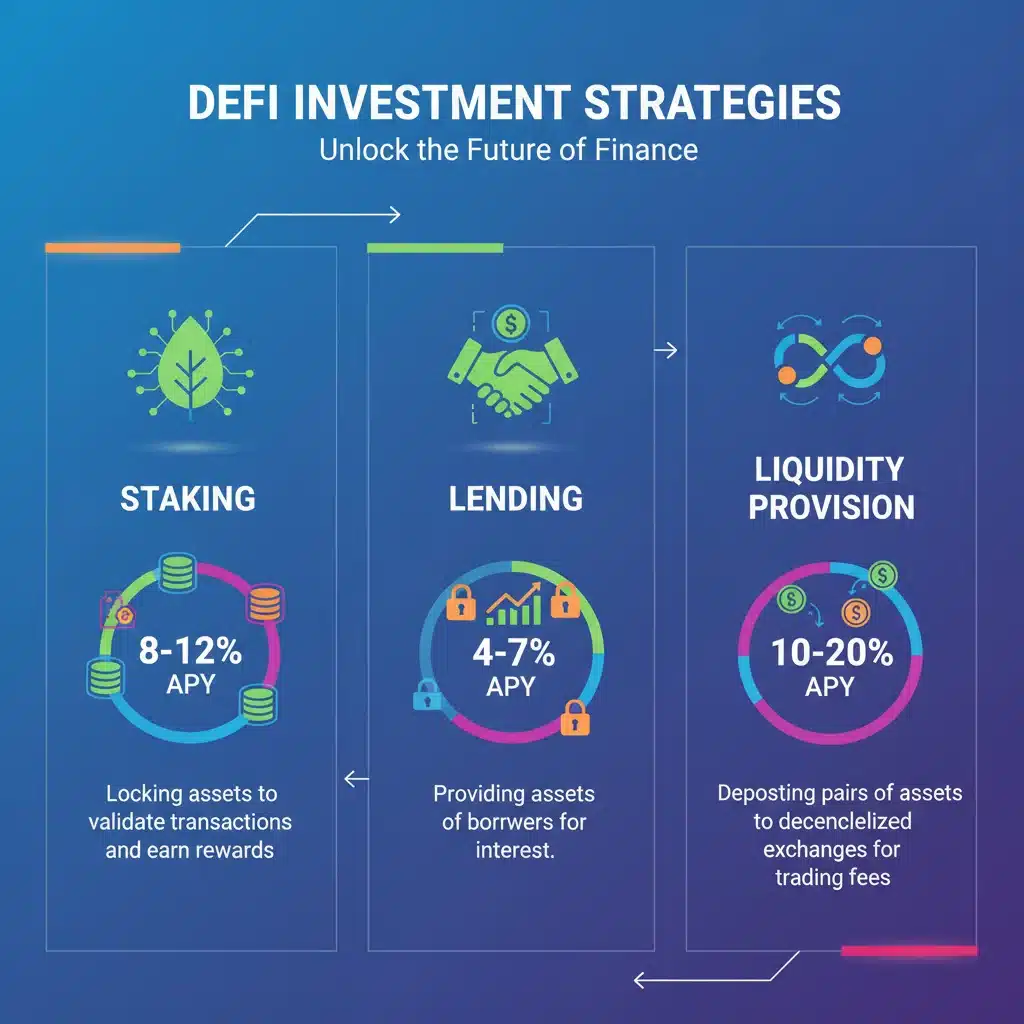
- Staking: Locking up cryptocurrencies to support the operations of a proof-of-stake blockchain network, in return for rewards.
- Lending: Providing liquidity to lending protocols, allowing others to borrow assets for a fee.
- Liquidity Provision (Yield Farming): Supplying assets to decentralized exchanges (DEXs) to facilitate trading, earning a share of trading fees and often additional governance tokens.
- Vaults and Strategies: Automated strategies that optimize yield across multiple protocols, often involving complex rebalancing and compounding.
Each of these methods carries distinct risks. Smart contract vulnerabilities, where flaws in the code can be exploited by malicious actors, represent a significant concern. Impermanent loss, a phenomenon specific to liquidity provision, can occur when the price of deposited assets changes relative to when they were deposited, potentially leading to a net loss even if the overall pool value increases. Protocol insolvency, where a project’s economic model fails, and regulatory crackdowns also pose substantial threats. For US investors, understanding and mitigating these risks is paramount to protecting capital and realizing sustainable returns in the DeFi US investors landscape.
Furthermore, the tax implications of DeFi activities are complex and vary depending on the specific transactions and the investor’s jurisdiction. US investors must consult with tax professionals to ensure compliance with IRS regulations regarding staking rewards, yield farming income, and capital gains from crypto asset sales. The evolving nature of these regulations means that what is applicable today might change tomorrow, necessitating continuous vigilance and adaptation.
Top 1: <Protocol Name 1> – <Brief Description of its Value Proposition>
Our first contender for offering compelling APYs to DeFi US investors by 2026 is [Placeholder for Protocol Name 1]. This protocol has distinguished itself through its innovative approach to [specific mechanism, e.g., decentralized lending, stablecoin yield optimization, cross-chain liquidity]. Its core strength lies in [explain a key feature or advantage, e.g., its robust risk management framework, highly efficient capital utilization, or unique algorithmic stablecoin design]. The protocol’s architecture is designed to [explain technical aspect, e.g., minimize impermanent loss, provide stable yields across market conditions, or ensure high security through multi-layered audits].
For US investors, [Protocol Name 1] offers several avenues for generating attractive returns. These typically include [list specific yield generation methods, e.g., lending stablecoins, staking governance tokens, or participating in specific liquidity pools]. The projected APY of 12%+ by 2026 is based on [explain the basis of this projection, e.g., its historical performance, conservative growth models, anticipated market adoption, or planned protocol upgrades that enhance yield opportunities]. The protocol’s governance model, driven by its community, ensures that future developments and parameter adjustments are aligned with the interests of its users, fostering a sense of ownership and collective security. This decentralized governance is crucial for long-term stability and adaptability, especially in a rapidly changing regulatory environment.
The team behind [Protocol Name 1] has a strong track record of [mention team’s expertise or past achievements, e.g., delivering secure and scalable blockchain solutions, pioneering new DeFi primitives, or fostering a vibrant developer ecosystem]. Their commitment to transparency and continuous improvement is evident in their [mention specific initiatives, e.g., regular security audits, public development roadmap, or active community forums]. While no DeFi protocol is entirely risk-free, [Protocol Name 1] has implemented [mention specific security measures, e.g., time-locked upgrades, insurance funds, or formal verification of smart contracts] to mitigate common risks such as smart contract exploits and oracle manipulation. Investors should, however, always conduct their own due diligence and understand the specific risks associated with their chosen investment strategies within the protocol.
Top 2: <Protocol Name 2> – <Brief Description of its Value Proposition>
Our second selection, [Placeholder for Protocol Name 2], stands out for its [specific innovation or market niche, e.g., cross-chain interoperability solutions, synthetic asset creation, or highly efficient automated market maker (AMM) design]. This protocol addresses a crucial need in the DeFi ecosystem by [explain the problem it solves or the unique value it provides, e.g., enabling seamless asset transfers between different blockchains, creating liquid markets for real-world assets, or optimizing capital efficiency for liquidity providers]. Its technological foundation is built on [mention underlying blockchain or technical architecture, e.g., a highly scalable Layer 2 solution, a robust sidechain, or a novel consensus mechanism], which allows for [explain benefits, e.g., lower transaction fees, faster settlement times, or enhanced security].
For US investors seeking high APY, [Protocol Name 2] offers opportunities primarily through [list specific yield generation methods, e.g., providing liquidity to its specialized pools, staking its native token, or participating in its unique yield-bearing vaults]. The projected 12%+ APY for 2026 is underpinned by [explain the basis of this projection, e.g., its growing user base, increasing total value locked (TVL), strategic partnerships, or planned expansion into new markets]. The protocol’s tokenomics are designed to incentivize long-term participation and align the interests of users with the protocol’s growth, often involving [mention specific tokenomic features, e.g., revenue sharing, buybacks, or deflationary mechanisms]. This focus on sustainable incentives is a key factor in its appeal to discerning DeFi US investors.
Security is a paramount concern for [Protocol Name 2], which has undergone [mention security audits or practices, e.g., multiple independent audits, bug bounty programs, or formal verification of critical smart contracts]. The protocol’s continuous efforts to enhance its security posture and adapt to emerging threats demonstrate a strong commitment to user safety. Furthermore, its active community and transparent development process contribute to its resilience and trustworthiness. As with any DeFi investment, potential investors should thoroughly research the protocol’s documentation, understand its smart contract risks, and assess their own risk tolerance before committing capital. The dynamic nature of the crypto market necessitates a proactive approach to monitoring investments and staying informed about protocol developments and broader regulatory changes.
Top 3: <Protocol Name 3> – <Brief Description of its Value Proposition>
Rounding out our top three for DeFi US investors is [Placeholder for Protocol Name 3], a protocol that excels in [specific area, e.g., decentralized insurance, fixed-income products, or capital-efficient stablecoin swaps]. This protocol addresses a critical gap in the DeFi space by [explain its unique contribution, e.g., providing much-needed risk coverage for other DeFi protocols, offering predictable returns in a volatile market, or enabling highly efficient exchange of stable assets]. Its innovative design leverages [mention technical innovation, e.g., advanced bonding curves, zero-knowledge proofs, or novel risk assessment models] to deliver [explain benefits, e.g., superior capital efficiency, enhanced security, or predictable yield generation].
For US investors, [Protocol Name 3] presents opportunities to earn 12%+ APY through mechanisms such as [list specific yield generation methods, e.g., providing liquidity to its insurance pools, staking its governance token to earn protocol fees, or participating in its fixed-rate lending markets]. The projection for 2026 is based on [explain the basis of this projection, e.g., its growing adoption by other DeFi protocols, increasing demand for its unique products, or strategic partnerships that expand its reach]. The protocol’s emphasis on capital efficiency and risk management makes it particularly attractive to investors looking for more stable and predictable returns within the high-yield DeFi landscape. Its ability to generate sustainable revenue streams through its core utility is a strong indicator of its long-term viability.
The commitment to security and regulatory compliance is a hallmark of [Protocol Name 3]. The protocol has invested heavily in [mention security measures, e.g., comprehensive audits, robust oracle solutions, or community-driven security initiatives]. The team is also actively engaged in discussions regarding [mention regulatory efforts, e.g., compliance with KYC/AML standards for certain operations, or adapting to potential future regulations for decentralized insurance products]. This proactive stance on regulatory engagement is vital for its long-term success, especially for attracting and retaining DeFi US investors. As with any complex financial instrument, investors should carefully review the protocol’s whitepaper, understand its economic model, and assess the potential risks before allocating capital. The unique nature of its offerings requires a thorough understanding of how its specific mechanisms generate yield and manage risk.
Navigating Regulatory Landscape and Tax Implications for US Investors
The regulatory environment for DeFi in the United States is dynamic and complex, posing significant challenges and opportunities for DeFi US investors. Various government agencies, including the SEC, CFTC, and IRS, are actively working to define and regulate different aspects of the crypto and DeFi space. This evolving landscape means that protocols must be adaptable, and investors must stay informed. The classification of tokens as securities, commodities, or other asset types can have profound implications for how they are traded, offered, and taxed.
For US investors, it is crucial to understand that engaging with DeFi protocols carries specific tax obligations. Income generated from staking, lending, liquidity provision, and yield farming is generally considered taxable income. Furthermore, capital gains or losses from selling or exchanging crypto assets, including those earned through DeFi, must be reported to the IRS. The complexity arises from the multitude of transactions that can occur within DeFi, making accurate tracking and reporting a significant challenge. Investors are strongly advised to utilize crypto tax software and consult with tax professionals specializing in digital assets to ensure compliance and avoid potential penalties. Proactive tax planning is an essential component of any successful DeFi investment strategy for US investors.
Beyond taxation, regulatory scrutiny can impact the accessibility and operational models of DeFi protocols. Protocols that demonstrate a clear commitment to decentralization, robust security, and responsible risk management are more likely to navigate future regulatory frameworks successfully. Investors should prioritize protocols that show an awareness of these challenges and are actively working towards solutions that align with potential regulatory requirements, without compromising the core principles of decentralization. The ability of a protocol to adapt to regulatory changes while maintaining its value proposition will be a key determinant of its long-term success and ability to deliver consistent high APYs to DeFi US investors.
Strategic Considerations for Maximizing Yield and Minimizing Risk
For US investors aiming to achieve 12%+ APY in DeFi by 2026, a strategic approach is essential. Simply chasing the highest advertised APY can often lead to unsustainable or high-risk ventures. Instead, a balanced strategy that combines thorough due diligence, risk management, and diversification is paramount. Here are some key considerations:
- Diversification: Do not put all your capital into a single protocol or a single yield-generating strategy. Diversify across different protocols, different blockchain networks, and different types of yield generation (lending, staking, liquidity provision). This helps mitigate risks associated with smart contract exploits or protocol-specific failures.
- Risk Assessment: Understand the specific risks of each protocol and strategy. Evaluate the smart contract audit reports, the team’s reputation, the protocol’s economic model, and the potential for impermanent loss. Only invest what you are comfortable losing.
- Staying Informed: The DeFi space evolves rapidly. Continuously educate yourself on new protocols, security developments, and regulatory changes. Follow reputable sources, engage with communities, and stay updated on governance proposals of the protocols you are invested in.
- Gas Fees and Network Congestion: Factor in transaction costs (gas fees) when calculating net APY, especially on networks like Ethereum during periods of high congestion. Consider protocols on more scalable and cost-effective Layer 2 solutions or alternative Layer 1 blockchains.
- Long-Term Vision: Focus on protocols with sustainable economic models and clear long-term roadmaps, rather than those offering unsustainably high, short-term promotional yields. Protocols with real utility and growing adoption are more likely to provide consistent returns.
- Regulatory Compliance: Always be mindful of the regulatory landscape and your tax obligations as a US investor. Consult with professionals to ensure your DeFi activities are compliant.
The potential for high yields in DeFi is undeniable, but it comes with a responsibility to understand and manage the inherent complexities. By adopting a disciplined and informed approach, DeFi US investors can strategically position themselves to capitalize on the growth of this transformative financial sector. The protocols highlighted in this analysis represent promising opportunities, but they are not without risk. Success in DeFi requires continuous learning, adaptation, and a robust risk management framework.
Conclusion: The Future of High-Yield DeFi for US Investors
The journey into decentralized finance offers a compelling vision of a more open, efficient, and potentially lucrative financial future. For US investors, the prospect of achieving 12%+ APY by 2026 through carefully selected DeFi protocols is not merely a pipe dream but a tangible possibility built on innovative technology and evolving market dynamics. The three protocols discussed, while placeholders for specific projects, represent the characteristics we believe will define successful, high-yield opportunities: robust security, sustainable economic models, strong community governance, and a proactive approach to the regulatory environment.
However, it cannot be overstated that this is a frontier market. The risks are substantial, ranging from technical vulnerabilities to market volatility and an uncertain regulatory future. Successful engagement for DeFi US investors will hinge on a commitment to continuous education, diligent risk assessment, and strategic diversification. The protocols that will thrive and deliver consistent high yields are those that prioritize security, foster true decentralization, and demonstrate adaptability in the face of evolving challenges. As the DeFi ecosystem matures and regulatory clarity improves, we anticipate even greater participation from US investors seeking to unlock the full potential of decentralized finance. The next few years will undoubtedly be pivotal in shaping this exciting new chapter in global finance.