Navigating SEC’s Digital Asset Framework: A Guide for US Crypto Investors by 2027

The landscape of digital assets is constantly evolving, and with it, the regulatory environment. For US crypto investors, the looming deadline of January 2027 marks a critical juncture as the Securities and Exchange Commission (SEC) solidifies its new digital asset framework. This comprehensive guide aims to demystify these upcoming changes, providing actionable insights and strategies to help you adapt and thrive in a more regulated future. Understanding the SEC digital asset framework is not just about compliance; it’s about safeguarding your investments and positioning yourself for long-term success in the burgeoning digital economy.
The journey towards a clearer regulatory structure has been a long one, characterized by a mix of anticipation, uncertainty, and sometimes, outright frustration. However, with a definitive timeline now in sight, proactive engagement with the impending regulations is paramount. This article will delve into the specifics of the SEC’s approach, explore the potential impacts on various facets of the crypto market, and offer practical steps investors can take to prepare. From understanding asset classification to navigating tax implications and exploring compliant investment vehicles, we’ll cover the essential elements to ensure you are well-equipped by January 2027.
Understanding the SEC Digital Asset Framework: A New Era for Crypto
The Securities and Exchange Commission (SEC) has long grappled with how to categorize and regulate digital assets. Unlike traditional financial instruments, cryptocurrencies and other digital assets often defy easy classification, leading to a patchwork of interpretations and enforcement actions. The upcoming SEC digital asset framework, expected to be fully implemented by January 2027, aims to bring much-needed clarity and consistency to this rapidly expanding sector. This framework is not a sudden imposition but rather the culmination of years of deliberation, public commentary, and evolving technological understanding.
At its core, the framework seeks to apply existing securities laws to digital assets where appropriate, while also acknowledging the unique characteristics of this new asset class. The SEC’s primary mandate is investor protection, and the framework is designed to mitigate risks associated with fraud, manipulation, and opaque market practices. This means a greater emphasis on disclosure, registration requirements, and robust oversight for entities involved in the issuance, trading, and custody of digital assets.
Key components of the SEC digital asset framework are likely to include:
- Clarified Definition of a Security: The framework will likely provide more explicit guidance on when a digital asset qualifies as a ‘security’ under the Howey Test, a long-standing legal precedent. This is crucial as it determines whether an asset falls under the SEC’s jurisdiction.
- Registration Requirements: Issuers and platforms dealing with digital asset securities will likely face stringent registration requirements, similar to those for traditional securities. This could involve detailed disclosures about the project, its financials, and the team behind it.
- Broker-Dealer and Exchange Oversight: Platforms that facilitate the trading of digital asset securities may need to register as broker-dealers or national securities exchanges, subjecting them to greater regulatory scrutiny and operational standards.
- Custody Rules: The framework will address how digital assets are held and secured, potentially requiring qualified custodians to hold investor assets, thereby reducing risks of theft or loss.
- Anti-Money Laundering (AML) and Know Your Customer (KYC) Compliance: While already a focus, the framework will likely reinforce and expand AML/KYC obligations for digital asset service providers to combat illicit financial activities.
The implications of this framework are far-reaching. For legitimate projects and platforms, it could foster greater investor confidence and attract institutional capital. For those operating in a regulatory gray area, it will necessitate significant operational adjustments and potentially lead to consolidation within the industry. Understanding these foundational elements of the SEC digital asset framework is the first step for any US crypto investor looking to navigate the future successfully.
Classifying Digital Assets: What the SEC Framework Means for Your Holdings
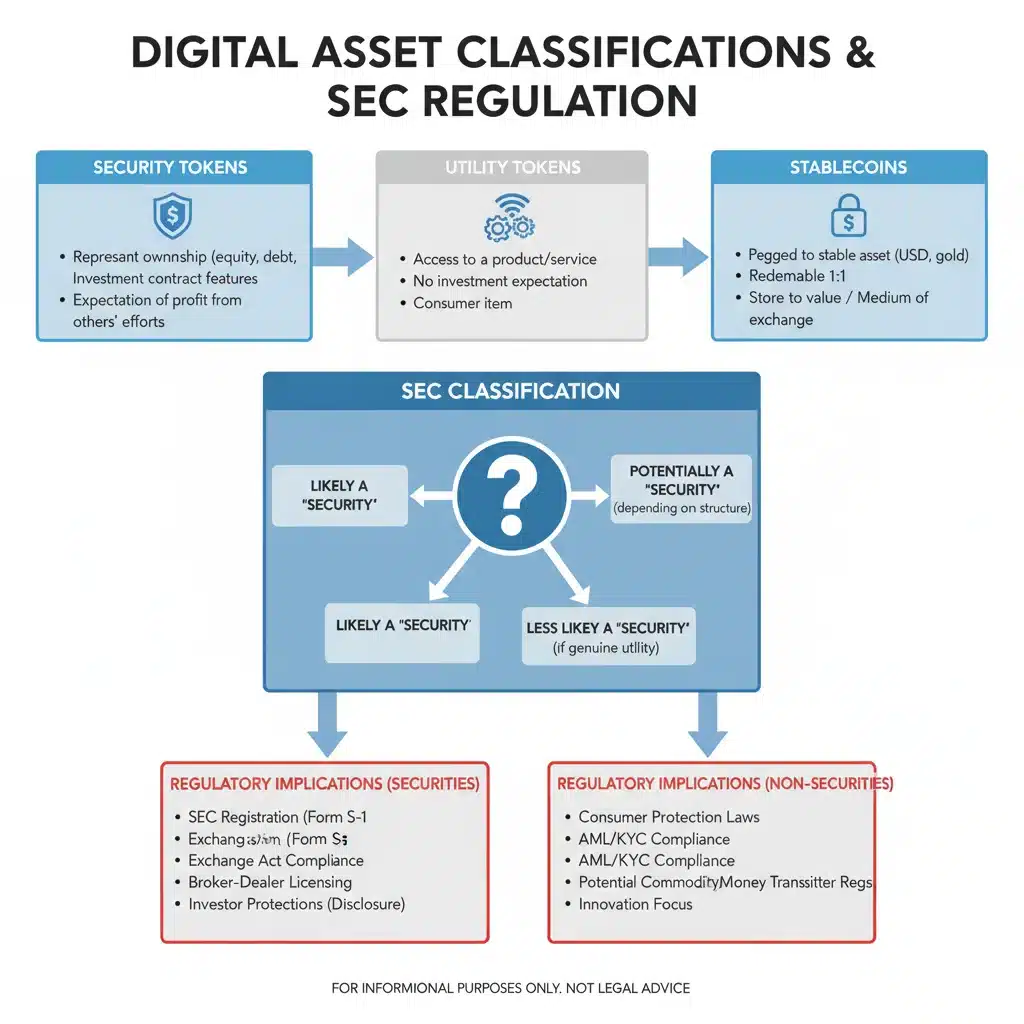
One of the most significant challenges in digital asset regulation is classification. Is a token a security, a commodity, or something else entirely? The SEC’s framework aims to provide clearer guidelines, and understanding these distinctions is paramount for US crypto investors. The classification of a digital asset directly impacts the regulatory requirements it must meet, and consequently, how you as an investor can legally interact with it.
The cornerstone of the SEC’s classification remains the Howey Test, derived from the 1946 Supreme Court case *SEC v. W.J. Howey Co.* This test defines an ‘investment contract’ (and thus a security) as an investment of money in a common enterprise with a reasonable expectation of profits to be derived from the entrepreneurial or managerial efforts of others. While seemingly straightforward, applying this test to the diverse world of digital assets has proven complex.
Under the new SEC digital asset framework, we can anticipate more detailed guidance on how different types of tokens will be assessed:
- Security Tokens: These are digital assets that clearly meet the criteria of the Howey Test. They often represent ownership in an underlying asset, share in profits, or have voting rights. Examples could include tokens representing equity in a company, real estate, or a share of a revenue-generating project. These will likely face the most stringent regulations, requiring registration, extensive disclosures, and trading on regulated platforms.
- Utility Tokens: These tokens are designed to provide access to a specific product or service within a decentralized network. The SEC has historically indicated that a true utility token, whose primary purpose is consumption rather than investment, might not be classified as a security. However, if the token’s value is primarily driven by speculative investment rather than its utility, or if its development is still highly reliant on the issuing entity, it could still be deemed a security. The framework will likely refine the ‘sufficiently decentralized’ concept to distinguish between utility tokens and security tokens.
- Stablecoins: These digital assets are designed to maintain a stable value relative to a fiat currency or other asset. The regulatory treatment of stablecoins is a complex area, involving not only the SEC but also other agencies like the Treasury and banking regulators. The SEC’s framework will likely focus on whether stablecoins, particularly algorithmic ones or those with unclear backing, could be considered securities or investment contracts. Legislative efforts are also underway to provide a clearer regulatory path for stablecoins.
- NFTs (Non-Fungible Tokens): While many NFTs are considered collectibles, the SEC has expressed concerns about NFTs that might function as investment contracts, particularly those that offer fractional ownership, revenue sharing, or are promoted as speculative investments tied to the efforts of others. The framework will likely provide guidance on the characteristics that could push an NFT into the realm of a security.
For US crypto investors, the implications are significant. You will need to scrutinize your portfolio and understand the likely classification of each digital asset you hold. Investing in unregistered securities carries substantial risks, including potential legal penalties and the inability to sell assets on regulated exchanges. The SEC digital asset framework will necessitate a more informed and cautious approach to asset selection.
Strategic Adaptation: How US Crypto Investors Can Prepare by 2027
The January 2027 deadline for the full implementation of the SEC digital asset framework might seem distant, but proactive preparation is key. Waiting until the last minute could expose investors to unnecessary risks and missed opportunities. Here are strategic steps US crypto investors can take to adapt and ensure compliance:
1. Educate Yourself Continuously
The regulatory landscape is dynamic. Stay informed about SEC pronouncements, proposed rules, and enforcement actions. Follow reputable crypto legal experts, financial news outlets, and participate in industry discussions. Understanding the nuances of the SEC digital asset framework is your first line of defense.
2. Review and Diversify Your Portfolio
Assess your current digital asset holdings. For each asset, consider its likely classification under the new framework. If you hold assets that might be deemed unregistered securities, evaluate the risks. Consider diversifying your portfolio to include assets that are more likely to be classified as commodities (like Bitcoin or certain other established cryptocurrencies) or those that have clear utility and are less likely to be seen as securities. This doesn’t mean abandoning all speculative assets, but rather balancing your exposure with a mindful approach to regulatory risk.
3. Utilize Compliant Platforms and Services
As the framework takes shape, regulated exchanges, custodians, and other service providers will become increasingly important. Prioritize using platforms that demonstrate a commitment to compliance, have robust AML/KYC procedures, and are actively engaging with regulators. Moving away from unregulated or offshore platforms, especially for significant holdings, can mitigate future risks. The SEC digital asset framework will likely make it harder for non-compliant entities to operate within the US.
4. Understand Tax Implications
Regulatory clarity from the SEC often goes hand-in-hand with increased scrutiny from the IRS. Ensure you understand the tax implications of your crypto activities, including capital gains, income from staking or mining, and reporting requirements. Consult with a tax professional experienced in digital assets to ensure accurate reporting and avoid future penalties. The integration of the SEC digital asset framework will likely lead to more cohesive government oversight across agencies.
5. Consider Professional Guidance
For significant investors or those with complex portfolios, seeking advice from legal and financial professionals specializing in digital assets is highly recommended. These experts can help you interpret the framework, assess risks, and develop a personalized strategy for compliance and growth. They can also assist in navigating potential registration requirements or understanding the implications of new product offerings that emerge under the framework.
6. Engage with the Regulatory Process (Where Possible)
While individual investors may have limited direct influence, supporting industry associations and advocacy groups that engage with the SEC can indirectly contribute to a more favorable regulatory environment. Staying informed about public comment periods for proposed rules can also be valuable, even if you don’t directly submit comments.
The Impact on Different Crypto Sectors and Investment Strategies
The SEC digital asset framework will not impact all sectors of the crypto market equally. Understanding these differentiated impacts is crucial for refining your investment strategies.
Decentralized Finance (DeFi)
DeFi, with its emphasis on permissionless and often anonymous interactions, presents a significant challenge for regulators. The SEC’s framework will likely scrutinize DeFi protocols that resemble traditional financial services (lending, borrowing, exchanges) and may impose requirements on developers, front-end providers, or even liquidity providers. Investors in DeFi should be aware of the potential for increased regulatory pressure and the need for protocols to adapt to compliance standards. Projects that prioritize decentralization and progressive decentralization will be better positioned.
Centralized Exchanges and Custodians
These entities are already under significant regulatory pressure, and the SEC digital asset framework will only intensify this. Expect more stringent licensing, capital requirements, and robust consumer protection measures. This will likely lead to consolidation in the industry, with smaller, non-compliant players struggling to compete. For investors, this means a greater emphasis on using well-regulated and reputable exchanges and custodians, as they will offer enhanced security and legal recourse.
Token Issuance and Fundraising
The era of unregulated initial coin offerings (ICOs) is largely over. The SEC digital asset framework will cement the requirements for token sales, pushing projects towards regulated avenues like Reg D, Reg A+, or Reg S offerings. This will mean more due diligence for investors, but also greater transparency and investor protections. Early-stage investments in new tokens will become more formalized and less accessible to retail investors unless they meet specific accreditation requirements.
Blockchain Infrastructure and Technology
Underlying blockchain technologies that are not directly involved in issuing or trading securities are less likely to be directly regulated by the SEC. This includes core protocol development, open-source tools, and general-purpose blockchain networks. However, applications built on these infrastructures that involve digital asset securities will still fall under the framework’s purview. Investing in foundational blockchain technology, rather than specific speculative tokens, might offer a more stable long-term play under the new regulations.
Potential Benefits and Challenges of the SEC Digital Asset Framework
While often viewed with apprehension, the SEC digital asset framework brings both potential benefits and challenges for the US crypto market and investors.
Benefits:
- Increased Investor Protection: This is the SEC’s primary goal. Clear rules can reduce fraud, market manipulation, and the risks associated with opaque projects.
- Enhanced Market Integrity: A regulated environment can foster greater trust and legitimacy for digital assets, attracting institutional investors and mainstream adoption.
- Clarity for Innovation: While regulations can sometimes stifle innovation, a clear framework can also provide certainty, allowing legitimate projects to build and operate without constant fear of regulatory uncertainty.
- Level Playing Field: The framework can create a more equitable environment, preventing bad actors from exploiting regulatory loopholes.
- Institutional Adoption: With regulatory clarity, more traditional financial institutions are likely to enter the digital asset space, bringing significant capital and expertise.

Challenges:
- Potential for Over-Regulation: Critics argue that applying traditional securities laws too broadly could stifle innovation and push some legitimate projects offshore.
- Compliance Costs: Meeting regulatory requirements can be expensive and complex, particularly for smaller projects and startups, potentially leading to centralization.
- Impact on Decentralization: The SEC’s focus on identifiable entities and centralized control could clash with the ethos of decentralization inherent in many crypto projects.
- Enforcement Challenges: Regulating a global, pseudonymous, and rapidly evolving market presents significant enforcement challenges for the SEC.
- Market Volatility: The announcement and implementation of new regulations can sometimes lead to short-term market volatility as investors and projects react.
For US crypto investors, navigating these benefits and challenges requires a nuanced approach. While the framework may introduce new hurdles, it also lays the groundwork for a more mature and stable digital asset market. Adapting to the SEC digital asset framework is about positioning yourself to capitalize on the opportunities while mitigating the risks.
The Global Context: How US Regulations Compare and What It Means for Investors
It’s important for US crypto investors to view the SEC digital asset framework within a global context. Regulatory approaches to digital assets vary significantly across jurisdictions, and these differences can influence investment decisions and market dynamics.
Divergent Global Approaches:
- European Union (MiCA): The EU’s Markets in Crypto-Assets (MiCA) regulation offers a comprehensive and unified framework across its member states. It distinguishes between different types of crypto-assets (e.g., asset-referenced tokens, e-money tokens, and other crypto-assets) and sets out clear rules for issuance, trading, and service providers. MiCA is often seen as a more forward-looking and proactive approach compared to the US’s reliance on existing securities laws.
- United Kingdom: The UK is developing its own regulatory regime, aiming to balance innovation with investor protection. It’s exploring specific frameworks for stablecoins and broader crypto asset regulation, often seeking to align with international standards while maintaining its own distinct approach.
- Asia: Countries like Singapore, Japan, and Hong Kong have adopted varying degrees of regulation, often focusing on licensing requirements for crypto service providers and stablecoin oversight. Some, like China, have implemented outright bans on certain crypto activities.
Implications for US Investors:
The differences in global regulation can create challenges and opportunities for US crypto investors:
- Market Arbitrage and Migration: Stricter US regulations under the SEC digital asset framework could lead some projects and liquidity to migrate to more permissive jurisdictions. US investors might find it challenging to access certain projects or platforms if they are not compliant with US rules.
- Innovation Hubs: Jurisdictions with clearer or more favorable regulatory environments might emerge as new innovation hubs, potentially attracting talent and capital away from the US in some sectors.
- Cross-Border Compliance: For US investors engaging with international platforms or projects, understanding both US and foreign regulations becomes critical. Non-compliance, even with foreign entities, can still have repercussions under US law.
- Regulatory Harmonization (Long-term): While current approaches differ, there’s a growing international dialogue aimed at harmonizing crypto regulations. The SEC digital asset framework, while US-centric, will contribute to this global conversation and could influence future international standards.
For US crypto investors, it’s not enough to just understand the domestic SEC digital asset framework. A global perspective is essential for making informed decisions about where to invest, what platforms to use, and how to assess the long-term viability of projects in an interconnected digital economy.
Looking Beyond 2027: The Future of Digital Asset Investing in the US
January 2027 is a significant milestone, but it’s by no means the end of the regulatory journey for digital assets in the US. The SEC digital asset framework will establish a foundation, but the landscape will continue to evolve. Investors should consider the long-term implications and potential future developments.
Continued Evolution of the Framework:
Regulations are rarely static. As technology advances and new digital asset use cases emerge, the SEC’s framework will likely undergo further refinements and expansions. Expect ongoing dialogue, new rule proposals, and potentially new legislation to address areas not fully covered by the initial framework. This iterative process means continuous vigilance will be necessary for investors.
Increased Institutional Participation:
A clear regulatory framework is a prerequisite for widespread institutional adoption. Post-2027, with the SEC digital asset framework firmly in place, we can anticipate a greater influx of traditional financial institutions, hedge funds, and corporate treasuries into the digital asset space. This could lead to increased liquidity, more sophisticated financial products (like crypto ETFs and derivatives), and potentially greater market stability, but also increased competition for retail investors.
Focus on Consumer Protection and Education:
Beyond institutional engagement, the SEC’s mandate extends to protecting retail investors. The framework will likely be accompanied by increased efforts in investor education and awareness campaigns, helping individuals understand the risks and opportunities of digital assets. For investors, this means access to more reliable information and potentially more straightforward ways to report issues.
Interagency Coordination:
While the SEC is a key player, other agencies like the CFTC (Commodity Futures Trading Commission), FinCEN (Financial Crimes Enforcement Network), and the Treasury Department also have roles in regulating digital assets. Expect greater interagency coordination and potentially a more unified government approach to digital asset regulation post-2027, building upon the foundation laid by the SEC digital asset framework.
Technological Advancements and Regulatory Response:
The pace of innovation in blockchain and digital assets is relentless. New technologies like zero-knowledge proofs, decentralized autonomous organizations (DAOs), and novel tokenomics models will continue to emerge. Regulators will face the ongoing challenge of adapting the framework to these innovations without stifling progress. Investors should keep an eye on how these new technologies are addressed within the evolving regulatory paradigm.
For US crypto investors, January 2027 is not an endpoint but a significant waypoint. The SEC digital asset framework will reshape how digital assets are perceived, traded, and integrated into the broader financial system. By understanding these changes, adapting your strategies, and remaining informed, you can confidently navigate the evolving digital asset landscape and position yourself for future success.
Conclusion: Embracing a Regulated Future for Digital Assets
The impending full implementation of the SEC digital asset framework by January 2027 represents a pivotal moment for the US crypto market. While the journey towards regulatory clarity has been complex and at times contentious, the establishment of a comprehensive framework is ultimately designed to bring greater stability, transparency, and investor protection to a nascent asset class. For US crypto investors, this is not a time for apprehension, but rather for proactive engagement and strategic adaptation.
We’ve explored the core components of the framework, from the critical classification of digital assets to the practical steps investors can take to prepare. Understanding whether your holdings constitute securities, diversifying your portfolio thoughtfully, utilizing compliant platforms, and seeking professional guidance are all essential elements of a robust adaptation strategy. The impact on various crypto sectors, including DeFi, centralized exchanges, and token issuance, will be profound, necessitating a nuanced approach to investment decisions.
While challenges such as potential over-regulation and compliance costs exist, the long-term benefits of a clear regulatory environment cannot be overstated. Increased investor confidence, greater institutional participation, and enhanced market integrity are all outcomes that can foster sustainable growth within the digital asset ecosystem. Furthermore, by understanding the global regulatory context, US investors can make more informed decisions in an interconnected world.
Looking beyond 2027, the digital asset landscape will continue to evolve, with ongoing regulatory refinements, technological advancements, and increasing mainstream adoption. The SEC digital asset framework will serve as a crucial foundation, but continuous education and adaptability will remain paramount. By embracing these changes, US crypto investors can not only safeguard their existing investments but also unlock new opportunities in a more mature and regulated digital economy. The future of digital assets is bright, and being prepared for its regulatory evolution is key to thriving within it.