Early-Stage Startup Valuations 2025: 3 Leading US Methodologies

Understanding the complexities of early-stage startup valuations in 2025 is crucial for founders and investors, requiring a deep dive into methodologies like the Scorecard, Berkus, and Risk Factor Summation to accurately assess potential in the dynamic US market.
Navigating the intricate world of startup funding can be daunting, especially when it comes to determining an accurate valuation. For founders and investors alike, understanding early-stage startup valuations in 2025 is paramount, particularly for US companies. This article delves into three leading methodologies—the Scorecard Method, the Berkus Method, and the Risk Factor Summation Method—offering a comprehensive comparison to help you make informed decisions.
The critical role of early-stage startup valuations
Early-stage startup valuations are more art than science, often relying on qualitative factors due to the lack of historical data and established revenue streams. In 2025, with rapid technological advancements and shifting market dynamics, these valuations are crucial for securing seed funding, attracting angel investors, and setting the stage for future growth. An accurate valuation ensures fair equity distribution and prevents dilution issues down the line.
The US market, known for its vibrant startup ecosystem, presents unique challenges and opportunities. Investors are increasingly sophisticated, demanding well-reasoned valuations that reflect both potential and inherent risks. Without a solid valuation, startups risk either undervaluing their company, giving away too much equity, or overvaluing it, scaring off potential investors. This delicate balance requires a nuanced understanding of available tools and approaches.
Why traditional valuation methods fall short for early-stage companies
- Lack of historical data: Early-stage startups often have no significant revenue or profit history, making discounted cash flow (DCF) or comparable company analysis (CCA) difficult to apply.
- Uncertainty of future cash flows: Projecting future financial performance for a nascent company is highly speculative, making traditional financial models unreliable.
- High failure rates: The inherent risk of startup failure means that conventional valuation approaches don’t adequately account for the probability of success.
The conclusion here is that traditional, established valuation methods designed for mature companies simply do not adequately capture the unique characteristics and inherent uncertainties of early-stage startups. This necessitates the adoption of specialized methodologies that prioritize qualitative factors and risk assessment.
The Scorecard Method: benchmarking against similar startups
The Scorecard Method, developed by Fred Wilson of Union Square Ventures, is a popular approach for valuing pre-revenue or early-revenue startups. It involves comparing the target startup to recently funded companies in the same industry and stage, then adjusting the average valuation based on several key factors. This method provides a relative valuation, offering a practical framework when concrete financial metrics are scarce.
In 2025, the proliferation of data on seed rounds and early-stage investments makes the Scorecard Method particularly relevant. Access to more granular data points allows for a more refined comparison, although the subjective nature of the adjustment factors remains a critical component. Founders need to articulate clearly how their company outperforms or falls short of benchmarks.
Key factors in the Scorecard Method
- Strength of the management team: Experience, cohesion, and relevant expertise are paramount.
- Size of the opportunity (market size): The potential market for the product or service.
- Product/technology: Uniqueness, defensibility, and stage of development.
- Competitive environment: Barriers to entry, existing players, and competitive advantages.
- Marketing/sales channels: Effectiveness of customer acquisition strategies.
- Need for additional investment: How much capital is required to reach the next milestone.
Each factor is assigned a weight and then scored against a benchmark, resulting in a multiplier applied to the average pre-money valuation of comparable companies. This systematic approach helps to standardize the qualitative assessment, making it easier for investors to justify their valuation estimates. The Scorecard Method provides a structured way to evaluate a startup’s potential beyond just its current financials.
The Berkus Method: valuing ideas and potential
The Berkus Method, conceived by angel investor Dave Berkus, focuses on valuing a startup based on its ideas and potential, rather than its assets or current revenue. It assigns a maximum pre-money valuation (typically $2 million to $2.5 million for US startups in 2025, though this can vary) and then adds value for specific milestones achieved. This method is particularly useful for very early-stage companies, often still in the idea or prototype phase, where the Scorecard Method might still be too reliant on market comparisons.
Berkus’s philosophy is that no business plan is perfect, and the real value lies in the team, the idea, and the ability to execute. It acknowledges that early investments are largely bets on the future, making tangible achievements more important than hypothetical financial projections. For founders, this method encourages focusing on critical developmental milestones that directly increase the company’s perceived value.
Milestone-based value drivers
- Basic value (sound idea): The fundamental concept and market need being addressed.
- Technology risk (prototype): The development of a working prototype or proof of concept.
- Execution risk (management team): The capability of the team to bring the idea to market.
- Market risk (strategic relationships): Securing key partnerships or early customer validation.
- Production risk (initial sales): Achieving initial revenue or product-market fit.
Each of these milestones can add up to $500,000 to the valuation, culminating in a maximum pre-money valuation. While the specific dollar amounts are guidelines and can be adjusted based on market conditions and investor preferences, the underlying principle remains: value is created through de-risking the venture. The Berkus Method offers a straightforward way to communicate value progression to early investors.
Risk Factor Summation Method: assessing and adjusting for risk
The Risk Factor Summation Method, developed by Ohio TechAngels, provides a comprehensive way to assess various risk factors inherent in an early-stage startup and adjust an initial valuation accordingly. This method starts with an average valuation for a pre-revenue startup in a similar industry and then systematically evaluates 12 specific risk categories, adding or subtracting value based on the perceived level of each risk. It offers a more granular risk assessment than the other methods, making it attractive to investors who prioritize mitigating potential downsides.
In 2025, as the startup landscape becomes increasingly competitive and complex, a detailed risk assessment is more vital than ever. This method allows for a transparent discussion between founders and investors about where the company stands in terms of risk, helping to build trust and alignment. Founders can use this framework to proactively address weaknesses and highlight strengths that reduce overall risk.
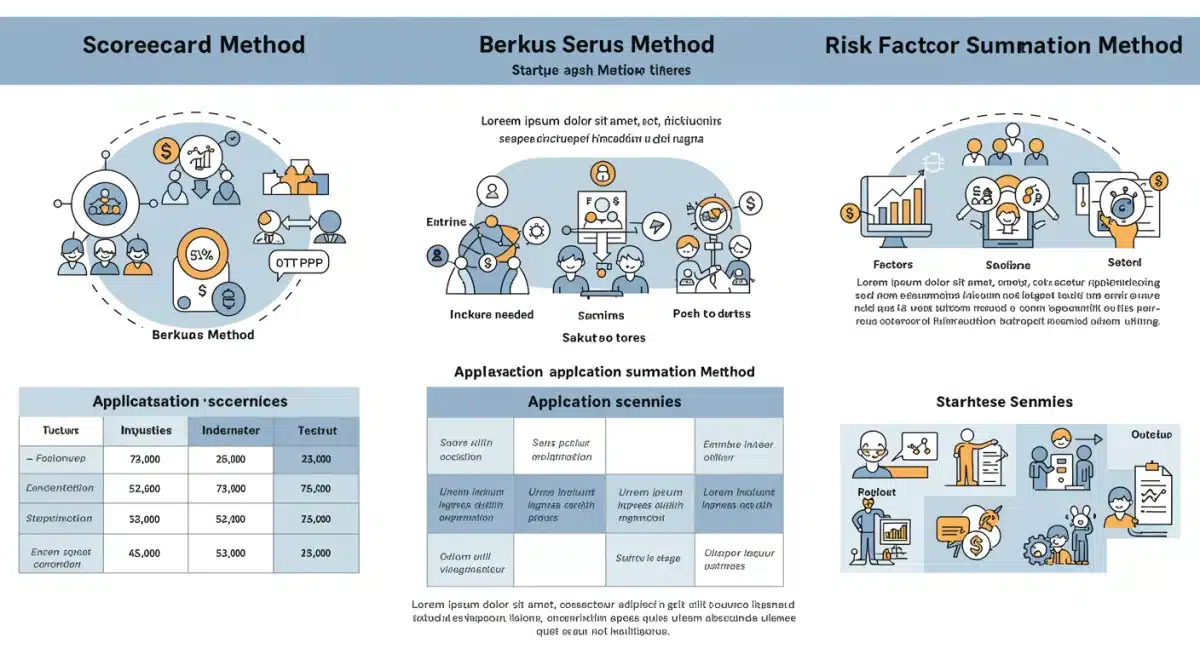
The 12 key risk categories
- Management risk: Experience and capability of the leadership team.
- Stage of the business: How far along the company is in its development cycle.
- Legislation/political risk: Potential impact of regulatory changes.
- Manufacturing risk: Challenges in production or scaling.
- Sales and marketing risk: Ability to acquire and retain customers.
- Funding/capital raising risk: Difficulty in securing future investment.
- Competition risk: Threat from existing or new competitors.
- Technology risk: Development challenges or obsolescence.
- Litigation risk: Exposure to legal disputes.
- International risk: Challenges of operating in global markets.
- Reputation risk: Potential damage to brand image.
- Exit risk: Feasibility of a successful acquisition or IPO.
Each risk factor is rated from -2 (very negative) to +2 (very positive), with 0 being neutral. These ratings are then multiplied by a fixed dollar amount (e.g., $250,000) and summed up, with the total adjustment added to or subtracted from the initial average valuation. This systematic approach provides a robust mechanism for adjusting valuations based on a comprehensive risk profile, offering a more realistic picture of a startup’s worth.
Comparing the three methodologies for US companies in 2025
Each of these three valuation methodologies—Scorecard, Berkus, and Risk Factor Summation—offers distinct advantages and is best suited for different stages and types of early-stage US startups. While they all aim to provide a reasonable pre-money valuation in the absence of robust financial data, their underlying philosophies and practical applications vary significantly. Understanding these differences is key for founders and investors to select the most appropriate method or to use a combination for a more holistic view.
In 2025, the US startup ecosystem continues to evolve, with increasing specialization and diverse funding sources. This means that a one-size-fits-all approach to valuation is rarely effective. Instead, a thoughtful application of these methods, often in conjunction, can lead to more defensible valuations that resonate with sophisticated investors. Transparent communication about the chosen methodology also builds investor confidence.
Strengths and weaknesses of each approach
- Scorecard Method: Strong for benchmarking against recent deals, but relies on subjective weighting and finding truly comparable companies. Good for startups with some traction.
- Berkus Method: Excellent for pre-seed, idea-stage companies with little to no revenue, focusing on de-risking milestones. Can be seen as simplistic and the fixed dollar amounts may not reflect market realities for all sectors.
- Risk Factor Summation Method: Provides a detailed risk assessment, offering transparency and a systematic way to adjust for various vulnerabilities. Can be complex to implement and requires careful judgment in assessing each risk factor.
Ultimately, the best approach often involves using elements from multiple methods. For instance, a founder might use the Berkus Method to establish an initial baseline for a very early-stage idea, then refine it with elements of the Scorecard Method once some market traction is gained, and finally apply the Risk Factor Summation to present a comprehensive risk-adjusted valuation to investors. This blended approach provides a more robust and defensible valuation.
Practical application and strategic considerations for founders
For US founders in 2025, applying these valuation methodologies isn’t just about crunching numbers; it’s a strategic exercise that influences funding rounds, equity distribution, and future growth. Understanding how investors perceive and use these methods allows founders to better position their companies, articulate their value proposition, and negotiate effectively. A well-prepared founder can guide the valuation discussion rather than simply reacting to investor offers.
Beyond the mechanics of each method, founders should consider the broader strategic implications. A valuation is not a static number but a dynamic reflection of a company’s progress, market conditions, and investor sentiment. Therefore, continuously updating and refining the valuation as the startup evolves is crucial. This proactive approach ensures that fundraising efforts are always aligned with the company’s true stage and potential.
Tips for founders when approaching valuation discussions
- Know your market: Thoroughly research comparable deals and industry trends specific to your sector and stage.
- Articulate your story: Clearly communicate your vision, team’s capabilities, market opportunity, and competitive advantages.
- Be transparent about risks: Acknowledge and address potential risks, demonstrating a thoughtful and realistic approach.
- Focus on milestones: Highlight achieved milestones and clear plans for future de-risking activities.
- Seek expert advice: Consult with experienced mentors, advisors, or valuation professionals to gain insights and refine your approach.
The goal is not just to arrive at a number, but to build a compelling narrative around that number, supported by data and a clear understanding of the methodologies. Founders who can confidently explain their valuation rationale are far more likely to secure favorable terms and attract the right investment partners. This strategic perspective turns a technical exercise into a powerful tool for growth.
Future trends impacting early-stage valuations in 2025 and beyond
The landscape of early-stage startup valuations is continuously shaped by technological innovation, economic shifts, and evolving investor preferences. In 2025, several trends are poised to significantly impact how US companies are valued. Understanding these developments is essential for both founders and investors to remain competitive and make astute decisions. The rapid pace of change means that valuation methodologies themselves may need to adapt.
One notable trend is the increasing emphasis on environmental, social, and governance (ESG) factors. Startups demonstrating strong ESG commitments may attract a premium from impact investors and a broader pool of capital. Additionally, the rise of AI-driven analytics tools is providing more sophisticated ways to analyze market data and predict future performance, potentially refining the subjective elements of current valuation methods. The move towards more data-driven insights will likely continue.
Emerging factors influencing valuations
- Impact of AI and automation: How AI integration affects scalability, efficiency, and competitive advantage, potentially leading to higher valuations for AI-native startups.
- Data privacy and cybersecurity: Startups with robust data protection frameworks may be perceived as less risky and more valuable.
- Decentralized autonomous organizations (DAOs) and Web3: New organizational structures and investment paradigms emerging from blockchain technology could influence how value is assessed.
- Talent acquisition and retention: The ability to attract and keep top talent remains a critical, often undervalued, asset that contributes significantly to long-term success and valuation.
Furthermore, broader macroeconomic conditions, such as interest rates, inflation, and geopolitical stability, will continue to play a significant role. A more volatile economic environment might lead to investors placing a higher premium on profitability and shorter paths to liquidity, potentially favoring startups with clearer revenue models. Staying attuned to these macro and micro trends is vital for accurately assessing early-stage startup valuations in 2025 and beyond.
| Methodology | Key Characteristic |
|---|---|
| Scorecard Method | Compares against similar startups, adjusted by qualitative factors. |
| Berkus Method | Values ideas and potential, adding for key de-risking milestones. |
| Risk Factor Summation | Adjusts initial valuation based on a detailed assessment of 12 risk categories. |
| Strategic Value | Often a blend of methods provides the most robust and defensible valuation. |
Frequently asked questions about early-stage startup valuations
Traditional methods like DCF rely heavily on historical financial data and predictable cash flows, which early-stage startups typically lack. Their future is highly uncertain, making such projections unreliable and often speculative for nascent businesses.
The Berkus Method is often ideal for pre-revenue startups as it focuses on the idea’s potential and de-risking milestones rather than financial metrics. It provides a structured way to value a concept and its team’s ability to execute.
The Scorecard Method accounts for market differences by benchmarking against recently funded companies in the same industry and geographic region (e.g., US market) and then adjusting for specific qualitative factors unique to the target startup.
Absolutely. Combining these methods often provides a more robust and defensible valuation. For example, using Berkus for a baseline, Scorecard for market comparison, and Risk Factor Summation for detailed risk adjustment can offer a comprehensive view.
Investor preferences are significant. Different investors prioritize different aspects—some focus on team, others on market size, or technology. Understanding their criteria helps founders tailor their valuation pitch and choose the most suitable method.
Conclusion
Successfully navigating early-stage startup valuations in 2025 for US companies demands a sophisticated understanding of methodologies beyond traditional financial models. The Scorecard, Berkus, and Risk Factor Summation methods each offer unique lenses through which to assess potential, mitigate risk, and establish fair value for nascent ventures. By strategically applying these tools, founders can build compelling cases for investment, while investors can make more informed decisions, ultimately fostering a healthier and more dynamic startup ecosystem. The art of valuation lies in blending these approaches to create a holistic and defensible picture of a company’s true worth and future promise.