Crafting the Winning 2026 Pitch Deck for a $1 Million Seed Round

Securing a $1 million seed round in 2026 is not merely about having a great idea; it’s about presenting that idea with precision, foresight, and an acute understanding of the evolving investor landscape. The 2026 pitch deck is more than just a presentation; it’s a strategic narrative designed to captivate sophisticated investors who are increasingly looking beyond traditional metrics. This comprehensive guide will dissect the essential elements of a winning 2026 pitch deck, providing you with the insights and actionable strategies needed to unlock that coveted $1 million seed investment.
The venture capital world is dynamic, with trends shifting rapidly. What impressed investors in 2023 might be considered standard, or even outdated, by 2026. Therefore, your pitch deck must reflect not only the current market realities but also anticipate future directions. We’ll delve into the foundational components, emerging trends, and critical nuances that will make your deck stand out in a crowded market.
Understanding the Evolving Investor Mindset in 2026
Before crafting a single slide, it’s crucial to understand who you’re pitching to and what drives their decisions in 2026. Investors are not just looking for returns; they’re seeking disruptive innovation, strong teams, and sustainable business models that align with future global challenges and opportunities. The emphasis has shifted from purely growth-at-all-costs to sustainable, impactful growth.
Beyond Financials: Impact and Ethics
By 2026, Environmental, Social, and Governance (ESG) factors will be even more integrated into investment theses. Investors will scrutinize your company’s commitment to sustainability, diversity, and ethical practices. Your pitch deck should subtly, yet effectively, weave in how your solution addresses societal needs or contributes positively to the environment. This isn’t just a ‘nice-to-have’; it’s becoming a fundamental expectation.
Data-Driven Storytelling
While storytelling remains paramount, it must be underpinned by robust data. Vanity metrics are out; actionable insights and verifiable traction are in. Investors want to see how you’ve used data to validate your assumptions, iterate on your product, and demonstrate early market fit. Be prepared to back every claim with evidence.
The Core Components of a 2026 Pitch Deck for a $1 Million Seed Round
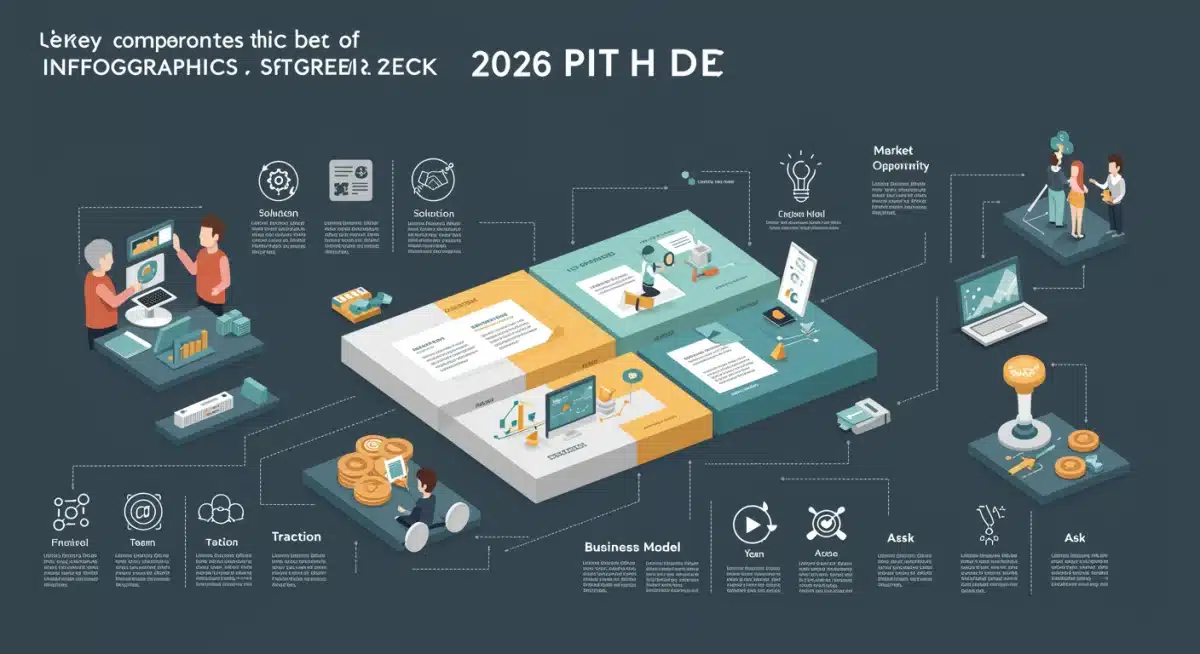
While the exact order can vary, a compelling 2026 pitch deck for a $1 million seed round typically includes the following slides. Remember, conciseness and clarity are key. Aim for 10-15 slides, with each slide conveying a single, powerful message.
1. The Hook: Title Slide & Problem Statement (1-2 slides)
- Title Slide: Your company name, logo, a compelling tagline, and your contact information. Keep it clean and professional.
- Problem: Articulate a clear, significant problem that your target audience faces. Use relatable language and, if possible, quantify the pain point. Why is this problem acute, and why hasn’t it been adequately solved yet? Investors want to see that you understand the core issue deeply. This is the foundation of your entire pitch, so make it resonate.
2. The Solution: Your Unique Offering (1-2 slides)
- Solution: Introduce your product or service as the elegant and effective answer to the problem you just presented. Focus on the benefits, not just the features. How does your solution alleviate the pain point? Use visuals – screenshots, mockups, or a brief demo video thumbnail – to illustrate your solution. Emphasize uniqueness and how it differentiates from existing options.
- Product/Service Overview: Briefly explain how your solution works. Avoid excessive jargon. Focus on the user experience and the core value proposition.
3. The Market Opportunity: Size & Scope (1-2 slides)
- Market Size: Define your Total Addressable Market (TAM), Serviceable Available Market (SAM), and Serviceable Obtainable Market (SOM). Use credible sources for your data. Investors want to see a large enough market to justify a significant return.
- Market Trends: Highlight relevant trends that support your market’s growth and your solution’s timeliness. Think about shifts in technology, consumer behavior, or regulatory environments that create tailwinds for your business. For a 2026 pitch deck, this could involve AI integration, Web3, sustainable practices, or new digital economy shifts.
4. Business Model: How You Make Money (1 slide)
- Revenue Model: Clearly explain your pricing strategy and how you generate revenue. Is it subscription-based, freemium, transaction fees, licensing? Provide projections and unit economics if possible. Transparency here builds trust. Investors need to understand the viability and scalability of your revenue streams.
5. Traction & Validation: Proof Points (1-2 slides)
- Key Metrics: This is arguably the most critical section for a seed round. Showcase your progress: user growth, revenue figures, customer acquisition cost (CAC), lifetime value (LTV), retention rates, pilot programs, partnerships, or press mentions. Visual representations like graphs are highly effective. If you have no revenue, focus on user engagement, product milestones, or successful beta tests.
- Milestones Achieved: What significant accomplishments have you already made? This demonstrates your team’s execution capabilities and reduces investor risk.
6. Go-to-Market Strategy: Reaching Your Customers (1 slide)
- Acquisition Channels: How will you acquire customers efficiently and at scale? Outline your marketing and sales strategies. Be specific about your channels (e.g., social media, content marketing, partnerships, direct sales).
- Competitive Advantage: What makes your go-to-market strategy superior or more cost-effective than competitors’?
7. Competitive Landscape: Your Edge (1 slide)
- Competitor Analysis: Acknowledge your competitors. Don’t dismiss them. Instead, show that you understand the landscape and can articulate your unique differentiators. A 2×2 matrix (e.g., price vs. features, innovation vs. market share) is often effective here.
- Sustainable Moat: Why can’t competitors easily replicate what you do? Is it proprietary technology, network effects, brand, unique partnerships, or superior execution?
8. The Team: The Engine of Your Success (1 slide)
- Founding Team: Introduce your key team members. Highlight their relevant experience, expertise, and track record. Emphasize complementary skill sets and why *this team* is uniquely positioned to solve this problem and execute the vision. Investors invest in people as much as ideas.
- Advisors (if applicable): Briefly mention any notable advisors and their contributions.
9. Financial Projections: The Future Outlook (1-2 slides)
- Key Financials: Provide realistic 3-5 year financial projections (revenue, gross margin, profitability). Break down assumptions clearly. Investors understand these are projections, but they want to see a logical path to significant revenue.
- Use of Funds: Clearly state how you plan to use the $1 million seed investment. Be specific: X% for product development, Y% for marketing, Z% for hiring. This demonstrates financial prudence and a clear strategic plan.
10. The Ask & Vision: Your Call to Action (1 slide)
- The Ask: Explicitly state the amount you are raising ($1 million) and what it will achieve (e.g., “This $1M seed round will allow us to achieve product-market fit, scale our user base to 100,000, and generate $500K ARR within 18 months.”).
- Vision: End with a powerful statement about your long-term vision and the impact your company will have. Inspire investors with the grand future you are building.
Emerging Trends to Incorporate into Your 2026 Pitch Deck
To truly stand out in 2026, your pitch deck needs to go beyond the basics and incorporate forward-thinking elements that resonate with contemporary investor priorities.
AI & Automation Integration
Whether your product *is* AI or simply *uses* AI, demonstrate how artificial intelligence and automation are integrated into your solution or operational processes. Investors are keenly aware of the productivity and competitive advantages AI offers. Show how you’re leveraging it for efficiency, personalization, or enhanced user experience.
Web3 & Decentralization (Where Applicable)
If your business model has any relevance to blockchain, NFTs, DAOs, or decentralized technologies, ensure this is clearly articulated. While the hype may have settled, genuine utility and innovative applications of Web3 principles will attract specific investor segments. Focus on how these technologies solve real problems, not just on the technology itself.
Sustainability & ESG Metrics
As mentioned, ESG is no longer optional. Dedicate a small section or integrate throughout your deck how your company contributes to sustainability, social good, or strong governance. This could be energy efficiency, fair labor practices, data privacy, or community engagement. Quantify your impact where possible.
Personalized & Adaptive Experiences
Customers in 2026 expect highly personalized experiences. How does your product adapt to individual user needs? Highlight any machine learning or data-driven personalization features that enhance user engagement and retention.
Creator Economy & Community Building
If your business touches the creator economy or relies heavily on community engagement, showcase your strategies for fostering and monetizing these aspects. Investors are interested in platforms that empower creators and build strong, active communities.
Crafting Your Narrative: Storytelling for Impact
A pitch deck is a story, not just a collection of facts. Your narrative should flow logically, building excitement and conviction with each slide. Here’s how to refine your storytelling:
Start with the ‘Why’
As Simon Sinek famously articulated, people don’t buy what you do, they buy why you do it. Begin by clearly stating your mission and the fundamental problem you’re passionate about solving. This creates an emotional connection.
Keep it Concise and Visual
Each slide should have minimal text and maximum visual impact. Use high-quality images, clean graphics, and easy-to-read fonts. Investors will likely skim your deck before a meeting, so each slide must convey its message at a glance.
Anticipate Questions
Think like an investor. What are their immediate concerns? What information would they want to see? Address potential objections proactively within your deck, or be prepared to answer them during the Q&A.
The ‘So What?’ Test
For every piece of information you include, ask yourself, “So what?” Does this statistic, feature, or metric truly matter to an investor? Does it move the narrative forward or highlight a critical advantage? If not, remove it.
Preparing for the Pitch Meeting: Beyond the Deck
The 2026 pitch deck is a tool, but your performance during the actual pitch meeting is equally critical. Here’s how to prepare:
Know Your Numbers Inside Out
Be ready to discuss your financials, unit economics, customer acquisition costs, and churn rates in detail. Don’t just present the numbers; understand the assumptions behind them and be able to defend them.
Practice, Practice, Practice
Rehearse your pitch until it flows naturally. Practice in front of peers, mentors, or even a mirror. Time your presentation to ensure it fits within the allotted slot (usually 10-20 minutes, leaving time for Q&A).
Be Prepared for Tough Questions
Investors will challenge your assumptions. They’ll ask about competition, market risks, scalability, and your team’s weaknesses. Have well-thought-out answers. If you don’t know an answer, admit it and offer to follow up. Honesty builds credibility.
Show, Don’t Just Tell
If possible, offer a brief live demo of your product. A functional product, even in its early stages, is far more compelling than just talking about it. This demonstrates execution and tangible progress.
Research Your Investors
Tailor your pitch to the specific investors you’re meeting. Understand their portfolio, investment thesis, and what types of companies they typically fund. Mentioning their interests or specific portfolio companies can show you’ve done your homework.

Common Pitfalls to Avoid in Your 2026 Pitch Deck
Even with a strong idea, certain mistakes can derail your fundraising efforts. Be mindful of these common missteps:
- Too Much Text: Overcrowding slides with text is a cardinal sin. Your deck should guide a conversation, not replace it.
- Unrealistic Projections: While ambition is good, wildly optimistic financial projections without clear justification will undermine your credibility.
- Ignoring Competition: Pretending you have no competitors shows a lack of market understanding. Acknowledge them and explain your advantage.
- Vague Problem Statement: If investors don’t understand the problem you’re solving, they won’t understand the value of your solution.
- Weak Team Slide: Underestimating the importance of showing why your team is the right one to execute.
- No Clear Ask: Failing to explicitly state how much you’re raising and what you’ll achieve with it leaves investors guessing.
- Poor Design: A sloppy or inconsistent design suggests a lack of attention to detail and professionalism. Invest in good design.
- Lack of Storytelling: A dry, fact-based presentation fails to engage investors emotionally and intellectually.
Post-Pitch Follow-Up: Maintaining Momentum
The pitch doesn’t end when you leave the room. The follow-up is crucial for maintaining investor interest.
Timely Thank You
Send a polite and concise thank-you email within 24 hours. Reiterate your appreciation for their time and briefly summarize key takeaways or next steps.
Address Action Items Promptly
If you promised to send additional data, answer specific questions, or introduce them to someone, do so quickly and efficiently. This demonstrates reliability and professionalism.
Keep Them Updated (When Appropriate)
If the investor expressed strong interest, consider sending periodic, concise updates on significant milestones or progress. Don’t inundate them, but strategic updates can keep you top-of-mind.
Conclusion: Your Path to a $1 Million Seed Round
Crafting a compelling 2026 pitch deck for a $1 million seed round is an art and a science. It requires a deep understanding of your business, your market, and the evolving expectations of investors. By focusing on a clear problem, an innovative solution, robust traction, a strong team, and a forward-looking vision, you can create a narrative that resonates deeply with venture capitalists.
Remember, the deck is a living document. It will evolve as your company grows and as you gather feedback. Be adaptable, be persistent, and always be prepared to articulate why your startup is not just a good investment, but the *right* investment for the future. The $1 million seed round is within reach when your pitch deck tells a story of inevitable success in the dynamic landscape of 2026.